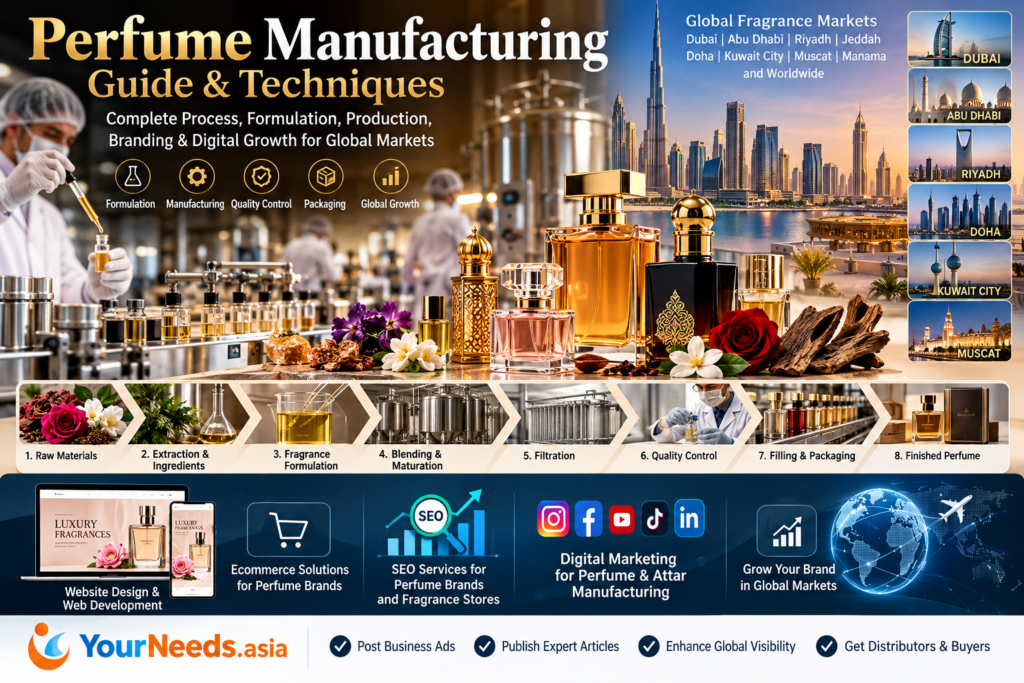
Perfume manufacturing is where chemistry, creativity, sensory science, production control, packaging and branding come together.
A commercially successful perfume is not created by simply mixing fragrance oil with alcohol and filling a bottle.
Professional perfume manufacturing begins with a fragrance concept, progresses through ingredient selection and formula development, and continues through controlled blending, maturation, filtration, quality evaluation, filling, packaging and regulatory preparation.
For companies targeting international fragrance markets such as Dubai, Abu Dhabi, Riyadh, Jeddah, Doha, Kuwait City, Muscat, London, Paris, Toronto or New York, manufacturing is only one part of the opportunity.
The complete business journey is:
Market Research → Fragrance Brief → Formula Development → Raw Materials → Trial Batches → Production → Maturation → Filtration → Quality Control → Filling → Packaging → Website → Ecommerce → SEO → Digital Marketing → Distributor Discovery → International Growth
This YourNeeds.asia guide explains both sides in detail:
Part 1 — How perfume is manufactured
Part 2 — Perfume manufacturing techniques
Part 3 — How to build and market a perfume manufacturing company internationally
1. What Is Perfume Manufacturing?
Perfume manufacturing is the controlled process of creating a fragrance formulation and producing it consistently at commercial scale.
Depending on the business, a manufacturer may produce:
- Eau de Parfum
- Eau de Toilette
- Parfum/extrait-style products
- Perfume oils
- Attars
- Oud-based fragrances
- Body sprays and mists
- Private-label perfumes
- Custom fragrances
- Home fragrances
- Gift collections
The manufacturing method varies according to the finished product.
For example, producing a traditional oil-based attar is not necessarily the same as manufacturing an alcohol-based Eau de Parfum.
That is why professional perfume development starts with a product specification, not with an internet recipe.
2. Step One: Research the Target Perfume Market
Before developing a fragrance, determine who will buy it.
This becomes particularly important for international manufacturers.
A fragrance developed for a premium audience in Dubai or Abu Dhabi may require different positioning from a mass-market fragrance intended for another region.
Likewise, a collection aimed at Riyadh, Jeddah or Doha should not automatically be based on stereotypes about Middle Eastern consumers.
Research the actual market.
A fragrance brief can consider:
Target Country → Target City → Consumer Segment → Price → Fragrance Family → Product Format → Occasion → Packaging → Distribution Channel
For example:
Premium unisex woody-amber fragrance intended for GCC ecommerce and boutique retail, with initial focus on Dubai, Riyadh and Doha.
That gives the perfumer and commercial team a defined direction.
3. Step Two: Create the Fragrance Brief
The fragrance brief converts the business idea into a development specification.
A detailed brief can define:
Product type: Eau de Parfum
Audience: Unisex
Positioning: Premium
Markets: UAE, Saudi Arabia and Qatar
Fragrance direction: Woody, amber, spicy
Character: Sophisticated, warm, contemporary
Usage: Evening and special occasions
Packaging: Premium glass bottle and gift carton
Distribution: Ecommerce + retail + distributors
The brief may also contain fragrances or olfactory styles the development team wants to understand, while still requiring an original formulation.
A good brief answers:
Who is it for?
What should it smell like?
How should it feel?
Where will it be sold?
What should it cost?
What makes it different?
4. Step Three: Understand Perfume Raw Materials
A perfumer works with a palette of aromatic materials.
These broadly include natural fragrance materials and synthetic aroma materials.
Natural materials can be derived from botanical sources such as flowers, woods, spices, herbs, citrus peels and resins.
Depending on the material, extraction techniques can include processes such as:
Steam Distillation
Steam or water is used to release volatile aromatic components from suitable botanical material. The vapour is condensed and the aromatic material can then be separated.
Expression
Commonly associated with citrus materials, mechanical processes can be used to obtain aromatic oil from the peel.
Solvent Extraction
Certain delicate botanical materials can be processed using appropriate extraction methods where conventional distillation would not produce the desired result.
CO₂ Extraction
Supercritical carbon dioxide extraction is another technique used for some aromatic botanical materials.
Synthetic Aroma Materials
Modern perfumery also uses synthetic aroma ingredients.
These give perfumers a much broader creative palette and can contribute to consistency, performance and effects that cannot practically be achieved with natural materials alone.
Professional perfumery should therefore not be reduced to:
Natural = good / Synthetic = bad.
What matters is whether the formulation is safe, stable, compliant, consistent and appropriate for the intended product.
5. Step Four: Build the Fragrance Architecture
Perfumes are often described using:
Top Notes
The opening impression of the perfume.
Examples can include citrus, aromatic, green and fresh effects.
Heart Notes
The central character that becomes more apparent as the opening develops.
Examples can include florals, fruits, spices and aromatic accords.
Base Notes
Materials and accords that contribute depth and persistence.
Examples can include woody, amber, musk-like, vanilla, resinous and other deeper effects.
For an Arabian-inspired perfume, the creative structure could conceptually move through:
Saffron / Spice Effect
↓
Rose / Floral Heart
↓
Oud-style / Amber / Woody Base
But professional perfumery is considerably more sophisticated than simply selecting three ingredients.
6. Step Five: Creating Perfume Accords
An accord is a combination of fragrance materials that creates a recognizable overall impression.
Think about musical chords.
Individual notes combine to create something greater than each note by itself.
Perfume accords might aim to evoke:
Rose
Amber
Leather
Marine freshness
Vanilla
Coffee
Woody warmth
Clean musk
Oud-style character
A perfumer may create several accords before integrating them into the full fragrance.
This is where perfume manufacturing becomes highly creative.
7. Step Six: Develop the First Formula
The perfumer now creates an initial formula.
Every material should be measured precisely and documented.
For illustration:
Formula V1 → Smelling Evaluation → Modification → Formula V2 → Skin/Blotter Evaluation → Modification → Formula V3
The formula might be modified because:
- Opening is too sharp.
- Floral heart is weak.
- Base overwhelms the composition.
- Desired character disappears too quickly.
- One accord masks another.
- Overall profile does not match the commercial brief.
Tiny changes can alter the fragrance significantly.
This is why professional fragrance development requires controlled measurements and documentation.
8. Step Seven: Perfume Evaluation
Perfume should be evaluated over time rather than judged only immediately after application.
Evaluators can assess the fragrance on appropriate smelling media and, where suitable and safely formulated, through wear evaluation.
They may observe:
Initial impression
↓
Development
↓
Heart
↓
Dry-down
↓
Persistence
The fragrance is then compared with the original brief.
Does it actually communicate the desired personality?
A fragrance developed as an elegant premium product should not accidentally feel inconsistent with that positioning.
9. Step Eight: Trial Batch Development
Once a formula looks promising, the development team can produce controlled trial batches.
Trial batches help determine whether the fragrance behaves as expected when moving beyond tiny experimental quantities.
Evaluate:
Fragrance profile
Colour
Clarity
Physical behaviour
Product stability
Packaging interaction
Batch consistency
Overall sensory experience
Problems discovered here should be corrected before commercial-scale production.
10. Step Nine: Determine Fragrance Concentration
Perfume products are commonly marketed under categories such as:
Parfum / Extrait
Eau de Parfum
Eau de Toilette
Eau de Cologne
Body Mist
Perfume Oil / Attar
However, manufacturers should avoid assuming that one fixed concentration universally defines product quality.
Actual fragrance performance depends on the entire formula, raw materials, product format, application and environmental conditions.
The manufacturer should determine concentration according to the desired product experience and applicable requirements.
11. Step Ten: Production Batch Preparation
Once development is approved, manufacturing can move toward commercial-scale production.
The production team should work from an authorized formula and manufacturing instruction.
A simplified workflow is:
Approved Formula
↓
Raw Material Verification
↓
Batch Calculation
↓
Accurate Weighing
↓
Controlled Addition
↓
Mixing
↓
Bulk Fragrance
Every raw material should be traceable to the appropriate production documentation.
If a problem occurs later, the manufacturer should be able to investigate which batch and materials were involved.
12. Step Eleven: Controlled Perfume Blending
The fragrance concentrate is blended with the appropriate product base according to the approved formulation.
For an alcohol-based perfume, this may involve suitable perfumery alcohol and other formulation components as required by the specific product.
This is not a stage for approximate measurements.
Manufacturers need appropriate equipment, controlled procedures and accurate measurement.
Variables may include:
Mixing sequence
Mixing time
Temperature
Container material
Batch size
Ingredient addition order
Environmental conditions
The appropriate process depends on the actual formulation.
13. Step Twelve: Maturation or Resting
After blending, certain perfume formulations may benefit from or require a controlled resting/maturation stage.
Consumers often call this process maceration, although terminology can vary.
During this period, the blended product is stored under conditions established for the formulation.
Important variables may include:
Time
Temperature
Light exposure
Container
Storage environment
There is no responsible universal rule saying:
“Every perfume must mature for exactly X days.”
The correct procedure should be determined through formulation and process validation.
14. Step Thirteen: Cooling and Filtration Where Appropriate
Depending on the formulation, manufacturers may use controlled processing and filtration before filling.
Filtration can help remove unwanted suspended matter and achieve the desired clarity.
A simplified workflow could be:
Matured Bulk Perfume → Appropriate Processing → Filtration → Visual Inspection → Finished Bulk Evaluation
Again, the exact procedure should be developed for the specific formulation.
15. Step Fourteen: Quality Control
Quality control is one of the most important parts of perfume manufacturing.
It should not begin after the bottles have already been shipped.
Depending on the product, manufacturer and applicable regulatory requirements, controls can address:
Raw material verification
Formula accuracy
Appearance
Odour
Colour
Clarity
Physical characteristics
Stability
Packaging compatibility
Batch consistency
Filling accuracy
Leakage
Labelling
Traceability
The manufacturing principle should be:
Batch 001 ≈ Batch 002 ≈ Batch 003
within established product specifications.
Consistency builds brand trust.
16. Step Fifteen: Stability & Packaging Compatibility
Imagine developing an excellent fragrance and later discovering that its packaging does not perform as intended.
That is why packaging compatibility matters.
Evaluate relevant interactions between the finished product and:
Bottle
Pump
Dip tube
Collar
Cap
Decoration
Label
Secondary packaging
International products may also encounter different shipping and storage environments.
A perfume moving between Dubai, Riyadh, Doha and London can experience very different external conditions.
Packaging development should therefore happen alongside product development.
17. Step Sixteen: Filling
Once the bulk product satisfies the manufacturer’s release requirements, filling can begin.
Typical workflow:
Finished Bulk
↓
Bottle Preparation
↓
Controlled Filling
↓
Pump / Atomizer Placement
↓
Closure / Crimping
↓
Leak Inspection
↓
Visual Inspection
The filling line may be manual, semi-automatic or automated depending on production scale.
18. Step Seventeen: Labelling & Packaging
After filling, products move into finishing and packaging.
This can include:
Label → Batch Identification → Cap → Carton → Seal → Final Inspection → Master Carton
International brands should plan labelling around the actual regulatory requirements of the destination market.
A product intended for the UAE, Saudi Arabia, Qatar, UK and EU should not simply assume that one label configuration will satisfy every jurisdiction.
19. Step Eighteen: Batch Release
Products should be released for sale only after the manufacturer’s required quality procedures are completed.
Records can connect:
Finished Product → Batch → Production Date → Formula → Raw Materials → QC → Packaging
Traceability becomes increasingly important as the manufacturer grows.
20. Step Nineteen: Warehousing & Distribution
Perfume manufacturing does not finish when a bottle enters a carton.
Manufacturers also need appropriate:
Storage
Inventory management
Batch tracking
Order fulfilment
Distributor management
Export preparation
Transport planning
Perfumes and alcohol-containing products can also be subject to transportation requirements, so international logistics should be planned with qualified logistics and regulatory partners.
21. Complete Perfume Manufacturing Flow
The complete process can therefore be visualized as:
Market Research
↓
Fragrance Brief
↓
Raw Material Selection
↓
Accord Development
↓
Formula Development
↓
Evaluation
↓
Trial Batch
↓
Safety / Regulatory Review
↓
Stability & Compatibility
↓
Commercial Batch
↓
Blending
↓
Maturation / Resting
↓
Filtration / Appropriate Processing
↓
Quality Control
↓
Filling
↓
Packaging
↓
Batch Release
↓
Warehousing
↓
Distribution
↓
Retail / Ecommerce
That is perfume manufacturing as a system, not a recipe.
22. Important Perfume Manufacturing Techniques
A modern manufacturer can use different techniques depending on the product.
Accord Building
Combining aroma materials to create a recognizable olfactory effect.
Layered Formula Development
Building opening, heart, transition and dry-down as one evolving fragrance experience.
Comparative Modding
Creating multiple versions of a formula and evaluating differences systematically.
Controlled Maturation
Allowing an appropriate formulation to develop under predetermined storage conditions.
Filtration
Using an appropriate filtration process where needed to achieve the required finished-product condition.
Batch Standardization
Maintaining manufacturing controls so commercial batches remain within approved specifications.
Sensory Evaluation
Evaluating the fragrance at multiple points rather than only immediately after spraying.
Stability Testing
Assessing how the product performs over its intended shelf life and under relevant conditions.
Packaging Compatibility
Determining whether the fragrance and its packaging work reliably together.
Market-Specific Product Development
Developing products according to genuine customer research rather than assuming one fragrance suits every country.
23. Perfume Manufacturing Opportunities in Dubai & UAE
Dubai is particularly interesting because it combines:
Luxury retail + residents + international tourism + ecommerce + travel retail + import/export + regional distribution.
A manufacturer targeting Dubai could offer legitimate services such as:
Private Label Perfume Manufacturing
Custom Fragrance Development
Oud Perfume Supply
Attar Supply
Luxury Fragrance Collections
Wholesale Perfumes
Distributor Partnerships
Corporate Gifting
Abu Dhabi can provide another premium UAE audience with opportunities around luxury fragrance, gifting and high-end retail.
24. Saudi Arabia: Riyadh, Jeddah & Dammam
Saudi Arabia is one of the most important perfume markets within the GCC.
Cities such as Riyadh, Jeddah and Dammam can be treated as individual commercial markets.
A manufacturer might develop:
Oud collections
Rose-oud combinations
Amber fragrances
Musk fragrances
Premium Eau de Parfum
Unisex collections
Luxury gift sets
Private-label products
But product development should be based on actual consumer and distributor research rather than simply assuming all Saudi consumers want heavy oud fragrances.
25. Doha & Qatar
Doha can be another target for luxury and niche fragrance companies.
A perfume manufacturer serving Qatar could develop appropriate landing pages, distributor campaigns and ecommerce content around:
Luxury Perfume Qatar
Oud Fragrances
Attar
Private Label Perfume
Premium Gift Collections
Wholesale Fragrance Supply
where those offerings genuinely apply.
26. Kuwait, Oman & Bahrain
A broader GCC strategy can include:
Kuwait City → Kuwait
Muscat → Oman
Manama → Bahrain
Oman’s association with frankincense also gives fragrance brands interesting opportunities for authentic educational storytelling when relevant to the actual product.
A strong GCC strategy therefore becomes:
Dubai + Abu Dhabi + Riyadh + Jeddah + Dammam + Doha + Kuwait City + Muscat + Manama
rather than a generic page labelled “Middle East.”
27. Manufacturing a Great Perfume Is Only Half the Business
This is where many technically capable manufacturers struggle.
They may have:
✔ Excellent formulation capability
✔ Good manufacturing infrastructure
✔ Attractive bottles
✔ Competitive private-label pricing
But their website says almost nothing.
Their catalogue exists only as a PDF.
Google cannot clearly understand their capabilities.
International buyers cannot find them.
Distributors cannot quickly evaluate them.
Their social media consists primarily of bottle photographs.
That creates a digital discovery problem.
The solution is to connect:
MANUFACTURING + WEBSITE + SEO + ECOMMERCE + DIGITAL MARKETING + CONTENT + BUSINESS DISCOVERY
28. Website Design for Perfume Manufacturing Companies
A perfume manufacturer’s website should be more than a corporate brochure.
It should function as a:
Digital Showroom + Manufacturing Profile + Product Catalogue + Knowledge Centre + Distributor Platform + Lead Generator
A strong architecture could be:
Homepage
→ About the Manufacturer
→ Manufacturing Capabilities
→ Fragrance Development
→ Private Label Perfume Manufacturing
→ Contract Manufacturing
→ Oud Perfumes
→ Attar Manufacturing
→ Eau de Parfum
→ Custom Fragrances
→ Packaging
→ Quality
→ Products / Collections
→ Wholesale
→ Distribution
→ International Markets
→ Knowledge Centre
→ FAQs
→ Request Samples
→ Distributor Enquiry
→ Contact
Every major commercial service deserves its own useful page.
29. Web Development for Perfume Manufacturers
Website design determines how the website looks.
Web development determines what it can do.
A modern perfume manufacturing website can include much more than static pages.
Product Catalogue
Allow visitors to filter fragrances by:
Fragrance Family
Gender/Unisex
Product Type
Oud
Attar
EDP
Size
Collection
Occasion
B2B Distributor Portal
International buyers could access:
Catalogues
Product information
Wholesale enquiry forms
Distributor applications
Sample requests
Manufacturing capabilities
Private-Label Enquiry System
Instead of a generic contact form:
Select Product Type
↓
Target Market
↓
Approximate Quantity
↓
Fragrance Direction
↓
Bottle Requirement
↓
Packaging Requirement
↓
Target Launch Date
↓
Submit Project
Now the website generates better-qualified leads.
30. Fragrance Finder Development
Ecommerce perfume stores face a fundamental limitation:
Customers cannot smell a webpage.
A custom fragrance finder can partially bridge that gap.
Ask:
Which fragrance family do you enjoy?
Fresh / Floral / Woody / Oud / Amber / Musk / Gourmand
↓
When will you use it?
Daily / Office / Evening / Wedding / Gifting
↓
Preferred intensity?
Light / Moderate / Rich
↓
Climate / Market?
↓
Recommended Products
This can improve product discovery and customer experience.
31. Ecommerce Solutions for Perfume & Fragrance Brands
YourNeeds.asia can build perfume ecommerce stores using appropriate platforms such as WooCommerce or Shopify, depending on the business requirements.
Features can include:
Product pages
Fragrance-note presentation
Variants
Bundles
Discovery sets
Sample kits
Gift boxes
Coupons
Wishlist
Reviews
Related perfumes
Cross-selling
Secure checkout
Inventory
Order tracking
Abandoned-cart workflows
Analytics
An international store can also consider market-appropriate:
Currencies
Languages
Shipping
Tax presentation
Regional catalogues
Market-specific content
subject to the company’s commercial and regulatory setup.
32. SEO Services for Perfume Brands & Fragrance Stores
A beautiful perfume website has limited commercial value if potential customers cannot discover it.
SEO should therefore be planned during website development.
A perfume manufacturer has multiple keyword groups.
Manufacturing Keywords
Perfume Manufacturer
Perfume Manufacturing Company
Private Label Perfume Manufacturer
Contract Perfume Manufacturer
Custom Perfume Manufacturer
Fragrance Manufacturer
Attar Manufacturer
Oud Perfume Manufacturer
Wholesale Keywords
Wholesale Perfume Supplier
Bulk Perfume Supplier
Perfume Distributor
Perfume Exporter
Fragrance Supplier
International Keywords
Where genuinely applicable:
Perfume Manufacturer Dubai
Private Label Perfume UAE
Perfume Manufacturer Abu Dhabi
Perfume Manufacturer Saudi Arabia
Perfume Supplier Riyadh
Perfume Supplier Jeddah
Perfume Manufacturer Qatar
Perfume Supplier Doha
Perfume Manufacturer Kuwait
Perfume Supplier Muscat
33. Product SEO for Perfume Ecommerce Stores
Product pages need their own SEO strategy.
Instead of:
Product 001
use meaningful product information.
For example:
Desert Rose Oud Eau de Parfum
Then clearly explain:
Fragrance Family
Opening
Heart
Base
Character
Occasion
Size
Product Information
Usage
Shipping
Reviews
FAQs
Related Fragrances
Product schema and other appropriate structured data can also help search engines interpret ecommerce content.
34. Content SEO for Perfume Companies
A fragrance company has an enormous educational content opportunity.
Publish genuinely useful guides such as:
How Is Perfume Manufactured?
What Is Oud?
What Is Attar?
Oud vs Attar
EDP vs EDT
How Perfume Notes Work
How to Choose a Perfume
How to Store Perfume
How to Start a Perfume Brand
How Private Label Perfume Manufacturing Works
How to Select a Perfume Manufacturer
Arabian Perfume Guide
Perfume Manufacturing Guide
This builds topical depth beyond commercial service pages.
35. International SEO for Perfume Manufacturers
If the manufacturer actually serves several countries, international SEO should reflect those markets properly.
Instead of one page saying:
“We export worldwide.”
build useful market-specific information.
For example:
UAE
→ Dubai
→ Abu Dhabi
Saudi Arabia
→ Riyadh
→ Jeddah
→ Dammam
Qatar
→ Doha
Kuwait
→ Kuwait City
Oman
→ Muscat
Bahrain
→ Manama
But don’t mass-produce hundreds of near-identical city pages.
Each useful international page should explain:
Products available
Manufacturing capability
Shipping/distribution availability
Private-label services
Market considerations
How to enquire
Relevant FAQs
36. Local SEO for Perfume Stores & Showrooms
Manufacturers with physical showrooms, stores or legitimate local operations can also benefit from Local SEO.
That includes:
Google Business Profile
Accurate business information
Store/location pages
Product/service categories
Customer reviews
Photos
Directions
Local landing pages
Local citations
For example, a genuine perfume store in Dubai may want visibility when consumers search for relevant nearby fragrance shopping queries.
37. AI SEO, AEO & GEO for Perfume Companies
Search behaviour is becoming increasingly conversational.
Potential customers may ask:
How is perfume manufactured?
What is the difference between oud and attar?
Which companies offer private-label perfume manufacturing?
How can I start a perfume brand in Dubai?
How do I find a fragrance manufacturer for Saudi Arabia?
A perfume manufacturer’s website should provide clear, well-supported answers.
Useful structure:
QUESTION → DIRECT ANSWER → DETAILS → EVIDENCE → RELATED QUESTIONS → NEXT ACTION
Build clear entities around:
Company
→ Manufacturer
→ Fragrance Products
→ Private Label
→ Markets Served
→ Manufacturing Capabilities
→ Quality Information
→ Product Documentation
→ Articles
→ FAQs
→ Contact
This improves information clarity for both conventional and AI-assisted search.
It does not guarantee recommendations or citations from ChatGPT, Gemini, Google AI or any other platform.
38. Digital Marketing for Perfume & Attar Manufacturing
Perfume is highly suited to visual storytelling.
But digital marketing should go beyond repeatedly showing a bottle.
Build campaigns around:
The fragrance story
Ingredient inspiration
Manufacturing
Perfumer’s concept
Fragrance notes
How to wear it
Occasions
Gifting
Packaging
Unboxing
Customer reactions
Behind the scenes
Fragrance education
Brand founder
Retail availability
Distributor opportunities
39. Social Media Marketing for Perfume Brands
Different formats can perform different jobs.
Visual brand building, Reels, product launches, lifestyle content, creator collaborations and customer content.
YouTube
Longer perfume stories, manufacturing documentaries, fragrance education, founder interviews and product explainers.
Short-Form Video
Create content around:
“How this fragrance was created”
“What does oud actually smell like?”
“3 fragrance notes explained in 30 seconds”
“Inside our perfume manufacturing process”
“From fragrance formula to finished bottle”
The factory itself can become content.
40. Influencer & Creator Marketing
Don’t simply send bottles to hundreds of creators.
Segment creators by audience:
Fragrance reviewers
Luxury lifestyle
Beauty
Men’s grooming
Women’s beauty
Middle Eastern lifestyle
Fashion
Gifting
Wedding
Travel
Then give creators a story worth discussing.
For example:
“From Raw Material to Dubai Shelf”
can be more interesting than:
“Here is our new perfume.”
41. PPC & Paid Advertising for Perfume Manufacturers
Paid campaigns can target different commercial goals.
B2C
Buy perfume online
Luxury oud perfume
Perfume gift set
B2B
Private label perfume manufacturer
Perfume contract manufacturer
Wholesale perfume supplier
Perfume distributor opportunity
These audiences should not land on the same generic homepage.
Create dedicated conversion pages.
42. Digital Marketing Services for Perfume & Cosmetic Brands
YourNeeds.asia can combine multiple digital channels into one system:
Website Design
↓
Web Development
↓
Ecommerce
↓
Technical SEO
↓
International SEO
↓
Product SEO
↓
AI SEO + AEO + GEO
↓
Content
↓
Social Media
↓
PPC
↓
Analytics
↓
Conversion Optimization
The objective is not simply more impressions.
It is to generate relevant:
Product Sales
Wholesale Enquiries
Private-Label Leads
Distributor Enquiries
Sample Requests
Store Visits
International Opportunities
43. Perfume Company Web Design Case Study — YourNeeds.asia Model
Consider a hypothetical perfume manufacturer with an outdated website.
Before
Home
About
Products
Contact
The site receives visitors, but international buyers cannot determine manufacturing capabilities.
YourNeeds.asia Redesign Strategy
Homepage
↓
Manufacturing
↓
Private Label
↓
Custom Fragrances
↓
Oud & Attar
↓
Product Collections
↓
Packaging
↓
Quality
↓
International Markets
↓
Wholesale
↓
Distributor Enquiry
↓
Knowledge Centre
↓
Ecommerce
Now connect SEO:
Google Search → Manufacturing Page
Private Label Search → Private Label Page
Dubai Search → UAE Market Page
Riyadh Search → Saudi Market Page
Question Search → Knowledge Article
Product Search → Ecommerce Page
That is a conversion architecture, not merely a redesign.
44. How YourNeeds.asia Helps Perfume Manufacturing Companies
The YourNeeds.asia ecosystem gives perfume manufacturers several different routes to digital discovery.
1. Build — YourNeeds.asia Digital Services
Through YourNeeds.asia Digital Services, fragrance businesses can develop:
Perfume Manufacturing Websites
Corporate Websites
Perfume Manufacturing WordPress Website development
Perfume Manufacturing companies Web Development
Ecommerce Stores development for Perfume Manufacturing companies
WooCommerce Development for Perfume Manufacturing brands
SEO Services for Perfume Brands and Fragrance Stores
International SEO
AI SEO
AEO
GEO
Digital Marketing for Perfume and Attar Manufacturing
Digital Marketing Services for Perfume & Cosmetic Brands
Conversion Optimization
The goal is to make the manufacturer’s website its primary digital business asset.
45. Promote — Post Perfume Manufacturing Ads on YourNeeds.asia
A manufacturer can use YourNeeds.asia Classifieds & Business Discovery as another discovery channel.
Possible advertisements include:
Private Label Perfume Manufacturer
Oud & Attar Manufacturer
Custom Fragrance Manufacturing
Wholesale Perfume Supplier
Perfume Manufacturer Looking for Distributors
Perfume Exporter
Corporate Gifting Perfume Manufacturer
Perfume Packaging Services
For international expansion, listings could describe genuine opportunities such as:
Looking for Perfume Distributors in Dubai
Perfume Distributor Opportunity in Saudi Arabia
Private Label Perfume Supply for Qatar
Wholesale Perfumes for UAE Retailers
A detailed listing can explain the products, manufacturing capabilities, location, markets served, commercial opportunity and enquiry process.
46. Publish — Submit Perfume Articles on Articles.YourNeeds.asia
Manufacturers can use Articles.YourNeeds.asia to publish genuine industry knowledge.
Instead of saying only:
“We are the best perfume manufacturer.”
demonstrate expertise through content:
Perfume Manufacturing Guide
How Perfume Is Manufactured
How to Start a Private Label Perfume Brand
Oud Manufacturing Guide
Attar Manufacturing Techniques
Perfume Packaging Guide
Understanding Fragrance Notes
How to Select a Perfume Manufacturer
How to Enter the Dubai Perfume Market
Understanding Saudi Arabia’s Fragrance Market
Perfume Ecommerce Guide
Fragrance Trends
This can strengthen the manufacturer’s overall content footprint and give prospective buyers more useful information to evaluate.
47. The YourNeeds.asia Advantage for Perfume Manufacturers
Instead of treating website development, SEO, advertising and publishing as unrelated activities, connect them.
MANUFACTURE
Create the product.
↓
BUILD
Develop the manufacturer website and ecommerce platform.
↓
OPTIMIZE
Use SEO, international SEO, product SEO and technical SEO.
↓
PROMOTE
Run digital marketing and publish relevant ads/listings on YourNeeds.asia.
↓
PUBLISH
Share industry knowledge through Articles.YourNeeds.asia.
↓
EDUCATE
Answer fragrance and manufacturing questions.
↓
BUILD TRUST
Show capabilities, products, expertise, reviews and relevant proof.
↓
GET DISCOVERED
Across search, local discovery, content platforms and potentially AI-assisted discovery.
↓
CONVERT
Turn qualified visitors into customers, distributors, retailers and private-label enquiries.
↓
EXPAND
Dubai → Abu Dhabi → Riyadh → Jeddah → Doha → Kuwait → Muscat → wider international markets.
That is a stronger digital-growth model for an international perfume manufacturing company.
Frequently Asked Questions
What is the complete perfume manufacturing process?
A typical professional workflow includes market research, fragrance briefing, raw-material selection, accord and formula development, evaluation, trial batches, safety and regulatory review, stability/compatibility work, commercial blending, appropriate maturation/processing, filtration where required, quality control, filling, packaging, batch release and distribution.
What is the most important perfume manufacturing technique?
There isn’t one universal technique. Accurate formulation, controlled blending, sensory evaluation, appropriate stability work, quality control and batch consistency all contribute to reliable commercial production.
What is maceration in perfume manufacturing?
The term is commonly used for a controlled resting or maturation period after blending. The appropriate conditions and duration depend on the formulation and validated production process.
How are oud perfumes manufactured?
Oud-oriented fragrances can use natural oud materials, other appropriate fragrance materials or perfumery accords designed to create particular woody/oud characteristics. The exact composition depends on the formula, product positioning and regulatory/safety requirements.
What is private-label perfume manufacturing?
A manufacturer produces fragrance products that another business markets under its own brand, according to the agreed formulation, packaging, commercial and regulatory arrangements.
Can a perfume manufacturer sell internationally?
Potentially, but the manufacturer needs to consider destination-country regulations, product compliance, labelling, logistics, import requirements, distribution and commercial arrangements.
Why does a perfume manufacturer need a website?
A strong website can communicate manufacturing capabilities, products, private-label services, quality information, markets served and enquiry options to consumers, distributors and wholesale buyers worldwide.
What should a perfume manufacturing website contain?
It can include manufacturing capabilities, fragrance development, product collections, private label, contract manufacturing, oud and attar, quality information, packaging, wholesale, distribution, international markets, FAQs, knowledge content and enquiry systems.
How does SEO help perfume manufacturers?
SEO can improve discoverability when potential buyers search for perfume manufacturers, private-label fragrance manufacturers, oud/attar manufacturers, wholesale suppliers and related products or questions.
What is international SEO for a perfume company?
International SEO structures content around the countries and markets genuinely served by the manufacturer, including appropriate market pages, language strategy, technical configuration, local search intent and market-specific content.
Can digital marketing help find perfume distributors?
It can increase visibility among relevant audiences through search advertising, SEO, content, social media, B2B campaigns and dedicated distributor landing pages, although it cannot guarantee distributor appointments.
How can YourNeeds.asia help a perfume manufacturer?
YourNeeds.asia can support the digital side through website design, web development, ecommerce, SEO and digital marketing. Manufacturers can also publish business advertisements through YourNeeds.asia and educational content through Articles.YourNeeds.asia.
What should readers know about Perfume Manufacturing Guide?
Perfume Manufacturing Guide should be explained with clear facts, useful examples, location relevance and trustworthy next steps so people and AI systems can understand the page without relying on hidden context.