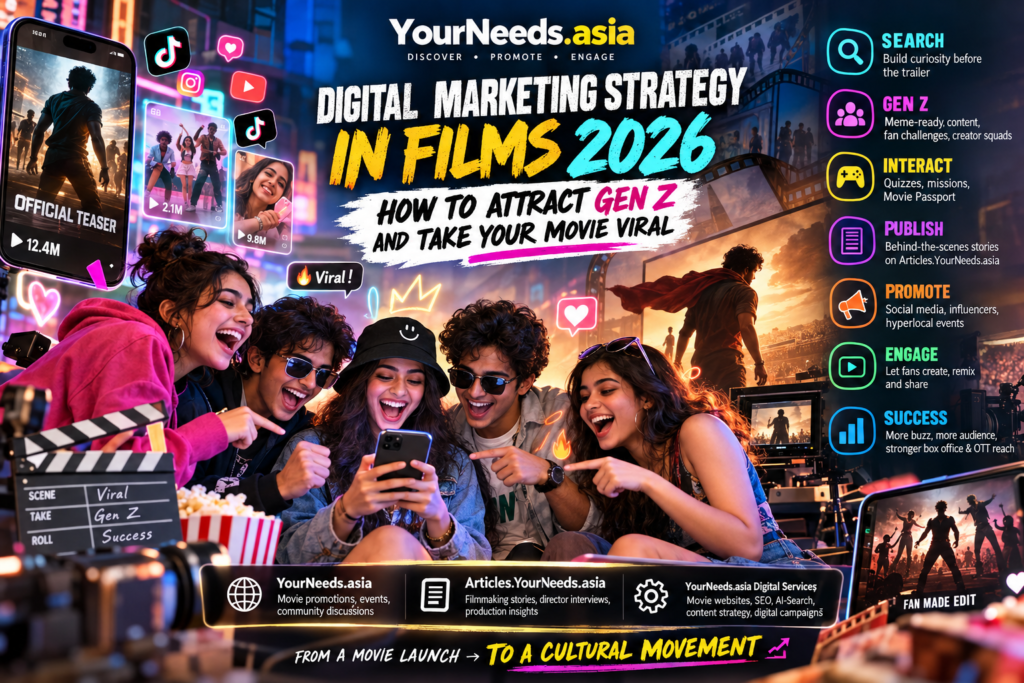
Movie marketing has changed dramatically.
But there is another problem emerging in 2026: many film campaigns have started looking exactly the same.
A movie announces its title. A first-look poster appears. The actors share it.
A teaser follows. Influencers react.
Songs are pushed through Reels.
The trailer gets YouTube advertising.
Cast interviews appear during release week.
Reviews and theatre reactions are posted after release.
These methods still matter.
They should not be abandoned.
The problem is that almost everybody is doing them.
So the next competitive advantage in a Digital Marketing Strategy in Films cannot simply be “post more content.”
At YourNeeds.asia, our approach would be different:
Don’t build only a promotional campaign around a movie. Build a searchable, interactive and continuously expanding digital universe around the movie.
A movie should be capable of being searched, questioned, explored, discussed, personalized, localized, experienced and rediscovered.
That is the idea behind what we call the YourNeeds.asia Movie Discovery Engine.
Quick Answer: What Should a Digital Marketing Strategy in Films Look Like in 2026?
A modern Digital Marketing Strategy in Films should combine traditional movie promotion—posters, teasers, trailers, social media, influencers, PR and advertising—with newer discovery mechanisms such as AI-search readiness, interactive character experiences, audience-personalized content, search-intent engineering, hyperlocal promotion, digital fandom hubs, searchable behind-the-scenes knowledge, community missions and long-term post-release discovery.
The objective changes from:
“How many people saw our promotion?”
to:
“How many different reasons did we create for people to discover, explore, discuss and eventually watch our movie?”
The Problem With Today’s Movie Digital Marketing
Imagine five movies releasing during the same month.
Open Instagram.
You may see the same pattern:
First Look → Teaser Announcement → Teaser → Song → Reel → Influencer Reaction → Trailer Announcement → Trailer → Interviews → Countdown → Release → Audience Reactions
Now open YouTube.
Again:
Teaser → Trailer → Songs → Interviews → Making Video
Open X.
Hashtags, countdowns, celebrity posts and fan reactions.
None of these strategies is inherently wrong.
Large film campaigns have long used phased promotion, teasers, trailers, social conversation, influencer activity and paid media rather than treating promotion as a single release-day event.
Pasted markdown
But when everyone uses similar tools, the tools themselves stop being the differentiator.
The experience becomes the differentiator.
From Movie Promotion to Movie Discovery
Consider the difference.
Traditional question
How do we promote our trailer?
YourNeeds.asia question
How many different digital paths can lead someone to discover this movie?
That’s a much bigger strategy.
A person might discover a movie because of:
a Google search,
an AI recommendation,
an actor,
a shooting location,
a song,
a meme,
a fashion look,
a dialogue,
a technical filmmaking article,
a community discussion,
a local event,
a creator,
a character,
a behind-the-scenes story,
or even a question they asked ChatGPT or Gemini.
Our objective would therefore be to build many Discovery Doors around one film.
Introducing the YourNeeds.asia Movie Discovery Engine
Instead of viewing film marketing as a straight line, we would build an ecosystem:
MOVIE
↙ ↓ ↘
SEARCH — SOCIAL — AI
↙ ↓ ↘
STORY — CHARACTERS — MUSIC
↙ ↓ ↘
CREATORS — COMMUNITIES — LOCATIONS
↙ ↓ ↘
INTERACTIONS — ARTICLES — EVENTS
↙ ↓ ↘
THEATRES — REVIEWS — OTT
Everything ultimately connects back to one entity:
the movie.
Here are the strategies we believe can make that model substantially different.
NEW IDEA 1: Build a “Movie Knowledge Graph” Before Marketing the Film
Most movie teams build social accounts first.
We would build the movie’s digital knowledge structure first.
Before the teaser launches, clearly establish:
Movie → Director
Movie → Producer
Movie → Production House
Movie → Actors
Actor → Character
Movie → Genre
Movie → Languages
Movie → Locations
Movie → Music Director
Movie → Songs
Movie → Trailer
Movie → Release Date
Movie → Official Website
Why?
Because search engines and AI systems increasingly need to understand entities and relationships, not merely keywords.
The official website becomes the authoritative information centre.
Instead of scattered information across 20 platforms, the movie develops a clean digital identity from day one.
NEW IDEA 2: Create a “Search Before Trailer” Campaign
Most producers wait for audiences to search for their movie.
We would deliberately create questions people want answered.
Imagine a thriller called The Last Door.
Several weeks before its teaser, the campaign publishes:
What is behind Door 17?
Then:
Why has nobody entered Room 17 for 27 years?
Then:
Who was the last person to open it?
These phrases appear in:
social posts,
short videos,
articles,
creator conversations,
movie website pages,
and community discussions.
Now curiosity itself becomes searchable.
The trailer eventually provides part—not necessarily all—of the answer.
This is Search Curiosity Engineering.
NEW IDEA 3: Create an “Ask the Movie” AI-Friendly Hub
This could become one of the most interesting additions to a 2026 movie website.
Instead of only:
HOME | CAST | TRAILER | GALLERY
create:
ASK ABOUT THE MOVIE
Visitors could explore questions such as:
Who is the hero?
Who plays the villain?
When is the movie releasing?
Is there a Telugu version?
Where was the movie filmed?
Who composed the music?
What genre is it?
Where can I watch the trailer?
Is it based on a true story?
When will it come to OTT?
Answers should come from verified production information rather than invented AI responses.
This simultaneously improves usability and creates highly structured, answer-oriented content.
NEW IDEA 4: Character-Owned Digital Spaces
Why should everything come from the official movie account?
Certain films could give major characters their own digital identity.
Not fake real people.
Fictional character experiences.
Imagine a detective film.
Instead of:
“Meet Inspector Arjun.”
create:
INSPECTOR ARJUN’S CASE FILE
Inside it:
suspect photographs,
evidence,
audio notes,
maps,
clues,
timelines,
and unresolved questions.
Now audiences aren’t simply reading character descriptions.
They’re investigating with the character.
For a romantic film, it might become a digital diary.
For science fiction, a research database.
For fantasy, a kingdom archive.
For sports, a player profile.
For crime, a case file.
The genre determines the experience.
NEW IDEA 5: Let Fans Unlock the Next Promotion
Normally marketers decide:
Trailer launches Friday at 6 PM.
What if the audience helped unlock it?
For example:
MISSION: Unlock Character X
10,000 votes
- 5,000 shares
- community puzzle completed
↓
CHARACTER REVEAL UNLOCKED
The next mission could unlock:
a song glimpse,
BTS photograph,
director message,
or exclusive scene.
This converts passive followers into participants.
The reward should remain achievable and genuine; artificial engagement manipulation would undermine trust.
NEW IDEA 6: Build a Digital Movie Passport
Give fans a lightweight digital Movie Passport.
They earn stamps for exploring campaign experiences.
For example:
🎬 Watched Official Teaser
🎵 Discovered First Song
🧩 Solved Character Puzzle
📍 Explored Shooting Location
🎤 Watched Director Story
📝 Read Making Article
🎭 Completed Character Quiz
🏆 Participated in Fan Challenge
This doesn’t need cryptocurrency, NFTs or complicated technology.
It could simply be a fun web-based participation system.
Completing the passport might unlock legitimate digital rewards such as wallpapers, badges, behind-the-scenes material or access to a livestream.
Now the campaign has progression.
NEW IDEA 7: “Which Character Are You?” Personalization
Audiences enjoy discovering something about themselves.
Suppose the movie contains five distinctive characters.
Create a short interactive quiz.
Which Character From [Movie] Are You?
After five questions:
You are ARJUN — 82%
Fearless • Loyal • Impulsive
Then generate a shareable card.
YOUR MOVIE CHARACTER
Name
Character Match
Movie Logo
Release Date
The audience now distributes branded content voluntarily.
The Barbie campaign demonstrated the power of giving audiences personalized creative material they could make their own; the broader principle is that participation can extend campaign reach far beyond a conventional poster. Pasted markdown
NEW IDEA 8: Personalized Trailer Paths
This goes further.
Why must everyone receive exactly the same introduction to a film?
Imagine three short promotional cuts.
ACTION FAN
20 seconds emphasizing action.
MUSIC FAN
20 seconds emphasizing soundtrack and visuals.
STORY FAN
20 seconds emphasizing emotional conflict.
A landing page asks:
What makes you choose a movie?
🔥 Action
❤️ Emotion
🎵 Music
😂 Comedy
🧠 Story
The viewer chooses.
The site presents the most relevant promotional cut.
It doesn’t change the movie.
It changes the entrance into the movie.
NEW IDEA 9: Turn Movie Locations Into Search Assets
Indian cinema travels everywhere.
Yet filming locations are frequently underused digitally.
Imagine a movie shot in:
Hyderabad,
Araku,
Goa,
Dubai,
and London.
Instead of merely publishing:
“Beautiful location!”
create searchable stories:
Where Was [Movie] Filmed?
Inside the Hyderabad Locations of [Movie]
Why the Director Chose Araku
How This Action Scene Was Filmed in Dubai
Travel searches can now become movie-discovery opportunities.
This is especially useful long after theatrical release.
NEW IDEA 10: Hyperlocal Movie Marketing
National campaigns often overlook neighbourhood-level discovery.
For a Hyderabad-heavy theatrical release, marketing could be localized around areas such as:
Madhapur,
Kukatpally,
Gachibowli,
Banjara Hills,
Secunderabad,
Kompally,
LB Nagar,
and Dilsukhnagar.
Not by creating spam pages.
Instead, campaigns can connect genuine local activity:
theatre appearances,
fan events,
college promotions,
mall events,
premieres,
contests,
and cast visits.
YourNeeds.asia could support discovery of appropriate local movie events and announcements.
National movie. Local excitement.
NEW IDEA 11: The “Movie Near Me” Layer
Search behaviour becomes highly local near release.
People may look for:
movie theatres near me,
movie tickets near me,
Telugu movies this weekend,
new movies Hyderabad,
movie events Hyderabad,
celebrity events Hyderabad.
A film’s digital infrastructure should be prepared to connect relevant location intent with legitimate ticketing and event information.
That creates a bridge between:
online discovery → offline viewing.
NEW IDEA 12: College Micro-Communities Instead of Generic Influencers
For youth-oriented movies, don’t spend the entire creator budget on large influencers.
Build micro-communities.
Select participating colleges where appropriate.
Create:
Movie Campus Captains
They can organize:
quiz competitions,
meme challenges,
music performances,
film discussions,
dance challenges,
poster design,
short-film competitions,
and legitimate ticket contests.
Now 30 campuses can create 30 localized conversations.
The movie becomes something students participate in rather than another sponsored Reel.
NEW IDEA 13: Profession-Based Creators
Don’t choose influencers only by follower count.
Match creators to the movie’s subject.
For a legal thriller:
lawyers and legal educators.
For a medical drama:
doctors or healthcare educators, with appropriate accuracy safeguards.
For a startup movie:
entrepreneurs.
For a sports movie:
athletes and coaches.
For a historical film:
historians and researchers.
For a technology film:
tech creators.
For a food movie:
chefs and food creators.
For a travel film:
travel creators.
This creates contextual credibility, not merely reach.
NEW IDEA 14: Give Creators Questions, Not Scripts
Traditional influencer promotion often sounds like advertising:
“Hi guys! Trailer is amazing. Please watch.”
Audiences recognize it immediately.
Instead, give creators something genuinely interesting to investigate.
For example:
Could this stunt actually happen?
Is the historical event shown in this movie real?
How would a lawyer handle this situation?
Could this technology exist?
Where is this filming location?
The creator produces content in their own expertise.
The movie becomes the conversation trigger.
NEW IDEA 15: The 100 Questions Strategy
Before release, build a database of genuine questions audiences might ask.
For example:
Who directed the movie?
Who produced it?
Who is the heroine?
Who composed the music?
Where was it filmed?
What is the genre?
What languages are available?
When is the release?
Is it a remake?
Is it based on a true story?
Who plays the villain?
Where can I watch the teaser?
What is the runtime once officially confirmed?
Where can I book tickets?
Which OTT platform has it once announced?
Instead of stuffing keywords into one page, build a verified movie knowledge centre.
This is useful for:
Google,
voice search,
AI discovery,
journalists,
fans,
and ordinary visitors.
NEW IDEA 16: Searchable Behind-the-Scenes Knowledge
Behind-the-scenes content is usually treated as entertainment.
We would also treat it as searchable intellectual property.
Instead of:
“BTS Video #4”
publish:
How We Filmed the 8-Minute Action Sequence in [Movie]
Why [Director] Chose Practical Effects for [Scene]
How the Costume Team Designed [Character]
How [Composer] Created the Film’s Main Theme
How the VFX Team Built [Environment]
These pages can remain discoverable years later.
NEW IDEA 17: Build an Official Movie Fact Room
Misinformation can spread rapidly around films.
Wrong release dates.
Fake OTT announcements.
Incorrect casting rumours.
Fake trailers.
Misquoted budgets.
Create:
OFFICIAL FACT ROOM
Official Release Date: …
Official Languages: …
Official Trailer: …
Official Cast: …
Official OTT Partner: Announced / Not Yet Announced
Official Ticketing: …
Whenever rumours appear, the production has a canonical reference.
This also creates cleaner information for search and AI systems.
NEW IDEA 18: Create a Movie Conversation Hub
Social media conversations disappear quickly into feeds.
YourNeeds.asia can add another layer:
structured discussion.
Examples:
Which character are you most excited about?
What did you notice in the teaser?
Which song is your favourite?
Predict the character’s secret.
What did you think after watching?
Explain the ending.
These discussions should not manufacture praise.
Positive, mixed and critical audience responses should remain authentic.
That builds a real community rather than an artificial promotional wall.
NEW IDEA 19: Publish the Film’s Knowledge on Articles.YourNeeds.asia
A movie contains far more publishable knowledge than most producers realize.
Through Articles.YourNeeds.asia, a campaign could publish substantive stories such as:
The Making of [Movie]
Meet the Director Behind [Movie]
How the Screenplay Was Developed
Inside the Movie’s Production Design
How the Action Was Choreographed
How the Music Was Composed
The Technology Behind the VFX
The Real Locations Behind the Film
Meet the Cinematographer
From Script to Screen
Now the movie owns an expanding body of searchable knowledge.
NEW IDEA 20: The 24-Hour Audience Intelligence Room
Release week should not run on autopilot.
YourNeeds.asia would propose a live digital monitoring workflow.
Track:
search trends,
social conversations,
popular characters,
popular dialogues,
unexpected memes,
high-performing clips,
questions,
confusion,
sentiment themes,
regional differences,
trailer engagement,
and genuine audience reactions.
Then adapt the campaign.
Suppose audiences unexpectedly love a supporting character.
Don’t wait three weeks.
Create content around that character.
If one dialogue explodes organically, make high-quality official assets available.
The audience tells you what to amplify.
NEW IDEA 21: Turn Audience Reactions Into a Real-Time Content Engine
After release, the audience becomes an important source of campaign signals.
Large film campaigns already recognize the importance of audience reviews, word of mouth and post-release momentum. Pasted markdown
We would systematize it.
Audience Reaction
↓
Identify Genuine Trend
↓
Verify
↓
Create Official Supporting Asset
↓
Distribute
↓
Community Recreates
↓
New Discovery
This is different from manufacturing viral moments.
You are amplifying what audiences genuinely chose.
NEW IDEA 22: The “Explain the Movie” Search Strategy
After release, searches change.
People may ask:
[Movie] ending explained
What happened to [Character]?
Why did [Character] do that?
Is there a sequel?
What does the final scene mean?
Where appropriate—and without spoiling the experience prematurely—the official ecosystem can eventually publish:
director explanations,
writer interviews,
scene breakdowns,
symbolism discussions,
production notes,
and spoiler-marked FAQs.
Instead of allowing all post-release search demand to flow elsewhere, the film can contribute authoritative first-party context.
NEW IDEA 23: Don’t Stop at Box Office — Build the OTT Relaunch
The OTT release should be treated almost like Movie Launch 2.0.
The audience has changed.
Some already watched theatrically.
Others deliberately waited for streaming.
Others may discover the film for the first time through recommendations.
So rebuild the campaign:
THEATRICAL MARKETING
↓
AUDIENCE CONVERSATION
↓
POST-RELEASE SEARCH
↓
OTT ANNOUNCEMENT
↓
NEW TRAILER CUT
↓
BEST MOMENTS
↓
DIRECTOR/CAST CONTENT
↓
AI + SEARCH DISCOVERY
↓
NEW AUDIENCE
OTT promotion is already an established part of modern film marketing; the opportunity is to make it a deliberate second discovery cycle rather than merely posting “Now Streaming.” Pasted markdown
NEW IDEA 24: Build a Permanent Digital Archive
Most movie websites effectively die after release.
That’s wasted digital equity.
Keep:
cast information,
trailers,
songs,
production stories,
awards,
verified milestones,
reviews,
interviews,
locations,
making content,
OTT information,
and official photographs.
Years later someone might discover an actor and search their earlier movies.
Your film should still be there.
NEW IDEA 25: Connect One Movie to the Production House’s Next Movie
This may be one of the most commercially valuable changes.
Movie A develops:
website visitors,
YouTube viewers,
social followers,
newsletter subscribers where consented,
fans,
search authority,
press relationships,
creator relationships,
and community recognition.
Then the movie finishes.
Most of that momentum is allowed to disappear.
Instead:
MOVIE A
↓
PRODUCTION HOUSE COMMUNITY
↓
MOVIE B
↓
MOVIE C
Now marketing investment compounds.
The goal isn’t merely building one successful campaign.
It is building a production-house audience asset.
What We Would Still Keep From Traditional Movie Digital Marketing
Innovation doesn’t mean throwing away strategies that work.
YourNeeds.asia would still use:
teasers,
trailers,
motion posters,
Instagram,
YouTube,
short-form video,
memes,
influencers,
digital PR,
Meta campaigns,
YouTube advertising,
brand partnerships,
audience reactions,
and post-release promotion.
The difference is that these become components of a much larger discovery system.
Modern campaigns already use platform-specific social strategies, YouTube, memes and performance advertising. Pasted markdown
So our differentiation cannot simply be:
“We also run Google Ads.”
It needs to be:
“We connect every marketing channel into an intelligent movie-discovery ecosystem.”
A Practical YourNeeds.asia 2026 Movie Campaign
Here is how that might look.
120–90 Days Before Release: BUILD THE UNIVERSE
Establish:
movie identity,
official website,
knowledge graph,
search architecture,
movie fact room,
audience segments,
character pages,
social accounts,
analytics,
creator categories,
and content library.
Don’t chase virality yet.
Build infrastructure.
90–60 Days: CREATE CURIOSITY
Start:
Search Before Trailer campaign,
character mysteries,
location stories,
director notes,
micro-content,
community questions,
campus/community planning,
and interactive experiences.
Make people ask:
“What is this movie?”
60–30 Days: CREATE PARTICIPATION
Launch:
character quiz,
Movie Passport,
fan missions,
creator collaborations,
UGC challenges,
campus activation,
fan artwork,
story-based interactive experiences,
and personalized promotional assets.
Move audiences from:
WATCH
to
PARTICIPATE.
30–7 Days: CREATE INTENT
Now increase:
trailer distribution,
YouTube,
SEO,
search advertising,
social advertising,
regional campaigns,
local campaigns,
cast interviews,
creator analysis,
ticket information,
event listings,
and retargeting where appropriate.
The objective shifts from curiosity to viewing intent.
Release Week: LISTEN AND AMPLIFY
Activate the Audience Intelligence Room.
Watch what audiences actually care about.
Don’t force yesterday’s marketing plan onto today’s audience reaction.
Amplify genuine:
characters,
dialogues,
music,
moments,
reviews,
memes,
and discussions.
Post-Release: OWN THE CONVERSATION
Build:
audience stories,
scene explanations,
director commentary,
making articles,
verified milestones,
search FAQs,
international discovery,
and community discussions.
Marketing shouldn’t suddenly stop.
OTT: RELAUNCH
Create a second campaign for audiences who didn’t watch theatrically.
New audience.
New creative.
New search intent.
New opportunity.
How YourNeeds.asia Would Be Different From a Typical Movie Marketing Agency
A conventional campaign may sell:
Social Media + Influencers + Ads + PR
YourNeeds.asia can build something broader:
1. BUILD
Through YourNeeds.asia Digital Services:
movie websites,
campaign landing pages,
SEO,
analytics,
AI-search readiness,
AEO,
GEO,
content architecture,
and digital campaign infrastructure.
2. PROMOTE
Through YourNeeds.asia:
appropriate movie announcements,
events,
promotional listings,
community discovery,
local activities,
requirements,
and discussions.
3. PUBLISH
Through Articles.YourNeeds.asia:
director interviews,
filmmaking stories,
production insights,
movie technology,
location stories,
music stories,
and behind-the-scenes knowledge.
4. PARTICIPATE
Build:
Movie Passports,
character quizzes,
fan missions,
interactive stories,
campus communities,
UGC,
creator challenges,
and audience discussions.
5. DISCOVER
Connect:
Google Search,
Google Maps where relevant,
YouTube,
social media,
local search,
AI-search readiness,
editorial discovery,
community discovery,
and long-term branded search.
That creates the YourNeeds.asia model:
BUILD → PROMOTE → PUBLISH → PARTICIPATE → GET DISCOVERED → WATCH → DISCUSS → REDISCOVER
What About ChatGPT, Gemini, Google AI and Perplexity?
This needs careful handling.
Nobody can responsibly guarantee:
“We will make ChatGPT recommend your movie.”
YourNeeds.asia shouldn’t make that promise.
Instead, we can improve AI citation and discovery readiness by building:
clear movie entities,
consistent first-party facts,
structured pages,
direct answers,
original interviews,
production information,
strong technical accessibility,
descriptive video information,
authoritative content,
and useful question-and-answer resources.
The goal is to make the film understandable, verifiable and worth referencing.
AI and interactive media are likely to become increasingly important parts of film promotion, but authentic storytelling and useful audience experiences remain fundamental. Pasted markdown
The Metric That Should Change in 2026
Don’t measure a movie campaign only by:
❌ Followers
❌ Likes
❌ Impressions
❌ Trailer views
Also measure:
Branded searches
Trailer completion
Repeat visitors
Character interest
Website engagement
Fan participation
UGC creation
Creator-driven discovery
Regional interest
Ticket-intent actions where measurable
Audience questions
Organic mentions
Search visibility
Post-release search growth
OTT rediscovery
Production-house audience growth
Views tell you somebody saw something.
Discovery depth tells you whether somebody entered the movie’s world.
The Future: Stop Advertising Movies and Start Building Movie Worlds
The biggest opportunity in Digital Marketing Strategy in Films isn’t another social network.
It isn’t another hashtag.
It isn’t posting 50 Reels instead of 20.
And it certainly isn’t using AI to produce hundreds of generic movie posts.
The opportunity is to connect technology with storytelling.
Imagine a movie where someone:
sees a mysterious Reel,
searches the clue,
finds the official movie site,
opens a character case file,
solves a puzzle,
receives a Movie Passport stamp,
discovers where the scene was filmed,
reads how it was made,
shares their character match,
watches the trailer,
discusses a theory,
books a ticket,
posts a genuine reaction,
returns for the ending explanation,
and rediscovers the film when it reaches OTT.
One person. One movie. Twelve digital interactions.
That is substantially more powerful than:
“They saw our sponsored poster three times.”
Conclusion: The YourNeeds.asia Difference
Movie marketing in 2026 shouldn’t be a competition to see who can publish the most content.
It should be a competition for meaningful audience attention.
Posters still matter.
Trailers matter.
Reels matter.
Influencers matter.
PR matters.
Advertising matters.
But those are now expected.
YourNeeds.asia can differentiate itself by connecting them with ideas many campaigns still underuse:
Search Curiosity Engineering
Movie Knowledge Graphs
Ask-the-Movie experiences
Character digital worlds
Movie Passports
Personalized trailer paths
Interactive fan missions
Hyperlocal discovery
Campus micro-communities
Profession-based creators
100-question knowledge centres
Official Fact Rooms
Searchable BTS knowledge
Real-time Audience Intelligence
Post-release search ownership
OTT Relaunch campaigns
Permanent movie archives
Production-house audience ecosystems
That changes the central marketing question.
Old thinking:
How do we promote our movie?
YourNeeds.asia thinking:
How many meaningful ways can we give an audience to discover, experience, participate in, watch, discuss and remember our movie?
That’s the difference between running a campaign and building a movie brand.
And that is where YourNeeds.asia can create its own space in film digital marketing.