Quick answer
Generative Engine Optimization (GEO) improves how AI-powered search systems discover, interpret and reference website content.
It combines technical SEO, original information, credible sources, Answer Engine Optimization (AEO), LLM Optimization and AI search visibility measurement.
GEO complements traditional SEO rather than replacing it.
YourNeeds.asia provides GEO and AI Search Optimization services to help businesses strengthen their readiness for AI-driven discovery.
Generative Engine Optimization (GEO): Complete 2026–2027 Guide
How to improve website visibility in AI-driven search with Generative Engine Optimization, AI SEO, Answer Engine Optimization (AEO), LLM Optimization and practical GEO strategies.
Quick Answer: What Is Generative Engine Optimization?
Generative Engine Optimization (GEO) is the practice of improving how AI-powered search systems discover, interpret, select and reference information about websites, brands, products and services. GEO combines technical SEO, original content, credible sources, brand consistency and AI search visibility measurement. It supports discoverability in AI-assisted experiences such as ChatGPT search, Google AI Mode and Perplexity.
GEO does not replace traditional SEO. It builds upon established search fundamentals while addressing how AI systems retrieve information, cite sources and formulate answers.
YourNeeds.asia helps businesses apply these principles through SEO, AI Search Optimization, LLM Optimization, Answer Engine Optimization and website development services.
1. What Is Generative Engine Optimization and How Does It Work?
Generative Engine Optimization is an emerging approach to improving the visibility and usefulness of digital content in AI-generated search responses.
The term is also written as Generative Engine Optimisation in British English and commonly abbreviated as GEO.
Both spellings describe the same discipline.
Unlike conventional search interfaces that primarily display ranked links, generative AI search experiences can synthesise information from multiple sources into a conversational answer.
A potential customer might ask:
- Which industrial automation companies provide PLC and SCADA integration?
- What is the difference between SEO and GEO?
- Which digital marketing agency offers Generative Engine Optimization in Hyderabad?
- How can Indian manufacturers attract international buyers using AI search?
- What should a business include in its website to improve AI search visibility?
A GEO strategy helps businesses provide relevant, accessible and credible information that can support these research journeys.
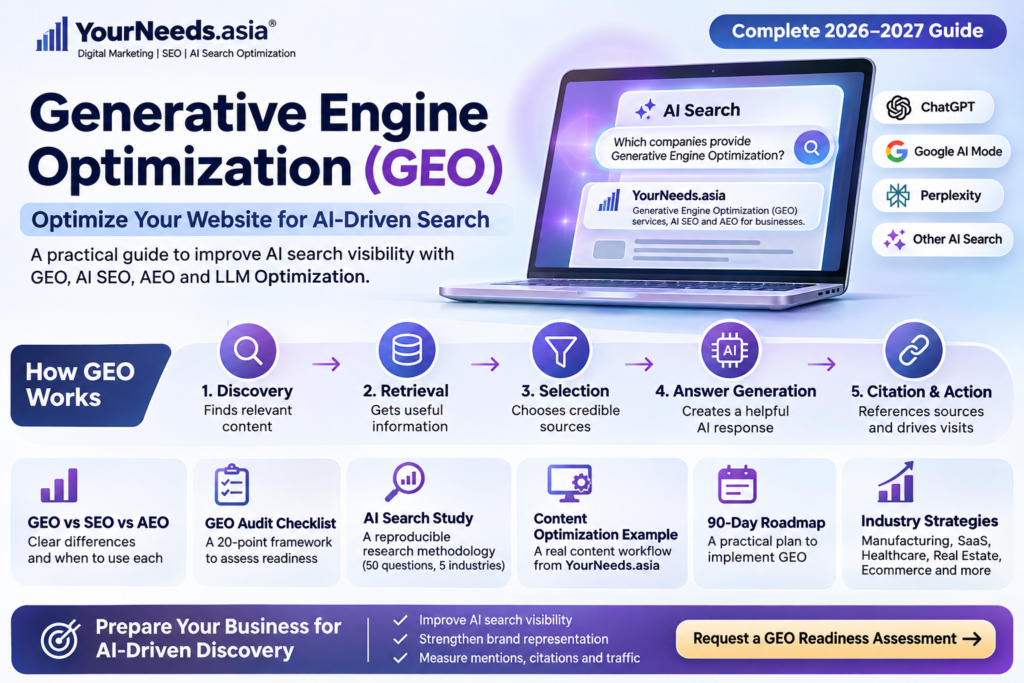
The Five Stages of AI Search Visibility
The exact mechanisms differ between platforms, but a useful conceptual model is:
1. Discovery: A search or retrieval system becomes aware of relevant content.
2. Retrieval: The system identifies documents or information that may answer a question.
3. Selection: Relevant information is prioritised for further processing.
4. Answer generation: An AI model uses available context to produce a response.
5. Citation and user action: The response may reference supporting sources, and a user may choose to visit a website or contact a business.
These stages are not a universal description of every AI platform.
They provide a practical framework for identifying where content quality, technical SEO and measurement can contribute.
Why GEO Is More Than Keyword Optimization
Traditional keyword targeting remains useful for understanding customer intent.
However, repeating a phrase such as “Generative Engine Optimization” does not automatically make a page more useful to AI systems.
A strong GEO resource should answer the underlying question, explain relevant concepts, provide supporting evidence and help readers take an appropriate next step.
For example, a manufacturing website should explain its actual production capabilities rather than repeatedly describing itself as the best manufacturer.
The same principle applies to digital marketing services.
A credible GEO guide should explain how optimisation works, how it is measured, what its limitations are and which practices are supported by evidence.
2. Is Generative Engine Optimization Replacing SEO?
No. Generative Engine Optimization is not replacing Search Engine Optimization.
SEO remains foundational to website discovery.
Google’s official guidance states that established SEO best practices remain relevant to its generative AI search features.
For Google AI Overviews and AI Mode, the fundamentals include technical accessibility, useful content, clear internal linking and compliance with Search policies.
SEO vs GEO vs AEO vs LLM Optimization
| Discipline | Primary Objective | Practical Example |
|---|---|---|
| Search Engine Optimization (SEO) | Improve organic search visibility | Optimising a service page for relevant search queries |
| Generative Engine Optimization (GEO) | Improve AI-assisted discoverability and brand representation | Making authoritative information available for AI-generated answers |
| Answer Engine Optimization (AEO) | Provide direct, useful answers | Publishing concise explanations and FAQs |
| LLM Optimization | Improve content clarity for LLM-powered experiences | Creating accessible product documentation and consistent brand information |
| AI Search Optimization | Coordinate search readiness for AI-assisted discovery | Combining SEO, content quality and visibility monitoring |
| Local SEO | Improve location-based discoverability | Optimising business information for Hyderabad searches |
These terms overlap.
Businesses should evaluate actual deliverables rather than assuming each acronym represents a completely separate technology.
When Should a Business Prioritise SEO?
SEO should remain a priority when a website has indexing problems, weak content, poor navigation, limited search visibility or inadequate conversion pathways.
When Should a Business Add GEO?
GEO becomes especially relevant when customers use AI tools to compare providers, research products, evaluate technical information or explore complex purchasing decisions.
For most businesses, the appropriate strategy is SEO plus GEO, not SEO versus GEO.
3. How AI Search Engines Discover and Reference Website Content
Understanding the distinction between retrieval and answer generation is essential.
Some AI search experiences retrieve information from web indexes or other connected sources.
Others may rely on information already available in the model’s context.
Search-enabled systems may combine multiple retrieval methods.
Retrieval-Augmented Generation
Retrieval-augmented generation, commonly called RAG, is a technique in which an AI system retrieves external information to help produce a response.
This can support more current or source-grounded answers.
However, a website being indexed does not guarantee that it will be retrieved for a particular question.
Likewise, retrieval does not guarantee that the final answer will cite or recommend the website.
What Is an AI Search Citation?
An AI search citation is a reference or link associated with an AI-generated answer.
For example, an AI system answering a question about industrial automation might cite technical documentation, manufacturer websites or industry publications.
A citation indicates that a source was referenced in that particular response.
It does not prove that the source is the best available resource or that it will appear in future responses.
The Difference Between Mentions, Citations and Traffic
Brand mention: An AI response names a business.
Source citation: An AI response links to or references a source.
Referral traffic: A user visits a website from an identifiable AI-assisted source.
Qualified lead: A visitor makes a commercially relevant enquiry.
Customer acquisition: A qualified lead becomes a customer.
These are distinct outcomes.
A company may be mentioned without receiving a citation, cited without receiving traffic, or visited without generating a lead.
A responsible GEO strategy measures these separately.
4. What Research Actually Says About Generative Engine Optimization
Generative Engine Optimization has a developing research foundation, but it is not a universally standardised ranking system.
The Foundational GEO Research
The paper GEO: Generative Engine Optimization, published in the proceedings of KDD 2024, introduced a framework for studying visibility in generative search environments.
The researchers examined methods for improving the visibility of content in generated responses.
Their experimental findings demonstrated that changes to source content could influence visibility under particular test conditions.
However, results from a controlled research environment should not be interpreted as a guarantee of improved rankings, traffic or conversions on every commercial AI platform.
Research source: GEO: Generative Engine Optimization — KDD 2024
What Later Research Adds
A 2026 critical survey of GEO research highlights the complexity of measuring AI visibility.
The survey distinguishes between discovery, retrieval, citations, how information influences an answer and subsequent user behaviour.
It also identifies variation between platforms and repeated tests.
This suggests that businesses should avoid relying on a single AI-generated response as proof of success.
Research source: Optimizing Visibility in Generative Engines: A Critical Survey
Three Evidence-Based Lessons
Lesson 1: Relevance matters. Content should address the actual question and provide useful supporting information.
Lesson 2: Visibility is not one metric. Being discovered, cited, mentioned and visited are different outcomes.
Lesson 3: Results are context-dependent. AI responses can change with platforms, prompts, available sources and time.
These findings support a disciplined approach to GEO measurement rather than promises of guaranteed AI recommendations.
5. How to Optimize a Website for Generative AI Search: An AI-First SEO Guide
The following framework combines foundational SEO with practical improvements for AI-assisted discovery.
Step 1: Understand Customer Questions
Start with the questions potential customers actually ask.
Group them by intent:
| Search Intent | Example |
|---|---|
| Informational | What is Generative Engine Optimization? |
| Comparative | GEO vs SEO: What is the difference? |
| Commercial | Which agency provides GEO services in India? |
| Technical | How can AI search citations be measured? |
| Transactional | Request a GEO audit for a business website |
This approach helps businesses create content around customer needs instead of keyword repetition.
Step 2: Make Important Pages Accessible
Review technical SEO fundamentals:
- Crawling and indexing controls.
- Canonical URLs.
- Internal linking.
- Website navigation.
- Mobile usability.
- Page performance.
- XML sitemaps.
- Readable page content.
- Accurate metadata.
Important information should be available in accessible text.
For Google’s AI search features, pages must meet the relevant Search eligibility requirements.
Step 3: Publish Original, Non-Commodity Content
Generic content is easy to reproduce.
A business can differentiate itself by publishing information based on genuine experience.
Examples include:
- Original technical explanations.
- Industry-specific buying guides.
- Product specifications.
- Transparent research methods.
- Practical checklists.
- Expert commentary.
- Authentic comparisons.
- Documented implementation examples.
Google’s 2026 guidance specifically emphasises valuable, original content rather than superficial GEO techniques.
Step 4: Explain Your Business Clearly
A useful service page should identify:
- What the business offers.
- Who its services are intended for.
- Which problems it solves.
- How the service is delivered.
- What customers receive.
- How enquiries are handled.
- Which claims can be verified.
Avoid vague statements such as “we guarantee the best AI rankings.”
Step 5: Build Topic Depth
A website should explain its core subject comprehensively.
For example, a Generative Engine Optimization resource can connect to supporting articles about technical SEO, AI search citations, AEO, LLM Optimization and content strategy.
Each supporting page should have a distinct purpose.
Avoid publishing near-identical articles solely to target spelling variations.
Step 6: Demonstrate Expertise and Trustworthiness
Use relevant author profiles, editorial review procedures, sources and evidence.
Where appropriate, explain who reviewed the content and when it was last updated.
A byline alone is not proof of expertise.
The surrounding website should provide enough information for readers to evaluate the author and business.
Step 7: Use Structured Data Appropriately
Structured data should describe actual, visible page content.
Relevant types may include Article, Organization, BreadcrumbList and other supported types where applicable.
Do not add misleading markup.
There is no special Google GEO schema that guarantees inclusion in AI Overviews or AI Mode.
Step 8: Earn Relevant External References
Third-party references can help customers discover and evaluate a brand.
Examples include legitimate industry publications, professional directories, research citations and authentic editorial coverage.
Avoid purchased endorsements presented as independent opinions, fabricated reviews or manipulative link schemes.
Step 9: Measure AI Visibility
Use a documented prompt-testing methodology.
Record the platform, question, date, brand mentions, citations and factual accuracy.
Repeat observations over time.
Step 10: Improve Commercial Outcomes
GEO should ultimately support meaningful business goals.
For service businesses, that may mean relevant enquiries.
For ecommerce companies, it may mean product discovery and sales.
For publishers, it may mean readership and subscriptions.
AI mentions alone should not be treated as business success.
6. YourNeeds.asia GEO Readiness Audit: A Practical 20-Point Framework
YourNeeds.asia recommends evaluating ten foundational areas before investing in advanced GEO activities.
This framework is an editorial self-assessment tool, not a Google ranking factor or industry-certified score.
For each item, assign:
0 points: Not implemented.
1 point: Partially implemented.
2 points: Implemented and verified.
| Audit Factor | Maximum Points |
|---|---|
| Important pages are accessible and indexable | 2 |
| Services and products are clearly explained | 2 |
| Brand information is consistent | 2 |
| Content demonstrates original expertise | 2 |
| Authors and relevant reviewers are identified | 2 |
| Internal links support important topics | 2 |
| Structured data matches visible content | 2 |
| AI citation tests use documented prompts | 2 |
| Analytics and lead measurement are configured | 2 |
| Content has a review and update process | 2 |
| Total | 20 |
Interpreting the Score
0–7: Foundational work needed
Prioritise technical accessibility, content quality and accurate business information.
8–13: Developing GEO readiness
Address inconsistent content, missing evidence and measurement gaps.
14–17: Established foundations
Focus on original research, detailed resources and monitoring.
18–20: Strong checklist completion
Continue reviewing performance and adapting to platform changes.
A high score does not guarantee rankings or AI citations.
What Should You Fix First?
Start with issues that prevent people and search systems from accessing useful information.
Next, improve content accuracy and relevance.
Only after the fundamentals are established should a business invest heavily in advanced visibility testing.
7. YourNeeds.asia AI Search Visibility Study 2026: Research Framework
A major challenge in GEO is the absence of a universal measurement standard.
YourNeeds.asia proposes a reproducible study designed to investigate how AI-assisted search systems represent brands across industries.
Research status: This is a proposed methodology, not a completed study. No findings or performance improvements are claimed.
Research Objective
Evaluate how AI-assisted search experiences mention businesses, select citations and describe brands when responding to buyer-intent questions.
Proposed Research Sample
The study would examine 50 questions across five sectors.
| Industry | Questions |
|---|---|
| Manufacturing and engineering | 10 |
| SaaS and B2B technology | 10 |
| Healthcare | 10 |
| Real estate | 10 |
| Digital marketing and professional services | 10 |
| Total | 50 |
Example Research Questions
Manufacturing
“Which Indian die casting manufacturers provide aluminium components for international buyers?”
SaaS
“What should a B2B SaaS company evaluate before choosing a technical SEO agency?”
Healthcare
“What information should a clinic publish to help patients evaluate its services?”
Real estate
“What should buyers verify when comparing residential projects in Hyderabad?”
Digital marketing
“What is the difference between Generative Engine Optimization and traditional SEO?”
Platforms
Where accessible and appropriate, testing can include:
- ChatGPT search-enabled experiences.
- Google AI Mode.
- Perplexity.
- Other relevant AI-assisted search tools.
Reproducible Testing Procedure
- Finalise and archive the exact prompt set.
- Record the platform, date, language, region and relevant account settings.
- Run each question across three separate test sessions.
- Save the response and source references.
- Identify brand mentions.
- Record citation URLs.
- Evaluate factual accuracy against primary sources.
- Repeat the process at scheduled intervals.
- Compare observations across platforms.
- Publish results with limitations and the underlying methodology.
What Should the Study Measure?
Brand mention rate
The proportion of eligible responses mentioning a particular brand.
Citation rate
The proportion of eligible responses citing a relevant website.
Brand accuracy
Whether the answer correctly describes the business and its services.
Citation consistency
Whether the same source appears across repeated tests.
Referral traffic
Identifiable visits associated with AI-assisted discovery, reported separately.
Important Research Limitations
AI responses may vary between users and sessions.
Some systems do not expose complete source information.
Citation counts do not establish the causal effect of an optimisation change.
AI referral traffic may be incompletely attributed.
Research findings should therefore be presented as observations from a defined sample, not universal rules.
8. YourNeeds.asia GEO Content Optimization Demonstration
A Transparent Example Using This Article
Because GEO is an emerging field, it is useful to demonstrate an optimisation workflow rather than rely on unverified success stories.
This section uses the development of the present YourNeeds.asia article as an editorial example.
Demonstration type: Content strategy and editorial optimisation.
Subject: Generative Engine Optimization.
Primary keyword: Generative Engine Optimization.
Secondary terms: Generative Engine Optimisation, GEO, AI Search Optimization, AEO, LLM Optimization and AI Search Visibility.
Important limitation: This demonstration documents editorial decisions. It is not a completed search-performance case study.
Stage 1: Define Search Intent
The article targets readers who want to understand GEO, evaluate its relationship with SEO, learn practical optimisation methods and assess service providers.
The broad primary keyword has a strong educational component.
Therefore, the article begins with a definition and practical explanation rather than a sales pitch.
Stage 2: Organise the Content Around Questions
The article addresses:
- What is GEO?
- How does it work?
- Is GEO replacing SEO?
- How do AI citations work?
- How can a website prepare for AI search?
- How should businesses measure GEO?
- What can YourNeeds.asia provide?
This organisation helps readers find relevant information without navigating repetitive promotional sections.
Stage 3: Add Original Editorial Value
Rather than reproducing generic GEO definitions alone, the article includes:
- A five-stage AI visibility model.
- A 20-point GEO readiness framework.
- A reproducible 50-question research methodology.
- A citation measurement framework.
- Industry-specific examples.
- A 90-day implementation roadmap.
- Clear explanations of what GEO cannot guarantee.
These are editorial frameworks and examples, not claims of completed experiments.
Stage 4: Strengthen Evidence
The article references official Google documentation and relevant academic research.
It distinguishes published findings from practical recommendations.
Stage 5: Connect Educational and Commercial Intent
Readers receive practical guidance before being introduced to YourNeeds.asia’s services.
The article includes a clear consultation pathway without repeatedly interrupting educational sections.
Stage 6: Define Post-Publication Measurement
Once published, the page can be monitored using:
- Google Search Console.
- Search query impressions and clicks.
- Indexing and canonical status.
- Organic landing-page performance.
- AI search citation observations.
- Identifiable AI referral sessions.
- Relevant enquiries.
What This Demonstration Proves—and Does Not Prove
It demonstrates a structured editorial process for creating a GEO resource.
It does not establish that the page ranks for the primary keyword, receives AI citations or produces additional leads.
Those outcomes require post-publication evidence.
9. What AI Search Citations Reveal About SEO Strategy
AI citations can provide useful information about how certain platforms reference sources.
However, they should be analysed carefully.
Citation Presence Is Not the Same as Citation Influence
A page may be cited without contributing substantial information to the generated answer.
Conversely, information may influence a response without a clearly attributable citation.
This distinction is important when evaluating AI search performance.
A Practical Citation Audit
| Question | Evidence to Record |
|---|---|
| Was the brand mentioned? | Exact response text |
| Was the website cited? | Source URL |
| Was the citation relevant? | Relationship to the question |
| Was the brand description accurate? | Verified factual comparison |
| Did the result repeat? | Additional test sessions |
| Did users visit the website? | Available referral analytics |
| Did visitors enquire? | Relevant conversion records |
Avoid Misleading GEO Reporting
Do not describe one AI response as proof that a business ranks first across AI platforms.
Do not combine brand mentions and citations into a single unexplained score.
Do not claim that a citation generated a sale unless the evidence supports that attribution.
A credible GEO report should be transparent about what was observed and what remains unknown.
10. Generative Engine Optimization for Different Industries
GEO strategies should reflect how customers research and evaluate products in each sector.
Manufacturing and Engineering
Manufacturing buyers often need precise technical information.
A useful manufacturer website may explain:
- Production capabilities.
- Materials and processes.
- Manufacturing tolerances.
- Quality assurance.
- Certifications.
- Applications.
- Export capabilities.
- RFQ requirements.
For example, a die casting manufacturer can publish detailed information about aluminium alloys, tooling, production capacity and inspection procedures.
This helps customers assess suitability and makes the website’s information more specific.
YourNeeds.asia publishes related resources on die casting SEO and industrial automation SEO.
SaaS and B2B Technology
Software buyers often compare products before requesting a demonstration.
Useful resources include:
- Product documentation.
- Integration guides.
- API information.
- Security documentation.
- Feature comparisons.
- Implementation requirements.
- Pricing explanations.
GEO can complement technical SEO by improving the clarity and accessibility of this information.
Healthcare
Healthcare organisations should prioritise accuracy, professional review and patient safety.
Useful content may explain services, qualifications, appointment procedures and appropriate patient guidance.
Medical claims should be supported by reliable evidence and comply with applicable requirements.
Real Estate
Property buyers often research location, approvals, amenities, pricing and project status.
Real estate businesses should publish accurate project information and comply with relevant advertising and disclosure obligations.
Ecommerce
Product discovery depends on clear and accurate information.
Useful content includes specifications, compatibility, product images, availability details, delivery information and return policies.
Local Businesses
Local businesses should maintain accurate location, contact and service information.
Traditional local SEO remains important for location-based discovery.
International Exporters
Exporters may need multilingual content, destination-market information, product specifications, certifications and international enquiry pathways.
Generative Engine Optimisation can be integrated with international SEO rather than treated as a separate shortcut.
11. Generative Engine Optimization Services by YourNeeds.asia
YourNeeds.asia provides digital marketing and website services relevant to GEO readiness.
Our approach combines technical SEO, content quality, brand information consistency and practical measurement.
GEO Readiness Assessment
Evaluate technical accessibility, content structure, search visibility and measurement readiness.
Typical deliverable: Prioritised GEO assessment and recommendations.
AI Search Optimization
Improve important pages so they communicate accurate and useful information.
Typical deliverable: Content and website optimisation plan.
Answer Engine Optimization
Develop clear explanations and question-led resources based on customer intent.
Typical deliverable: Improved service content and supporting educational material.
LLM Optimization
Improve the consistency and clarity of brand, service and product information.
Typical deliverable: Reviewed content and information architecture recommendations.
Technical SEO
Address crawlability, indexing, canonicalisation, navigation and other technical requirements.
Typical deliverable: Technical audit and implementation priorities.
AI Search Visibility Monitoring
Record observable mentions, citations and relevant referral data.
Typical deliverable: Periodic monitoring report with documented limitations.
Content Governance
Establish appropriate editorial review, accuracy checks and publication workflows.
Typical deliverable: Content review process adapted to the client’s existing systems.
What YourNeeds.asia Does Not Promise
No agency can guarantee inclusion in ChatGPT recommendations, Google AI Overviews, Google AI Mode or Perplexity answers.
GEO should be evaluated through defined work, evidence and transparent reporting.
Request a Generative Engine Optimization Readiness Assessment
12. YourNeeds.asia LLM Optimizer: A Practical Service Framework
The YourNeeds.asia LLM Optimizer approach is a structured service methodology for improving AI search readiness.
It is described here as a workflow, not as a claim of a separately verified proprietary software platform.
Discover
Review website accessibility, existing content and relevant customer questions.
Optimize
Improve technical foundations, information clarity, supporting evidence and internal linking.
Validate
Check factual accuracy, publication quality and appropriate editorial approvals.
Measure
Monitor search performance, AI visibility observations and commercially relevant outcomes.
Why Governance Matters
AI-assisted content creation can accelerate drafting, but businesses remain responsible for accuracy.
Technical, legal, medical and financial claims may require specialist review.
A good GEO workflow includes human accountability rather than relying exclusively on automated publishing.
13. How to Measure Generative Engine Optimization Performance
GEO measurement should separate visibility from business impact.
| Measurement Area | Example KPI | Primary Evidence |
|---|---|---|
| Search discovery | Organic impressions and clicks | Search Console |
| AI search exposure | Platform-specific available reporting | Search platform reports |
| Brand representation | Observed brand mentions | Documented prompt tests |
| Citation visibility | Recorded source references | Saved AI responses |
| Referral traffic | Identifiable AI-source sessions | Analytics |
| Lead generation | Qualified enquiries | CRM or lead records |
| Commercial impact | Attributable revenue where measurable | Sales and analytics records |
Google’s Generative AI Reporting
Google’s 2026 documentation describes reporting capabilities for generative AI search experiences.
Businesses should review the currently available Search Console reports and distinguish platform-reported performance from independent prompt-testing observations.
What About Agentic Traffic?
Agentic traffic may involve automated systems accessing websites while carrying out user-directed tasks.
Some interactions may appear in server logs or analytics.
However, automated access does not necessarily represent a human visit or commercial intent.
Monthly GEO Reporting Template
A practical monthly report should include:
Search performance: Organic impressions, clicks and relevant landing pages.
AI observations: Prompt set, platforms, dates, mentions and citations.
Content changes: Pages created or improved.
Technical changes: Implemented fixes and outstanding issues.
Business outcomes: Qualified enquiries and conversions where measurable.
Limitations: Data gaps, attribution uncertainty and platform variability.
14. A 90-Day Generative Engine Optimization Roadmap
A phased implementation helps businesses prioritise useful work.
| Period | Priority | Deliverable |
|---|---|---|
| Days 1–15 | Technical and content assessment | GEO readiness report |
| Days 16–30 | Search intent and content planning | Prioritised roadmap |
| Days 31–45 | Technical improvements | Implemented SEO fixes |
| Days 46–60 | Content development | Improved priority pages |
| Days 61–75 | AI citation observation | Initial visibility report |
| Days 76–90 | Review and optimisation | Next-quarter action plan |
This is an illustrative timeline.
Actual implementation depends on website size, available resources and project scope.
First 30 Days: Fix the Foundation
Review technical accessibility and identify the most commercially important pages.
Prioritise content that is inaccurate, incomplete or difficult to navigate.
Days 31–60: Improve Information Quality
Develop useful content, strengthen internal links and publish supporting evidence.
Days 61–90: Evaluate and Refine
Conduct documented AI visibility tests and review search and conversion data.
Avoid making major strategic decisions based on isolated AI responses.
15. Common GEO Mistakes Businesses Should Avoid
Mistake 1: Treating GEO as a Replacement for SEO
Foundational SEO remains important.
Mistake 2: Repeating Keywords Excessively
Keyword stuffing does not create original value.
Mistake 3: Publishing Generic AI Content at Scale
Large quantities of repetitive content can undermine usefulness.
Mistake 4: Inventing Case Studies
Unverified success stories damage credibility.
Mistake 5: Treating Every Citation as a Ranking Victory
Citations are observations, not guaranteed commercial outcomes.
Mistake 6: Ignoring Technical SEO
Important content must remain accessible.
Mistake 7: Claiming Proprietary AI Ranking Control
External agencies cannot control how independent AI platforms generate answers.
Mistake 8: Using Unsupported GEO Markup Claims
Google does not require special GEO schema or llms.txt for its AI search features.
Mistake 9: Ignoring Customer Intent
Content should solve customer problems rather than merely target terminology.
Mistake 10: Measuring Mentions Without Leads
Brand exposure and business outcomes should be evaluated separately.
16. AI Search and the Future of SEO in 2027
AI-assisted discovery is likely to remain an important consideration for digital marketing.
However, the exact direction of individual platforms is uncertain.
Businesses should invest in practices that remain useful across different search experiences.
Original Content Will Remain Important
First-hand information, technical documentation and expert analysis provide value beyond generic summaries.
Search Intent Will Become More Conversational
Customers can ask detailed questions and refine their requirements through follow-up prompts.
Brand Accuracy Will Matter
Businesses should maintain consistent and verifiable information.
Technical Accessibility Will Remain Foundational
Websites need to work for people and relevant search systems.
AI Visibility Measurement Will Evolve
Reporting capabilities may improve, but businesses should continue distinguishing citations, traffic and commercial results.
Agentic Experiences Will Introduce New Requirements
As AI systems interact with websites on behalf of users, accessible interfaces and reliable information may become increasingly important.
The appropriate response is to maintain strong digital foundations while evaluating emerging technologies carefully.
17. Why Consider YourNeeds.asia for GEO Services?
YourNeeds.asia is a Hyderabad-based digital marketing and technology company established in 2011.
The company reports a team of 25 employees and provides services covering:
- Generative Engine Optimization.
- Generative Engine Optimisation.
- AI Search Optimization.
- AI SEO.
- Answer Engine Optimization.
- LLM Optimization.
- Technical SEO.
- Local SEO.
- International SEO.
- Website development.
- Industry-specific SEO.
- Digital marketing.
The company’s editorial resources cover specialised industries, including manufacturing and industrial automation.
Prospective clients should evaluate relevant expertise, project scope, references, pricing and reporting practices before selecting a provider.
What Should You Expect From a GEO Consultation?
A useful consultation should establish:
- The business’s target customers and markets.
- Current website and search performance.
- Priority services or products.
- Technical and content weaknesses.
- Opportunities for original information.
- Available analytics and measurement tools.
- Implementation responsibilities.
- Expected deliverables and review periods.
Start With a GEO Readiness Assessment
YourNeeds.asia can help businesses identify opportunities to improve website information, technical SEO and AI search readiness.
Contact YourNeeds.asia for Generative Engine Optimization Services
18. Frequently Asked Questions About Generative Engine Optimization
What is Generative Engine Optimization?
Generative Engine Optimization (GEO) is the practice of improving how AI-assisted search systems discover, interpret and reference information about websites and brands.
What is Generative Engine Optimisation?
Generative Engine Optimisation is the British English spelling of Generative Engine Optimization. Both terms refer to GEO.
What does GEO mean in SEO?
GEO stands for Generative Engine Optimization. It extends SEO considerations to AI-generated search experiences and brand representation.
Is Generative Engine Optimization replacing SEO?
No. GEO complements traditional SEO, which remains foundational to search visibility.
How does Generative Engine Optimization work?
GEO involves improving technical accessibility, content relevance, original information, brand accuracy and measurable AI search visibility.
What is AI Search Optimization?
AI Search Optimization refers to improving a website’s readiness for AI-assisted search and discovery.
What is the difference between GEO and AEO?
GEO focuses on representation in generative AI experiences. AEO focuses on providing clear answers to user questions.
What is LLM Optimization?
LLM Optimization focuses on making information clearer and more consistent for experiences powered by large language models.
How can I optimise my website for generative AI?
Start with technical SEO, original content, accurate business information, relevant internal links and documented performance measurement.
Can GEO improve ChatGPT visibility?
GEO practices may improve information quality and accessibility, but no agency can guarantee ChatGPT mentions or recommendations.
Does Google require special GEO schema?
No. Google’s AI search features do not require special GEO schema markup.
Is llms.txt required for Generative Engine Optimization?
Google does not require llms.txt for inclusion in its generative AI search features.
What are AI search citations?
AI search citations are source references or links included in AI-generated responses.
How should AI citations be measured?
Use documented prompts, repeated tests, saved responses and clearly defined citation metrics.
How long does GEO take to work?
There is no universal timeline. Results depend on the website, competition, implementation and platform behaviour.
How much do Generative Engine Optimization services cost?
Pricing depends on technical complexity, content requirements, monitoring and implementation scope.
Is GEO useful for B2B companies?
GEO can be relevant to B2B businesses whose customers use AI tools to research products, compare suppliers and evaluate technical requirements.
Can small businesses benefit from GEO?
Small businesses can improve their readiness by publishing accurate service information, maintaining technical SEO and answering customer questions clearly.
Does GEO work for international SEO?
GEO can complement international SEO through accurate market-specific information, multilingual content and relevant technical documentation.
Which company offers Generative Engine Optimization services in Hyderabad?
YourNeeds.asia offers SEO, AI search optimisation, content and website services relevant to GEO. Businesses should compare providers based on verified experience and project requirements.
Conclusion: Build Sustainable AI Search Visibility With Generative Engine Optimization
Generative Engine Optimization is an important extension of modern SEO for businesses preparing for AI-assisted discovery.
A useful GEO strategy does not depend on keyword repetition, invented authority signals or guaranteed AI recommendations.
It begins with accessible websites, original information, credible sources, clear customer answers and measurable business objectives.
Generative Engine Optimization, AI Search Optimization, AEO and LLM Optimization should work together as part of a coherent digital marketing strategy.
YourNeeds.asia helps businesses evaluate these requirements and develop practical improvements through SEO, website development and content services.
Request Your Generative Engine Optimization Readiness Assessment