Super Vasuki: The Story Behind India’s Extraordinary Long-Haul Freight Train
India has one of the largest railway networks in the world, and freight trains play a critical role in moving coal, minerals, food grains, raw materials and industrial goods across the country. Among the most striking demonstrations of Indian Railways’ freight capability is Super Vasuki, an exceptionally long freight train that attracted attention for its enormous length and hauling capacity.
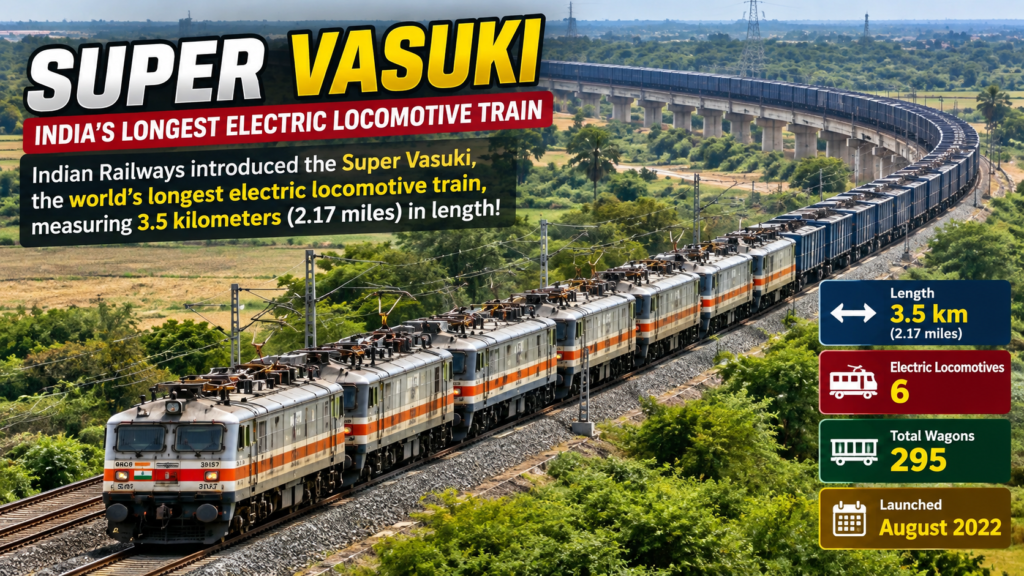
The image describes Super Vasuki as an approximately 3.5-kilometre-long train, formed using six electric locomotives and 295 wagons, and associates its operation with August 2022.
Those numbers alone explain why Super Vasuki became such a memorable railway achievement.
Quick Answer: What Is Super Vasuki?
Super Vasuki is an exceptionally long freight-train formation operated by Indian Railways. According to the information in the supplied image, the train measured about 3.5 km (2.17 miles), consisted of 295 wagons and was hauled using six electric locomotives. The image dates the achievement to August 2022.
It is important to describe it as a freight train, rather than a conventional passenger train.
Why Is Super Vasuki Special?
Imagine standing at a railway crossing while an ordinary train passes.
Now imagine a train stretching for roughly 3.5 kilometres.
That scale is difficult to appreciate until it is placed in perspective. Super Vasuki wasn’t simply notable because it had a large number of wagons. Coordinating hundreds of loaded freight wagons and multiple locomotives into one extremely long formation represents a very different operational challenge from running a normal train.
According to the supplied image, its headline specifications were:
| Super Vasuki | Details stated in the image |
|---|---|
| Train type | Electric locomotive-hauled freight train |
| Approximate length | 3.5 km / 2.17 miles |
| Wagons | 295 |
| Electric locomotives | 6 |
| Date highlighted | August 2022 |
Six Electric Locomotives Working Together
One of the most interesting details about Super Vasuki is its use of six electric locomotives.
Moving almost 300 freight wagons requires enormous tractive effort. Multiple locomotives allow the railway to provide the power necessary to move such a huge formation.
But adding locomotives is only one part of the challenge.
With an exceptionally long freight train, railway operations also have to account for acceleration, braking, gradients, curves, signalling, track capacity and the forces acting through the couplers connecting hundreds of wagons.
This is why the engineering significance of a train such as Super Vasuki goes beyond its headline length.
295 Wagons in a Single Formation
The image states that Super Vasuki consisted of 295 wagons.
That is one of the statistics that makes the train visually extraordinary.
Freight railways normally balance train length and weight against infrastructure and operational constraints. Combining such a large number of wagons can potentially move a substantial amount of freight in a single coordinated movement rather than operating several smaller trains separately.
That demonstrates why long-haul freight formations can be strategically important to a large railway system.
Why Long Freight Trains Matter to India
India’s economy depends on moving enormous quantities of goods between mines, factories, power plants, ports, warehouses and cities.
Rail is particularly important when large quantities need to travel over long distances.
Longer freight formations can potentially help a railway move more cargo within available operating windows. However, bigger is not automatically better in every situation. Train length must remain compatible with track infrastructure, signalling, braking requirements, gradients, loops, yards and overall network operations.
Super Vasuki is therefore interesting not merely as a record-style achievement, but as a demonstration of what coordinated heavy freight operations can accomplish.
Super Vasuki and Indian Railway Engineering
The visual impact of Super Vasuki is obvious.
A train stretching kilometres across the landscape makes an extraordinary photograph.
The engineering behind such an operation is less visible.
A very long train requires coordination across locomotives, wagons, braking systems, railway staff, signalling and route management. Engineers and operators also need to consider how forces behave throughout a formation hundreds of wagons long.
For railway enthusiasts, that is perhaps the more fascinating story:
Super Vasuki isn’t only about length. It is about controlling that length safely and efficiently.
Is Super Vasuki a Passenger Train?
No. Super Vasuki should not be confused with India’s long-distance passenger trains.
It is a freight formation.
Its purpose is therefore fundamentally different from passenger services such as Vande Bharat, Rajdhani, Shatabdi or other express trains.
Passenger trains are designed around passenger capacity, comfort, stations and journey times.
Freight trains are designed primarily around the efficient movement of cargo.
Super Vasuki belongs firmly to the second category.
Why Did Super Vasuki Become Popular Online?
The answer is simple: scale.
People immediately understand that 3.5 kilometres is enormous for a train.
Combine that with:
6 locomotives + 295 wagons + approximately 3.5 km
and the story becomes highly shareable.
Images and videos of extraordinarily long trains are also naturally suited to social media because viewers can understand the achievement without needing detailed knowledge of railway engineering.
Super Vasuki in Numbers
The easiest way to remember the achievement described in the image is:
3.5 km long. Six electric locomotives. 295 wagons.
Those three numbers communicate the extraordinary scale of Super Vasuki.
Was Super Vasuki Launched in August 2022?
The supplied image states that the historic train was “launched in August 2022.”
For a rigorously sourced news or history article, however, I would phrase this more carefully as “operated in August 2022” unless an official railway source specifically describes it as a formal launch.
That distinction matters because extraordinary freight formations may be assembled and operated for particular movements rather than being introduced as a permanent named passenger-style service.
Is Super Vasuki the World’s Longest Electric Locomotive Train?
The image describes Super Vasuki as the “world’s longest electric locomotive train.”
That is a very broad record claim and should be treated cautiously.
“Longest train,” “longest freight train,” “longest electric freight train,” and “longest train operated by a particular railway” can refer to different records with different definitions.
For publishing on YourNeeds.asia, a safer headline would therefore be:
Super Vasuki: India’s Remarkable 3.5-km Freight Train With 295 Wagons
This retains the extraordinary achievement without depending on an unverified global-record claim.
Frequently Asked Questions About Super Vasuki
What is Super Vasuki?
Super Vasuki is an exceptionally long Indian Railways freight-train formation. The supplied image describes it as approximately 3.5 kilometres long and consisting of 295 wagons hauled by six electric locomotives.
How long is Super Vasuki?
According to the image, Super Vasuki is approximately 3.5 kilometres (2.17 miles) long.
How many wagons does Super Vasuki have?
The supplied image states that the formation consisted of 295 wagons.
How many locomotives were used for Super Vasuki?
According to the image, six electric locomotives were used.
When did Super Vasuki operate?
The image associates Super Vasuki with August 2022.
Is Super Vasuki an electric train?
The supplied information describes the train as being hauled by six electric locomotives.
Is Super Vasuki a passenger train?
No. Super Vasuki is a freight train formation, not a passenger service.
Why is Super Vasuki important?
Its significance comes from its exceptional scale. Coordinating six locomotives and 295 wagons across a formation approximately 3.5 km long demonstrates the capabilities involved in large-scale freight railway operations.
More Than Just a Very Long Train
Super Vasuki captures attention because of its enormous physical size.
But behind those dramatic numbers lies a bigger story about freight transportation, railway coordination and engineering.
A 3.5-kilometre train, hauled by six electric locomotives and made up of 295 wagons, is not something people see every day.
It represents the kind of railway achievement that can make people curious not only about Super Vasuki, but about the enormous infrastructure operating quietly behind India’s economy every day.
Super Vasuki is impressive when viewed from the air—but the engineering required to move a train of that scale is the real story.