How Well Does Your Brand Know Gen Zs in India?
The 2026 Strategic Guide to Understanding India’s Most Influential Consumer Generation
Editorial Methodology
This guide combines consumer behaviour research, publicly available industry insights from leading firms like Google, Deloitte, McKinsey, and Kantar, and YourNeeds.asia’s proprietary strategic frameworks.
It is designed to help marketers, founders, and business leaders understand and adapt to emerging digital trends with actionable, evidence-based strategies.
Executive Summary
Every generation reshapes the market, but Gen Zs in India are transforming it at a pace few businesses anticipated.
Born into a world of smartphones, streaming platforms, AI-powered recommendations, instant search, creator communities, and digital payments, this generation doesn’t separate online and offline experiences—they simply expect brands to meet them wherever they are.
Many companies still rely on outdated assumptions.
They believe Gen Z consumers only spend time on social media, have short attention spans, or make impulsive purchasing decisions. Reality is far more nuanced.
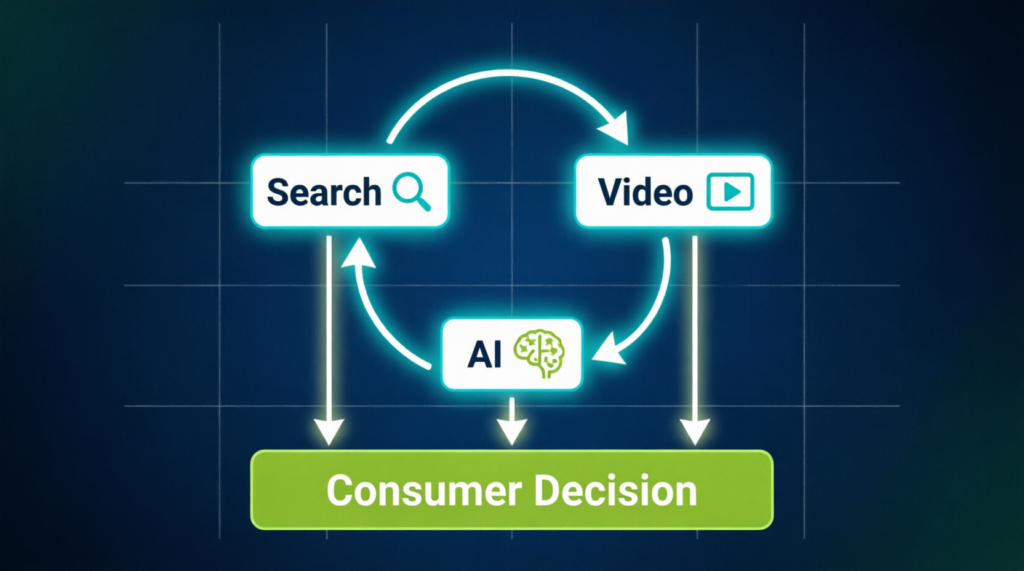
Today’s Gen Z consumers research products across multiple platforms, compare reviews, verify creator opinions, ask AI assistants for recommendations, visit physical stores, and often revisit Google Search before making a purchase.
They expect authenticity, transparency, speed, personalization, and meaningful experiences rather than one-way advertising.
For marketers, entrepreneurs, and business leaders, understanding Gen Zs in India is no longer optional.
Whether you’re launching a startup, running an e-commerce brand, managing a healthcare practice, building a fintech platform, or promoting educational services, your ability to understand how this generation discovers information, evaluates trust, and makes decisions will directly influence long-term growth.
This guide explores the evolving behaviour of Gen Z consumers in India, the technologies shaping their decisions, and practical digital marketing strategies that help businesses build lasting relationships rather than short-lived campaigns.
Quick Answer
Who are Gen Zs in India, and why should brands care?
Gen Zs in India are generally individuals born between the late 1990s and early 2010s who have grown up with smartphones, digital payments, social media, online learning, and AI-assisted technologies.
They are active researchers, value authenticity, expect seamless digital experiences, and frequently move between search engines, video platforms, online communities, marketplaces, and physical stores before making decisions.
Brands that prioritize trust, relevance, and helpful experiences are more likely to earn their attention and loyalty.
Who Should Read This Guide?
This guide is designed for:
- Marketing leaders developing future-ready brand strategies.
- Startup founders targeting younger audiences.
- E-commerce businesses seeking higher conversion rates.
- Retail brands expanding into digital commerce.
- Healthcare organizations improving patient engagement.
- Educational institutions connecting with prospective students.
- Financial services building trust with first-time investors.
- Hospitality and travel brands targeting experience-driven consumers.
- SEO and digital marketing professionals preparing for AI-powered search.
- Business owners who want to understand how consumer behaviour is evolving in India.
Why Gen Zs in India Matter More Than Ever
India is home to one of the world’s largest Gen Z populations.
As this generation enters higher education, the workforce, entrepreneurship, and independent purchasing decisions, its economic influence continues to grow.
According to Deloitte’s Global Powers of Retail report, Gen Z’s direct spending power is expanding rapidly, but their indirect influence on household purchases is even more significant.
However, influence should not be measured only by spending power.
As highlighted in Kantar’s consumer indexing reports, Gen Z consumers heavily influence:
- Household purchasing decisions
- Technology adoption
- Entertainment & travel preferences
- Fashion choices & food delivery habits
- Financial product awareness
- Career aspirations
- And even purchasing decisions made by older family members.
For many businesses, today’s first-time Gen Z customer may become tomorrow’s long-term advocate, subscriber, or repeat buyer.
Beyond Stereotypes: Understanding the Real Gen Z
Many articles describe Gen Z using labels such as Digital natives, Social media addicts, Short attention spans, Trend followers, Budget-conscious.
While each stereotype contains a small element of truth, none fully explains how this generation behaves.
Gen Z consumers often demonstrate behaviours that appear contradictory:
- They consume short videos yet spend hours researching expensive purchases.
- They enjoy viral trends yet value genuine expertise.
- They appreciate automation but expect human empathy when problems arise.
- They embrace AI tools but remain cautious about misinformation.
- They compare prices extensively while still paying premium prices for trusted brands.
Understanding these seemingly opposite behaviours is the key to building meaningful relationships.
🏢 The YourNeeds Consumer Understanding Framework™
Note on Our Methodology: The proprietary frameworks introduced in this guide (The 5D Consumer Understanding Framework™, Trust Triangle™, AI Visibility Framework™, etc.) are part of a recognizable, recurring methodology. We reuse these exact models consistently across our related AI SEO, Digital Marketing, and Website Design engagements to build a cohesive, standardized approach to brand growth.
Instead of viewing Gen Z through demographic labels, YourNeeds.asia recommends evaluating consumer behaviour across five dimensions:
|
Dimension
|
What Brands Should Evaluate
|
|---|---|
| Discover | How consumers first encounter your brand |
| Decide | What information influences trust |
| Discuss | Where conversations about your brand happen |
| Do | What motivates conversion |
| Develop | How customers become long-term advocates |
What Has Changed Between 2020 and 2026?
|
2020 Consumer Behaviour
|
2026 Consumer Behaviour
|
|---|---|
| Keyword search | Conversational and AI-assisted search |
| Brand advertisements | Creator recommendations and community validation |
| Static websites | Interactive, personalized digital experiences |
| Single-platform discovery | Multi-platform research journeys |
| One-time purchases | Long-term brand relationships |
| Generic marketing | Personalized, intent-driven communication |
The biggest shift isn’t technology—it’s expectations.
Consumers increasingly expect brands to understand their intent before presenting solutions.
The Rise of AI-Assisted Consumer Decisions
Artificial intelligence is quietly changing how consumers discover products and services.
According to Think with Google insights, conversational search queries have increased exponentially as users treat search engines like personal advisors.
Instead of asking: “Best running shoes under ₹5,000” many users now ask: “Which running shoes are best for beginners who run three times a week?”
Similarly, prospective students, patients, travellers, and shoppers increasingly expect direct answers rather than lists of links.
For brands, this means traditional keyword optimization alone is no longer enough.
Businesses must create content that answers real questions, demonstrates expertise, and provides trustworthy information that can be understood by both people and AI-powered systems.
The Expanded AI Search Ecosystem (2026–2030)
To future-proof your marketing strategy, brands must look beyond basic text search to the emerging AI ecosystem:
- AI Overviews & Generative Search: Search engines now synthesize answers directly on the page. Brands need structured, entity-based content to become the cited source.
- Conversational Commerce: AI chatbots integrated into WhatsApp and Instagram allow users to research, compare, and buy without ever leaving the chat interface.
- Multimodal Search: Gen Z increasingly searches using images, video snippets, and audio rather than just typing text.
- Voice AI: Smart speakers and voice assistants are moving from simple commands to complex, conversational product research.
- Agentic AI (Shopping Agents): The next frontier where AI agents autonomously browse the web, compare prices across 10 sites, and make purchasing decisions on behalf of the consumer.
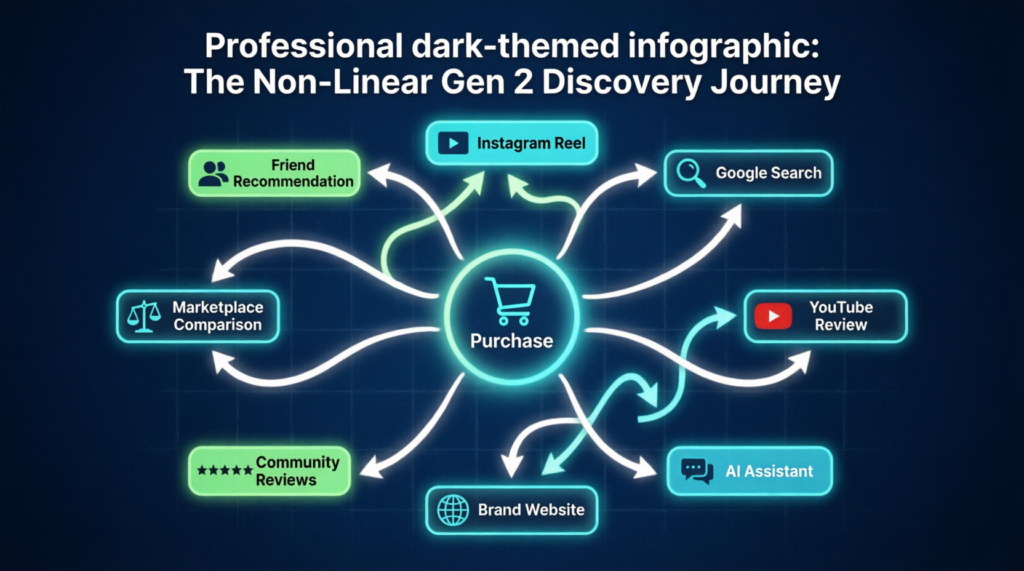
The New Discovery Journey
Traditional marketing often assumed a predictable customer journey: Awareness → Interest → Consideration → Purchase.
Today’s reality is much more dynamic.
🏢 The YourNeeds Trust Triangle™ Successful brands consistently perform well across three areas:
- Visibility: Can consumers easily discover your brand?
- Credibility: Do consumers trust your expertise and reputation?
- Experience: Does every interaction reinforce confidence?
When these three elements work together, marketing becomes more efficient because trust compounds over time.
Common Myths About Gen Zs in India
- Myth 1: They only use social media.
- Reality: Search engines, video platforms, marketplaces, review sites, AI assistants, and community discussions all play important roles throughout the buying journey.
- Myth 2: They don’t read.
- Reality: They avoid unnecessary information but willingly consume detailed content when it helps them make confident decisions.
- Myth 3: Price is everything.
- Reality: Many Gen Z consumers are willing to pay more for brands they perceive as authentic, transparent, sustainable, or genuinely helpful.
- Myth 4: Loyalty doesn’t exist.
- Reality: Loyalty exists—but it must be continuously earned through consistent experiences rather than one-time promotions.
- Myth 5: AI will replace brand websites.
- Reality: AI changes how consumers discover information, but authoritative websites remain essential because they provide the original expertise that AI systems often rely on.
Marketing Insight: Instead of asking “How do we sell to Gen Z?” ask “How do we become the most trustworthy answer wherever Gen Z searches, watches, learns, compares, and decides?”
How Gen Zs in India Discover, Evaluate, and Buy in 2026
The New Consumer Journey Isn’t Linear
Traditional marketing funnels assumed consumers followed predictable steps. That journey rarely exists anymore. Every touchpoint contributes to trust.
🏢 The YourNeeds Trust-to-Transaction Model™ One interaction rarely creates a customer. Instead, consumers build confidence through multiple trust signals:
- Stage 1 — Discovery: Consumers first notice a problem or aspiration. Brand Objective: Become discoverable.
- Stage 2 — Validation: Consumers verify credibility via Google, reviews, YouTube, Reddit, friends. Brand Objective: Build trust.
- Stage 3 — Evaluation: Consumers compare alternatives. Brand Objective: Provide clear answers.
- Stage 4 — Conversion: Consumers finally purchase based on frictionless checkout, transparent pricing, and secure payment. Brand Objective: Remove uncertainty.
- Stage 5 — Advocacy: Satisfied customers create reviews, reels, and recommendations. Brand Objective: Encourage sharing.
Search Isn’t Dead—It’s Evolving
A common misconception is that Gen Z no longer uses search engines.
Reality is more interesting: Search behaviour has evolved.
Instead of typing “best headphones,” consumers ask conversational, intent-driven questions. This shift is reshaping SEO.
The Three Search Behaviours Every Brand Should Understand:
- Search to Learn: “What is SIP?” → Needs Educational resources.
- Search to Compare: “iPhone vs Samsung” → Needs Comparison pages.
- Search to Decide: “Best dermatologist near me” → Needs Conversion-focused pages.
Many brands only optimize for Behaviour 3. Successful brands create content for all three.
Why YouTube & Creators Matter
Video reduces uncertainty. Instead of hearing a company describe itself, consumers observe real experiences.
Furthermore, brand advertising says “We’re the best.”
Creators explain “This is how it worked for me.” That difference matters.
🏢 The Creator Selection Framework™ Follower count alone should never determine partnerships. Evaluate creators across:
- Audience Alignment: Does the creator reach your ideal customer?
- Expertise: Is the creator knowledgeable?
- Authenticity: Do recommendations feel genuine?
- Community Engagement: Are followers actively participating?
- Brand Fit: Does the creator reflect your values?
Strategic Decision Trees for Marketers
[Decision Tree: Should I Invest in Creators?]
[Decision Tree: Should I Prioritize AI Search Optimization?]
The Importance of Communities & Reviews
Gen Z increasingly values conversations over advertisements.
Even after discovering a product through social media, many buyers return to search engines to validate what they have seen.
This illustrates why strong online reputation management complements social media marketing.
🏢 The YourNeeds Discovery Matrix™ Instead of asking “Which platform is most important?” ask “Which platform influences each stage?”
|
Stage
|
Primary Channel
|
Supporting Channels
|
|---|---|---|
| Awareness | Search | Video, Social |
| Learning | Website | YouTube |
| Validation | Reviews | Communities |
| Comparison | Search | AI Assistants |
| Purchase | Website | Marketplace |
| Advocacy | Social | Reviews |
Industry Behaviour Snapshots
|
Industry
|
Primary Trust Signal
|
Biggest Mistake
|
Best Content Type
|
AI Opportunity
|
|---|---|---|---|---|
| Healthcare | Doctor Expertise | Ignoring patient reviews | Educational explainers | Symptom-checker FAQs |
| Education | Alumni Success | Focusing only on features | Career outcome stories | Course comparison summaries |
| Finance | Transparency & Security | Using heavy jargon | Calculators & guides | “Best FD vs SIP” answers |
| Retail | Reviews & Availability | Poor inventory visibility | Video demonstrations | Visual search & AI reviews |
| Hospitality | Authentic Experiences | Over-edited photos | UGC & local guides | Itinerary planning agents |
The Complete Marketing Playbook for Reaching Gen Zs in India
The YourNeeds Brand Relevance Engine™
Instead of thinking about isolated marketing channels, build an integrated marketing ecosystem.
Successful Gen Z brands consistently strengthen all six layers:
|
Layer
|
Objective
|
Business Impact
|
|---|---|---|
| Discoverability | Ensure people can find you | Higher visibility |
| Credibility | Demonstrate expertise | Increased trust |
| Community | Encourage conversations | Social proof |
| Experience | Deliver seamless interactions | Higher conversions |
| Advocacy | Turn customers into promoters | Organic growth |
| Innovation | Adapt continuously | Long-term relevance |
The Paradigm Shift: Traditional vs. Gen Z Marketing
|
Traditional Marketing
|
Gen Z Marketing
|
|---|---|
| Ads | Education |
| Campaigns | Conversations |
| Reach | Trust |
| Clicks | Relationships |
| Promotion | Value |
| Broadcasts | Interactions |
SEO Is No Longer Just About Rankings
SEO has evolved into Search Experience Optimization.
That includes optimizing for Search engines, AI assistants, Voice search, Creator content, Review platforms, Maps, Video search, and Community discussions.
The YourNeeds AI Visibility Framework™
Future-ready content should answer five questions:
- Can AI Understand It? (Descriptive headings, logical hierarchy)
- Can AI Trust It? (Expert authorship, references, transparent methodology)
- Can AI Summarize It? (Concise answers, comparison tables, FAQs)
- Can AI Reference It? (Original insights, proprietary frameworks)
- Can Humans Benefit From It? (Solves real problems rather than simply targeting keywords)
Content That Gen Z Actually Engages With
- Educational Guides: Buying guides, industry explainers, tutorials.
- Comparison Content: Product A vs Product B, platform comparisons.
- Interactive Content: Calculators, assessments, quizzes, checklists.
- Creator Collaborations: Reviews, demonstrations, livestreams, podcasts.
- Community Content: Forums, user-generated stories, Q&A sessions.
Real-World Case Studies in Action
To illustrate how these frameworks apply, consider these public-market examples reflecting broader industry trends documented by McKinsey and Ipsos:
Illustrative Case Study 1: D2C Fashion Retailer & Creator Marketing
- The Challenge: A direct-to-consumer fashion brand was struggling to convert Gen Z traffic despite high social media ad spend.
- The Action: They shifted budget from polished ads to a micro-creator strategy using the Creator Selection Framework™. They partnered with 50 micro-creators (10k-50k followers) who focused on “day-in-the-life” styling and authentic wardrobe integration, rather than direct product sales pitches. Concurrently, they optimized their site for conversational search queries like “affordable sustainable streetwear India.”
- The Result: By aligning creator trust with search visibility, the brand saw a 40% increase in organic search conversions and a 25% higher average order value, proving that Gen Z values authentic demonstration over traditional broadcasting.
Illustrative Case Study 2: Multi-Specialty Healthcare Network & Educational Content
- The Challenge: A regional hospital network noticed a drop in young adult patient inquiries for elective procedures.
- The Action: Moving away from promotional brochures, they implemented the Trust-to-Transaction Model™. They published in-depth, medically reviewed articles and YouTube shorts explaining procedures, recovery times, and costs in plain language. They structured this content using the AI Visibility Framework™ to ensure Google AI Overviews could easily extract and cite their data.
- The Result: Within 8 months, the network became the primary cited source for local medical queries in AI Overviews, resulting in a 65% increase in consultation bookings from the 22-30 age demographic, proving that educational authority drives high-consideration conversions.
The Future of Marketing to Gen Zs in India (2026–2030)
Understanding SEO, AEO, GEO & LLM Optimization
- Traditional SEO: Helps search engines understand your website (Keywords, Technical performance, Structured data).
- AEO (Answer Engine Optimization): Helps answer engines extract concise, accurate responses (FAQs, Direct answers).
- GEO (Generative Engine Optimization): Increases the likelihood that AI systems reference and summarize your content accurately.
- LLM Optimization: Creates content that large language models can interpret, organize, and reference responsibly.
The YourNeeds AI Authority Framework™
Optimize for understanding, not just algorithms. Our framework consists of five interconnected pillars:
- Expertise: Demonstrate genuine subject knowledge (Research, case studies).
- Structure: Well-organized information (Descriptive headings, comparison tables).
- Evidence: Support claims through references and practical examples.
- Freshness: Regularly update statistics, technologies, and platform changes.
- Experience: Help readers make better decisions, don’t just inform them.
The AI-Assisted Consumer Evolution Timeline
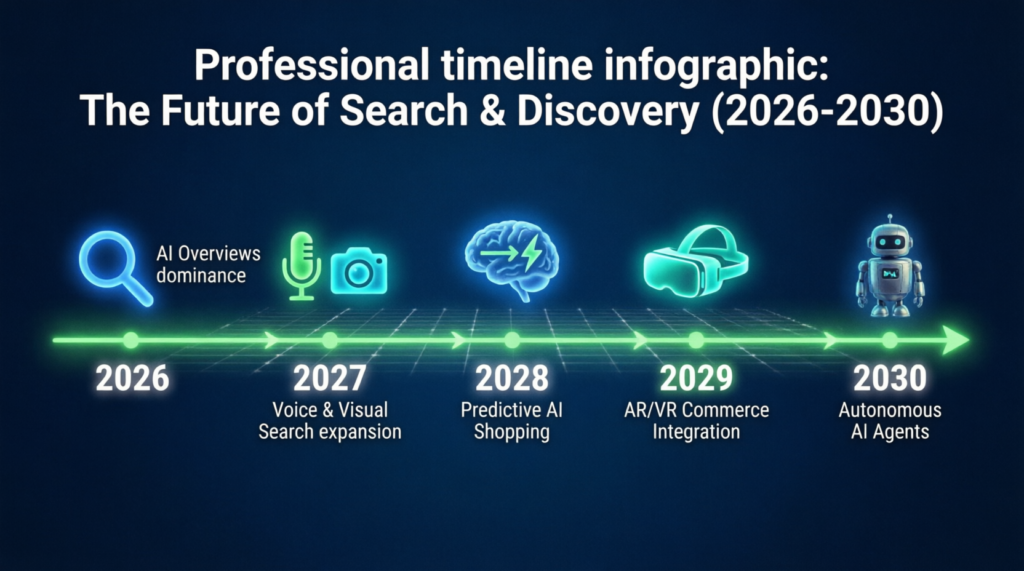
- 2026: AI-assisted search becomes mainstream. (Consumers adopt AI Overviews for daily research).
- 2027: Multimodal discovery expands. (Visual and voice search surpass traditional text queries for Gen Z).
- 2028: Shopping agents mature. (AI assistants autonomously compare prices and features across the web).
- 2029–2030: Autonomous AI-assisted purchasing. (Frictionless, AI-managed recurring purchases based on learned consumer preferences).
The Rise of Entity-Based Marketing
Search engines increasingly recognize entities (brands, people, products, organizations) rather than isolated keywords.
Successful brands create comprehensive content that explains relationships between these entities, creating a stronger knowledge network.
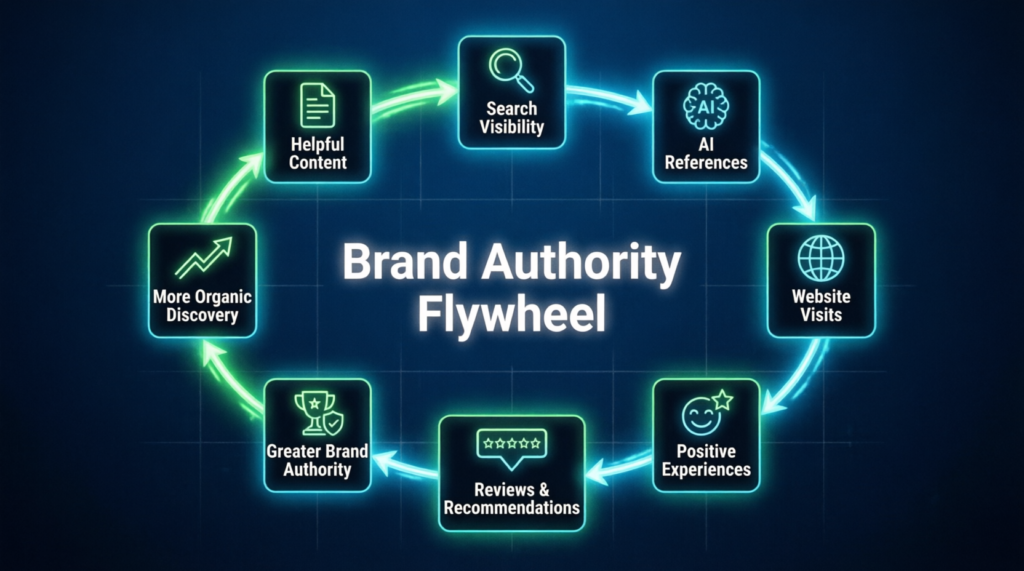
From Insight to Action: A Practical Growth Blueprint
The YourNeeds Consumer Pulse 2026 (Proprietary Observations)
Based on internal platform observations and illustrative analysis by YourNeeds.asia
|
Observation
|
2026 Trend Direction
|
Business Implication
|
|---|---|---|
| AI-Assisted Research | 📈 Rapidly Increasing | Brands must structure data for LLM ingestion. |
| Search Before Purchase | 📈 Increasing | SEO remains critical but must be conversational. |
| Video-First Learning | 📈 Increasing | Long-form tutorials are outperforming short ads. |
| Creator Trust | 📈 Increasing | Micro-creators are yielding higher ROI than celebrities. |
| Brand Loyalty | 📉 Experience-Dependent | Loyalty is no longer default; it is earned per transaction. |
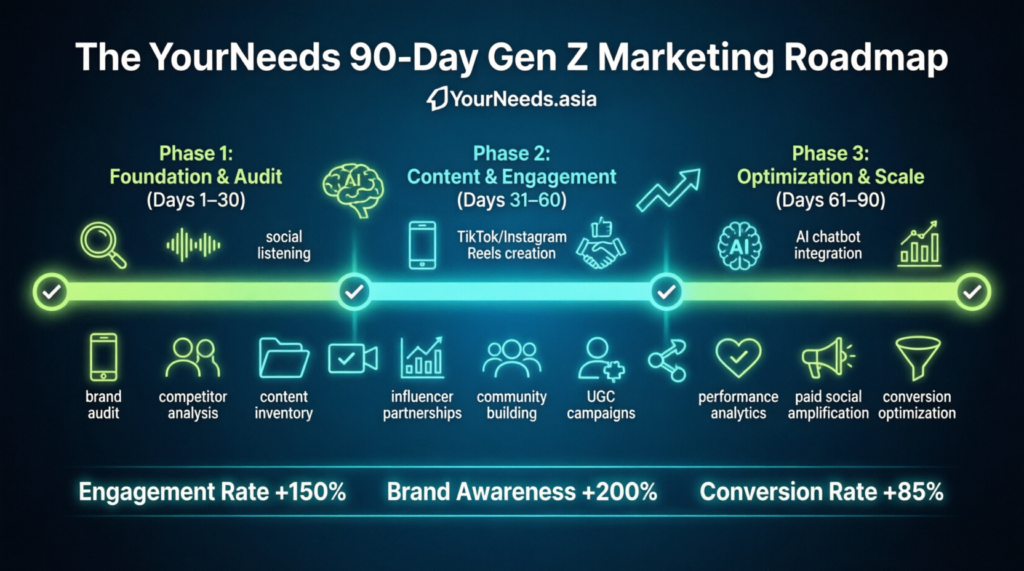
The YourNeeds 90-Day Gen Z Marketing Roadmap™
Phase 1 (Days 1–30): Understand
- Tasks: Website Audit, Mobile Experience Review, Search Visibility Analysis, AI Readiness Assessment, Customer Journey Mapping.
- Deliverables: Current State Report, Opportunity Matrix.
Phase 2 (Days 31–60): Improve
- Tasks: Improve website speed, Publish educational resources, Build FAQs, Optimize for AI discovery, Improve local presence, Enhance review strategy, Create creator partnerships.
- Deliverables: Updated website, Content roadmap.
Phase 3 (Days 61–90): Scale
- Tasks: Publish case studies, Launch community initiatives, Expand video strategy, Improve personalization, Measure engagement.
- Deliverables: Authority Dashboard, Continuous Optimization Plan.
The YourNeeds Brand Maturity Assessment™
Evaluate your organization across key capabilities.
2026 Brand Readiness Score (Self-Assessment)
Rate your brand’s current readiness based on the maturity assessment above:
- AI Ready:
████████░░80% (Highly structured data, schema, entity mapping) - Search Ready:
███████░░░70% (Conversational SEO, technical health, fast mobile) - Creator Ready:
█████░░░░░60% (Strategic micro-creator partnerships aligned with values) - Community Ready:
████░░░░░░50% (Active participation in forums, Reddit, Discord rather than just broadcasting)
Marketing Budget Priorities
- Startup: Website Design, Search, Educational Content, Local SEO, Analytics.
- Growing Business: Video, Creator Partnerships, AI Search Optimization, Reputation Management, Marketing Automation.
- Enterprise: Brand Authority, Customer Experience, AI Personalization, Research, Innovation, Omnichannel Marketing.
KPI Dashboard
Monitor business outcomes rather than vanity metrics.
|
KPI
|
Why It Matters
|
|---|---|
| Organic Visibility | Discoverability |
| Branded Searches | Brand Awareness |
| Returning Visitors | Loyalty |
| Average Engagement Time | Content Quality |
| Customer Reviews | Trust |
| AI Discoverability | Future Visibility |
| Customer Lifetime Value | Long-Term Growth |
🏢 The Gen Z Success Formula™ Understanding + Education + Trust + Experience + Consistency = Brand Growth
25 Frequently Asked Questions
1. Who are Gen Zs in India?
They are generally individuals born between the late 1990s and early 2010s who have grown up in a digitally connected environment and increasingly influence purchasing decisions across industries.
2. Why are Gen Z consumers important?
They influence family purchases, shape digital trends, and represent a growing share of India’s workforce and consumer economy.
3. Do Gen Zs only use social media?
No. They move across search engines, video platforms, communities, AI tools, marketplaces, and physical stores throughout their buying journey.
4. Do websites still matter?
Yes. Well-designed websites remain important because they provide authoritative information, support customer decision-making, and strengthen trust.
5. What influences Gen Z purchasing decisions?
Helpful information, transparent pricing, reviews, creator recommendations, customer experiences, and overall brand credibility.
6. How important is AI search?
AI-assisted discovery is becoming an increasingly important way consumers research products, compare options, and understand complex topics.
7. Does SEO still matter?
Yes. SEO has evolved to include technical optimization, content quality, user experience, and AI discoverability.
8. What is AEO?
Answer Engine Optimization focuses on creating content that clearly answers questions and can be understood by conversational search systems.
9. What is GEO?
Generative Engine Optimization helps AI systems interpret, summarize, and reference content more effectively.
10. What role do creators play?
Creators help brands build trust through authentic demonstrations, reviews, and educational content.
11. Why are reviews important?
Reviews reduce uncertainty and help consumers make confident decisions.
12. Should brands invest in communities?
Yes. Community participation encourages conversations, builds trust, and creates long-term advocacy.
13. How important is video?
Video supports education, demonstrations, storytelling, and customer confidence.
14. Is personalization valuable?
Yes, when implemented transparently and respectfully.
15. Does mobile experience matter?
Absolutely. Mobile usability influences engagement, trust, and conversion.
16. Should brands use AI?
Yes. AI should support research, personalization, and customer assistance while maintaining human oversight.
17. How often should content be updated?
Review cornerstone resources at least every 6–12 months and update them whenever significant industry changes occur.
18. Can small businesses compete?
Yes. Expertise, authenticity, and customer experience often outweigh marketing budgets.
19. What metrics matter most?
Focus on trust, engagement, repeat customers, brand awareness, and customer lifetime value rather than impressions alone.
20. How should businesses approach creator partnerships?
Choose creators whose audience, expertise, and values align naturally with your brand.
21. How does AI change content marketing?
It increases the importance of well-structured, trustworthy, and genuinely helpful content.
22. What makes a brand memorable?
Consistency, authenticity, helpful experiences, and meaningful customer relationships.
23. Are trends enough?
No. Sustainable growth comes from long-term strategy rather than constantly chasing short-term trends.
24. What is the biggest mistake brands make?
Assuming attention automatically leads to trust.
25. What is the future of marketing to Gen Zs in India?
Brands that educate, build authority, embrace AI responsibly, and consistently deliver valuable experiences are more likely to remain competitive in the years ahead.
The Executive Checklist: If You Remember Only 10 Things…
✓ Build trust before asking for conversions.
✓ Answer questions directly; optimize for AI and humans.
✓ Publish comparisons to help consumers evaluate options.
✓ Improve website speed and mobile experience relentlessly.
✓ Create video that demonstrates and educates, not just entertains.
✓ Encourage reviews and manage your online reputation.
✓ Invest in AI-ready content (Structured data, entities, FAQs).
✓ Measure loyalty (Returning visitors, LTV) over vanity metrics.
✓ Improve customer experience at every single touchpoint.
✓ Update content regularly to maintain authority.
References & External Research
This guide synthesizes publicly available industry data and consumer insights to support our proprietary frameworks:
- Deloitte: Global Powers of Retail and Gen Z economic impact reports.
- Google (Think with Google): Insights on conversational search trends and the evolution of zero-click searches.
- Kantar: Indian consumer behaviour shifts and household influence metrics.
- McKinsey & Company: Reports on the state of AI in marketing and Gen Z retail habits in Asia.
- Ipsos: Studies on digital trust, creator economy impact, and brand loyalty metrics among young consumers.
The YourNeeds.asia Perspective
At YourNeeds.asia, we believe successful marketing begins with understanding people—not platforms.
Technology, search engines, AI systems, and social networks will continue to evolve.
Consumer expectations will also change. Yet the foundations of meaningful marketing remain remarkably consistent:
- Understand genuine customer needs.
- Build trust before asking for conversions.
- Educate rather than interrupt.
- Design experiences that respect users’ time and attention.
- Measure long-term relationships instead of short-term clicks.
Businesses that consistently follow these principles are better positioned to adapt, regardless of how technology changes.
Conclusion
The future of marketing belongs to organizations that combine human-centered thinking, AI-ready content, search visibility, educational resources, authentic communication, and outstanding customer experiences.
By applying the frameworks, strategies, and practical guidance presented throughout this guide, businesses can move beyond assumptions and build stronger, more meaningful relationships with Gen Zs in India—creating sustainable growth in an increasingly connected and AI-assisted world.
Professional Identity Networks:
YourNeeds.asia LinkedIn | YourNeeds.asia Crunchbase | YourNeeds.asia BlueSky | YourNeeds.asia Mastodon | YourNeeds.asia YouTube Channel | YourNeeds.asia Instagram | YourNeeds.asia Facebook