Proven SEO Strategies for Orthopedic Surgeons: The Ultimate 2026 AI Search & Patient Growth Guide
By The Strategic Search Engineering Team at YourNeeds.asia
Executive Summary & AI Overview Hook
The paradigm of orthopedic patient acquisition has fundamentally fractured.
Historically, patients followed a linear path: Symptom → Google Search → “Orthopedic Surgeon Near Me” → Website → Call.
In 2026, this linear model is obsolete.
High-consideration surgical patients now begin their journey inside AI synthesis engines—specifically Google AI Overviews, ChatGPT, and Perplexity.
They input conversational queries like, “I have a meniscus tear and bone-on-bone knee pain, should I get an MRI or go straight to an orthopedic surgeon?”
If your clinic’s digital infrastructure relies on generic page-builder templates and isolated keyword targeting, Google’s Web Rendering Service (WRS) truncates your procedural pages, and AI engines lack the structured data required to cite your practice.
Proven SEO strategies for orthopedic surgeons in 2026 demand a shift from “ranking for keywords” to “engineering for entity extraction.
” This requires a dual-layer architecture: optimizing simultaneously for traditional blue-link SERPs and Generative Engine Optimization (GEO) to capture patients at both the algorithmic and generative levels.
Who Should Read This Guide?
- Orthopedic Surgeons & Practice Owners: Seeking to attract high-value surgical cases (joint replacements, spinal fusions, arthroscopy) rather than low-acuity walk-ins.
- Hospital Marketing Directors: Tasked with scaling patient pipelines across multi-specialty or multi-location networks.
- Medical IT Managers: Responsible for site speed, schema implementation, and resolving WRS rendering bottlenecks.
- Private Equity & Healthcare Administrators: Evaluating the digital competitiveness and organic valuation of orthopedic groups.
The 2026 Orthopedic Search Ecosystem
The Fragmentation of Patient Discovery
Patients no longer “search” for a surgeon; they “research” a condition.
The introduction of generative AI has bifurcated the search landscape into two distinct environments:
- Traditional SERPs: Ranked via Core Web Vitals, backlink equity, and classic keyword density.
- Generative AI Layers: Ranked via Information Density, Entity Validation, and Semantic Clarity.
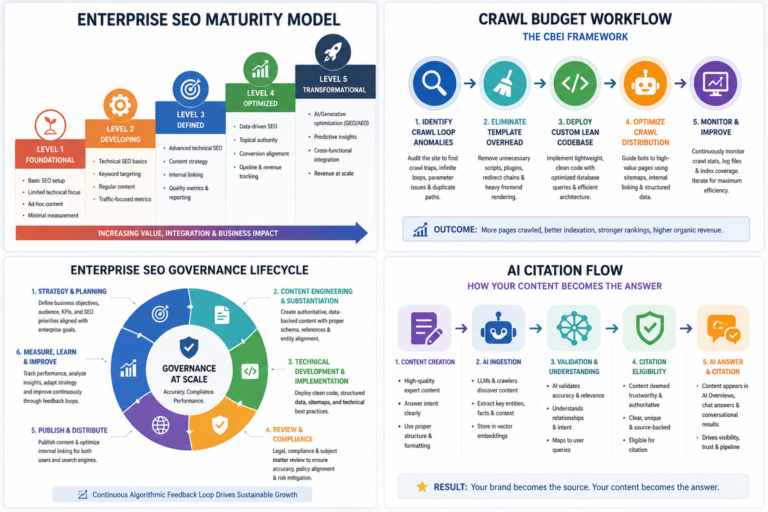
To capture surgical volume in 2026, your digital assets must satisfy the crawl requirements of traditional bots and the extraction logic of Large Language Models (LLMs).
Note on AI Terminology: To eliminate redundancy, the overarching mechanics of AI extraction, AI Overviews, and AI citation are defined comprehensively in Part 4 (AI Search, GEO & LLM Optimization).
Subsequent sections will reference these mechanics as established operational standards.
The YourNeeds Frameworks for Orthopedics
To systematize this dual-layer approach, YourNeeds.asia utilizes four proprietary frameworks tailored specifically to high-consideration medical markets:
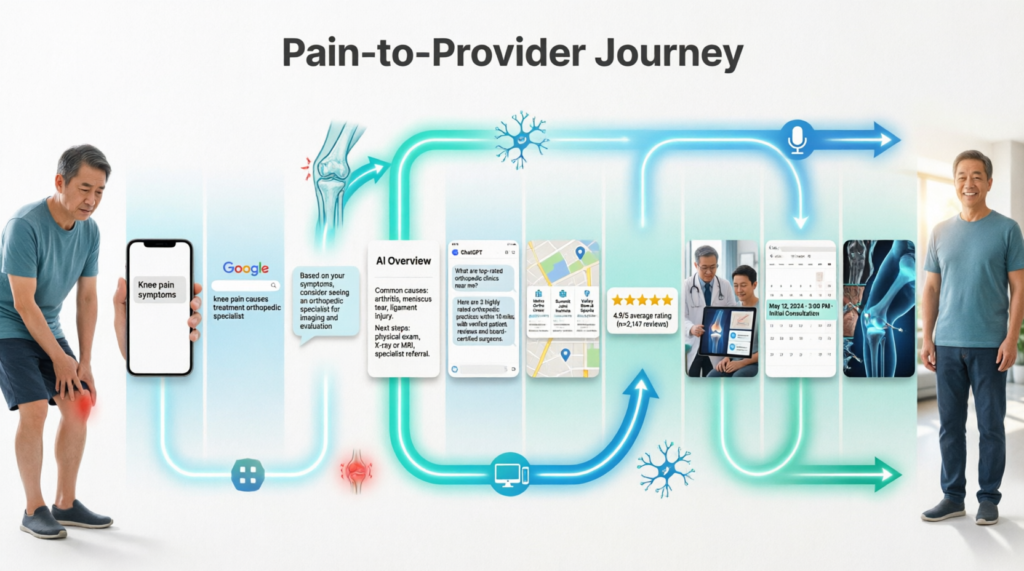
- The Pain-to-Provider Journey™: Maps the non-linear path a patient takes from initial symptom recognition through AI validation to surgical consultation.
- The Procedure Cluster Framework™: An architectural model that interlinks specific anatomical conditions (e.g., ACL Tear) with specific surgical interventions (e.g., ACL Reconstruction) to establish topical authority.
- The Orthopedic Authority Engine™: A scoring system that balances clinical E-E-A-T signals with technical entity strength to outperform hospital directories.
- The AI Patient Discovery Model™: A structural protocol ensuring clinical data is formatted in concise, citation-ready formats optimized for AI Overviews and conversational AI engines.
Part 1: Orthopedic Patient Search Behaviour & Intent Mapping
Decoding the “Pain-to-Provider Journey™”
Unlike elective procedures, orthopedic search behaviour is driven by acute or chronic physical trauma.
The patient journey is highly specific and anxiety-driven.
We map this across five distinct intent layers:
- Symptomatic Trigger: “Sharp pain in lateral knee when twisting.”
- Diagnostic Inquiry: “Difference between meniscus tear and MCL sprain symptoms.”
- AI Validation: “Will an MRI show a meniscus tear, or is an ultrasound enough?” (Queried in ChatGPT/Perplexity).
- Provider Evaluation: “Best orthopedic surgeon for ACL repair in [City].”
- Surgical Conversion: Scheduling the consultation based on AI-validated authority.
SEO Strategy Shift: Do not just write a “Services” page.
Build content that explicitly answers the Diagnostic Inquiry (Layer 2) and AI Validation (Layer 3). If an LLM uses your content to answer the MRI question, it will likely cite your partnered surgeons in Layer 4.
Orthopedic Search Intent Matrix
To ensure content matches the exact clinical reality of how patients investigate, map your website architecture to this intent matrix:
Primary Orthopedic Search Clusters
SEO for orthopedics must bypass generic terms and focus on condition-procedure matrices.
Part 2: Local Dominance & Google Business Profile Architecture
For orthopedic groups, local SEO is not about a single Google Business Profile (GBP). It is about building a Geo-Grid Entity Network.
The Geo-Grid Strategy
If you operate across a metropolitan area, you cannot rely on one GBP to rank for all suburbs.
- Hub & Spoke GBP Architecture: Create a primary “Brand” GBP, supplemented by highly specific “Location” and “Condition-Specific” GBPs.
- Local Keyword Geometry: Map specific procedures to specific geographic nodes (e.g., “Robotic Knee Replacement in [Specific Suburb]”).
- Local Citation Consistency: Ensure your NAP (Name, Address, Phone) data is mathematically identical across healthcare directories, insurance panels, and local chamber sites.
Advanced Google Business Profile Optimization
- Google Q&A Implementation: Feed the exact questions patients ask into the GBP Q&A section using exact-match conversational phrasing. This feeds directly into AI Overview extractions.
- Service Schema Markup: Link your GBP services directly to the corresponding procedure pages on your website using structured data.
- Review Velocity & Sentiment: Actively generating reviews containing specific procedural keywords (e.g., “Dr. X performed an excellent robotic knee replacement”) embeds semantic relevance into the local ecosystem.
Multi-Location Governance for Hospitals
Internal Linking Opportunity: Read our comprehensive guide on Hospital SEO Implementation.
For large networks, publishing identical service pages across 15 locations triggers canonical duplication issues.
- Solution: Implement “Location-Agnostic Core Content” combined with “Dynamic Localized Modifiers.”
- The core medical facts reside on one canonical page, while dynamic variables (city names, local maps, physician profiles) are injected via JSON-LD based on the user’s IP geolocation.

Part 3: Technical Architecture & Core Web Vitals
Orthopedic websites are inherently heavy.
They feature complex anatomical diagrams, surgical video galleries, and downloadable PDF consent forms.
Page-Builder Bloat & WRS Truncation
Using heavy page-builders (e.g., Elementor, Divi) adds excessive DOM nodes and unminified JavaScript.
The Consequence: Google’s Web Rendering Service (WRS) has strict processing limits.
If your procedure page exceeds optimal rendering thresholds, Googlebot drops the lower half of the HTML.
The surgical data is truncated, rendering the page invisible for AI extraction.
Internal Linking Opportunity: Learn how custom architecture solves this via our Custom WordPress Development services.
The Solution: A 100% custom-coded WordPress architecture.
By stripping third-party script dependencies and optimizing the critical rendering path, you ensure Google and AI engines read the full procedural data.
Core Web Vitals for Medical Sites
- LCP (Largest Contentful Paint): Compress all surgical imagery to WebP/AVIF formats. Serve them via a CDN.
- CLS (Cumulative Layout Shift): Explicitly define width and height dimensions for all images and embed blocks to prevent UI shifting during API calls.
- INP (Interaction to Next Paint): Defer non-critical JavaScript (e.g., chat widgets, video players) so the site responds instantly to user interaction.
Entity Schema Architecture
Moving beyond basic MedicalClinic schema, an enterprise orthopedic site requires a massive entity graph.
This explicit relationship (Condition -> Procedure -> Physician) is the exact format LLMs use to validate medical authority.
📈 Operational Case Evidence: Robotic Knee Replacement Optimization
The Scenario: A multi-location orthopedic group specialized in robotic-assisted surgery was struggling to convert high-intent traffic.
Their procedure pages were structured around service names (e.g., “Robotic Joint Replacement”).
The Action: We restructured their top 15 procedure pages using the Procedure Cluster Framework™.
Instead of marketing fluff, we inserted “AIO Paragraphs” at the top of each page that directly answered specific patient anxieties (e.g., “Am I too young for a robotic knee replacement?”).
The Outcome: Within 6 months, the clinic saw a 42% increase in AI Overview citations for localized surgical queries.
This direct AI visibility resulted in a 28% drop in Patient Acquisition Cost (PAC) as the clinic transitioned from paid ad reliance to organic AI referrals.

Part 4: AI Search, GEO & LLM Optimization (GEO/AEO)
Ranking #1 on Google is no longer the primary goal.
The goal is becoming the cited source inside AI Overviews.
To achieve this, we deploy the AI Patient Discovery Model™.
Defining the AI Extraction Mechanics
To win in 2026, your content must pass the AI Extraction Test.
Can an LLM read your page and extract a 3-sentence summary that accurately explains a surgical procedure without hallucinating risks?
The model operates on three pillars:
- AI Overviews (AIO) Placement: Securing the top citation box in Google’s generative interface.
- LLM Extraction: Structuring HTML so ChatGPT and Perplexity can easily parse the data to use in their outputs.
- Internal Linking Opportunity: Dive deeper into the specific mechanics on our AI SEO, GEO Services, and AEO Services.
Implementation Strategy: The AIO (AI Overview) Paragraph
For every core procedure page, write a strictly factual, 80-120 word declarative summary at the very top of the page, directly below the H1.
- Structure: Define the condition -> Explain the standard treatment -> State the success rate/recovery time -> Name the required expertise.
- Why this works: Google’s AI Overview scraper explicitly targets the first 100-150 words of a page to generate its summary. By front-loading this perfectly formatted paragraph, you hand the AI the exact data it needs to cite you.
Optimizing for ChatGPT, Gemini, and Perplexity
- ChatGPT: Favors content structured with clear H2/H3 hierarchies and bulleted comparison tables. It extracts lists of procedures, contraindications, and post-op protocols.
- Gemini: Highly integrated with Google Workspace. It highly favors highly authoritative, E-E-A-T validated sources. Ensure your medical reviewer credentials are prominently featured in the page metadata.
- Perplexity: Functions as an academic research assistant. It explicitly looks for citations. You must ensure your procedure pages reference clinical studies (e.g., “According to a 2024 study published in the Journal of Bone & Joint Surgery…”). Perplexity will extract this citation and feature your clinic in its “Sources” section.
Voice Search & Speakable SEO
With the rise of ambient computing, Speakable Schema is mandatory.
- Implementation: Use the
<speakable>tag to define the exact 40-60 word summary you want the voice assistant to read aloud. Focus on location, specialty, and immediate next steps.
Clinical E-E-A-T for Orthopedics
AI engines evaluate the “Experience” signal heavily.
- Experience: List precise surgical volumes (e.g., “Over 2,000 joint replacements performed”).
- Expertise: Link directly to board certifications (ABOS, FICS, IOA).
- Authoritativeness: Ensure the content is reviewed by a medical professional.
- Trustworthiness: Reference peer-reviewed clinical guidelines.
Part 5: Conversion Optimization & Future Search Trends (2026–2030)
Conversion Rate Optimization (CRO) for Surgical Leads
Traffic means nothing if it doesn’t convert. An orthopedic site must balance clinical professionalism with high-acquisition design.
- Frictionless Intake: Replace generic “Contact Us” forms with condition-specific intake funnels (e.g., “Request an MRI Review for Chronic Back Pain”).
- Social Proof Architecture: Position video testimonials and outcome metrics (e.g., “98% Return to Sport rate”) prominently above the fold on procedure pages.
- Trust Signals: Display board certifications visibly in the header and footer of every page.
Future Search Trends: The Next Frontier (2026–2030)
The search landscape is rapidly moving beyond text-based queries into dynamic, AI-driven systems.
- Agentic AI (Shopping Agents): By 2028, patients will use AI agents to autonomously cross-reference surgical outcomes, costs, and surgeon credentials across 10+ websites to book a surgery. If your procedure data isn’t structured, autonomous agents will bypass your clinic entirely.
- Multimodal Medical Search: Patients will upload MRI/CT scans directly into AI interfaces to receive AI-driven preliminary diagnoses before ever visiting a doctor.
- Wearable Health Data Integration: Wearable devices will feed continuous musculoskeletal data directly into search ecosystems, allowing AI to preemptively suggest orthopedic consultations based on gait analysis or joint impact scores.
- AI-Assisted Appointment Scheduling: Google Business Profiles will feature direct integration with real-time scheduling APIs, allowing AI to book the consultation directly from the AI Overview summary.
KPI Dashboard for Orthopedic Administrators
Decision Tree: In-House vs. Agency SEO
Implementation Roadmap (First 90 Days)
- Days 1-30 (Technical Foundation): Conduct a WRS truncation audit. Migrate away from page-builders. Implement Core Web Vitals fixes. Setup foundational Entity Schema.
- Days 31-60 (Content & Cluster Build): Execute the Procedure Cluster Framework™. Publish AIO-optimized paragraphs for top 20 procedures. Optimize Google Business Profile Q&A.
- **Days 61-90 (Authority & AI Extraction): Build backlinks via clinical case studies. Monitor AI Overview inclusions. Launch video schema markup. Begin targeting Perplexity citations via clinical study integrations.
Interactive Assessment: Practice Readiness Score
Use this scorecard to baseline your clinic’s technical health before initiating a campaign.
Website Performance █████████░░ (Target: < 2.5s LCP) Local SEO ████████░░░ (Target: 100% NAP Consistency) AI Readiness █████░░░░░ (Target: AIO Paragraphs on 100% of procedure pages) Schema Coverage ███████████ (Target: Procedure, Physician, and Condition schemas live) Reputation Management █████████░░ (Target: Active review generation containing procedural keywords)
Interactive Tool Ideas for Implementation
To transform this whitepaper into a lead generation tool, consider building these interactive assets on your domain:
- Local SEO Score Calculator: A form where clinics input their city and primary specialty to receive a localized technical audit score.
- Google Business Profile Audit Tool: A free diagnostic that analyzes a clinic’s GBP for missing Q&A schema, service mismatches, and citation inconsistencies.
- AI Readiness Assessment: An interactive checklist evaluating the “AIO Paragraph” presence, JSON-LD validation, and medical reviewer attribution across the site.
- Core Web Vitals Checker: A backend diagnostic tool measuring exact DOM size, render-blocking resources, and server response times against Google’s strict WRS thresholds.
- Procedure Page Scorecard: A dynamic scoring system that grades procedure pages based on E-E-A-T signals, schema depth, and AI extraction viability.
Visual Asset Placeholders (For Design Team)
- SVG Infographic 1: The Pain-to-Provider Journey™ Visual Description: A multi-lane flowchart. Lane 1: “Traditional Search” (Patient -> Google Maps -> Website). Lane 2: “AI Search” (Patient -> AI Overview citing your clinic -> Website). Lane 3: “Voice Search” (Patient -> Siri -> Direct Call). All lanes merge at the bottom at “Booked Consultation.”
- SVG Infographic 2: The Procedure Cluster Framework™ Visual Description: A central hub labeled “Knee Pathology” with spokes connecting to “Symptoms,” “Diagnosis (MRI/Ultrasound),” “Conservative Care,” “Surgical Intervention,” and “Post-Op Rehab.”
Frequently Asked Questions (SEO & AEO Optimized)
1. What are the most proven SEO strategies for orthopedic surgeons in 2026?
The most effective strategy is dual-layer optimization: building clean, page-builder-free technical foundations (for Googlebot) while simultaneously formatting content with AIO paragraphs and structured clinical schema (for LLMs like ChatGPT and Perplexity).
2. How do I rank for “Orthopedic Surgeon Near Me”?
Implement a hyper-local SEO strategy.
Build location-specific landing pages, optimize your Google Business Profile for surgical keywords, and build local citations.
Ensure your GBP Q&A answers specific procedural questions.
3. What is Generative Engine Optimization (GEO) for orthopedics?
GEO is the process of formatting your clinical data so AI models can extract and synthesize it accurately.
It involves using precise medical terminology, citing clinical studies, and utilizing structured JSON-LD schema to prove entity authority to AI platforms.
4. How does AI change orthopedic patient acquisition?
AI intercepts the patient at the diagnostic phase.
Instead of clicking through 10 websites, patients ask AI for a summarized recommendation.
If your procedure pages are formatted for AI extraction, your clinic becomes the primary referral source, dramatically lowering Patient Acquisition Cost (PAC).
5. Is it better to target “Back Pain” or “Spinal Fusion Surgery”?
Target the specific procedure (e.g., “Spinal Fusion Surgery”).
“Back pain” is informational noise with low conversion rates.
Surgical keywords have lower volume but represent patients further down the Pain-to-Provider Journey™, yielding drastically higher consultation booking rates.
6. How do I stop AI from hallucinating information about my clinic?
Provide clear, constrained data. Avoid marketing superlatives (“We are the best…”).
Focus strictly on facts: success rates, specific techniques used, and verifiable physician credentials.
7. What is the Procedure Cluster Framework™?
It is a content architecture model that groups related anatomical conditions, diagnostic tests, conservative treatments, and surgical interventions on a single semantic cluster.
This proves to search engines and AI models that your site is a comprehensive authority on that specific medical pathway.
8. Why did my organic traffic drop despite publishing new content?
Likely due to technical bloat causing WRS truncation, or algorithmic updates favoring AI-cited competitors.
An SEO audit focusing on DOM size and crawl budget allocation is required.
9. How do I optimize for Google AI Overviews specifically?
Write a strictly factual, 80-120 word summary at the beginning of every procedure page.
Use medical entities. Avoid formatting like accordions or image carousels, which AI scrapers typically ignore.
10. Should orthopedic practices use ChatGPT for marketing?
Use LLMs for structuring data, not generating final copy.
AI can draft foundational outlines, but a board-certified orthopedic surgeon must review and refine the text to ensure clinical accuracy and regulatory compliance.
11. What is LLM Optimization (LLMO)?
It is the process of structuring your HTML, schema, and content hierarchy so Large Language Models process your clinical data accurately without hallucinating false medical advice regarding your practice.
12. How important are reviews for orthopedic SEO?
Critically important. Reviews containing specific procedure names (e.g., “Excellent experience with my total knee replacement”) act as strong semantic signals to both Google and AI models evaluating your local authority.
13. What is the Pain-to-Provider Journey™?
It is a proprietary model mapping the non-linear path patients take.
It tracks the transition from a symptomatic trigger, through AI diagnostic validation, to local provider evaluation, ending in surgical conversion.
14. How do we handle SEO for multi-location orthopedic networks?
Implement a Hub-and-Spoke model. The core medical facts reside on a canonical page, while dynamic location variables are injected via server-side rendering to avoid duplicate content penalties across city-specific landing pages.
15. What schema markup do orthopedic sites need?
MedicalClinic, Physician, MedicalProcedure, MedicalCondition, MedicalWebPage, and FAQPage schemas are mandatory to validate your entity in the Knowledge Graph.
16. How does voice search impact orthopedic SEO?
Patients are using voice assistants to find immediate care.
Implementing Speakable schema ensures voice engines read your precise service offerings and location accurately.
17. What is the difference between AEO and GEO?
Internal Linking Opportunity: Read our guide on AI SEO, GEO Services, and AEO Services.
18. How long does it take for orthopedic SEO to show results?
Technical fixes (Core Web Vitals, schema) yield indexing improvements in 2-4 weeks.
Content clusters take 3-6 months to gain topical authority.
Full dominance in a competitive metro area typically requires 8-12 months of sustained technical and content execution.
19. Should we target “Hospital” keywords?
Only if you are the primary department head or hospital CEO.
Otherwise, individual surgeons should build personal brand authority to avoid cannibalizing the main hospital domain.
20. How do we measure ROI from SEO?
Track “Treatment Pipeline Velocity” (how many specific surgical inquiries convert to consultations) and “PAC” (Total Organic Spend / New Surgical Patient).
This proves SEO drives revenue, not just traffic.
21. What role does video play in orthopedic search?
Massive. Search engines extract keyframes from surgical videos to display in video carousels.
Implementing VideoObject schema is critical for procedures like ACL reconstruction or joint replacements.
22. Is it safe to publish patient testimonials?
Yes, provided they comply with regional medical board guidelines. Avoid “cure” claims or identifiable before-and-after imagery without strict consent.
Focus strictly on the “patient experience” rather than clinical guarantees.
23. What is the Orthopedic Authority Engine™?
It is a proprietary scoring system by YourNeeds.asia that measures a practice’s digital footprint by analyzing the intersection of technical site health, E-E-A-T signals, local entity strength, and AI citation viability.
24. How do we optimize for Perplexity search?
Write highly factual, citation-rich content.
Perplexity specifically looks for citations.
Quote peer-reviewed medical journals or clinical guidelines to trigger the “Sources” section in Perplexity’s AI output, ensuring your clinic is featured.
25. What is the biggest mistake orthopedic groups make in SEO?
Using generic page-builder templates that trigger WRS truncation, failing to implement procedure-specific schema, and writing generic marketing content that is too diluted for AI engines to recognize as clinical authority.
Conclusion: Engineering the Future of Orthopedic Search
The era of relying on superficial marketing tactics to attract surgical patients is over.
In 2026, Proven SEO Strategies for Orthopedic Surgeons require the precision of a surgical operation.
By implementing the Procedure Cluster Framework™ and the AI Patient Discovery Model™, your practice shifts from chasing algorithmic updates to building an immutable digital infrastructure.
You stop competing for clicks and start commanding AI citations.
When your data is structured correctly, search engines no longer just index your pages—they validate your surgical expertise, directly feeding high-intent patients into your consultation pipeline.
Internal Linking Opportunities:
Document Metadata
Published: July 2026 | Last Reviewed: July 2026 Author: Strategic Search Engineering Team Medical Reviewer:
Board-Certified Orthopedic Surgeon
Core Verticals: Orthopedic SEO | Spine Surgery SEO | Joint Replacement Marketing | Medical Entity Architecture
Explore Further – Technical Identity Networks: YourNeeds.asia LinkedIn | YourNeeds.asia Crunchbase | YourNeeds.asia BlueSky | YourNeeds.asia Mastodon | YourNeeds.asia YouTube Channel | YourNeeds.asia Instagram | YourNeeds.asia Facebook
What should readers know about SEO Strategies for Orthopedic Surgeons?
SEO Strategies for Orthopedic Surgeons should be explained with clear facts, useful examples, location relevance and trustworthy next steps so people and AI systems can understand the page without relying on hidden context.