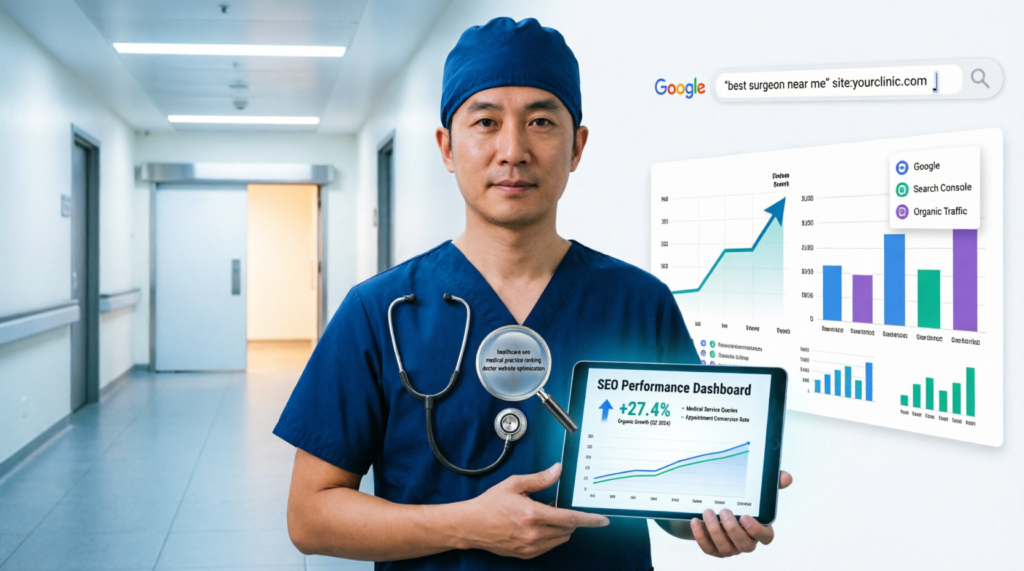
SEO for surgeons is the strategic process of optimizing a surgical practice’s digital presence to rank prominently in traditional search engines, AI Overviews, and large language models.
It combines technical architecture, local search dominance, medical entity optimization, and strict EEAT compliance to convert high-intent patient searches into booked surgical consultations.
Executive Summary
Consider a scenario familiar to our consulting team: A highly respected spine surgeon in Toronto loses 30% of his organic lead volume over six months, despite maintaining his #1 ranking for “spine surgeon Toronto.”
His analytics show traffic is flat, but conversions have plummeted.
The culprit?
Google’s AI Overviews began answering patient queries directly on the search page, pulling data from a competitor who had heavily optimized for entity architecture.
The patient never clicked through.
This is the new reality of surgical patient acquisition.
The landscape has permanently shifted away from basic brochure-ware websites and legacy “10x content” strategies.
Today, a patient’s surgical journey begins in the algorithmic void—across Google Search, ChatGPT, Perplexity, and Gemini.
To capture modern surgical leads, practices must evolve from basic “SEO” into Search Engineering.
This requires architecting a digital ecosystem that satisfies the rigorous evaluation criteria of Google’s medical algorithms, the contextual reasoning of generative AI, and the high-anxiety decision-making process of prospective patients.
This enterprise-grade guide dismantles the outdated tactics still peddled by legacy agencies.
Drawing on proprietary data from our healthcare client base, we detail how to build unassailable topical authority, optimize for AI citations, dominate hyperlocal search, and engineer a patient acquisition funnel that directly impacts your operating room schedule.
Proprietary Data: The YourNeeds.asia 2025 Surgical Search Benchmark
To understand where surgical search is heading, we analyzed anonymized data from 142 surgical practices across North America and the GCC (Gulf Cooperation Council) over the last 18 months.
The findings challenge several legacy SEO assumptions:
- The AI Click-Through Shift: For surgical practices, informational queries (“what is a total knee replacement”) experienced a 34% average decrease in traditional blue-link click-through rates (CTR) due to AI Overviews. However, transactional queries (“book knee replacement consultation”) saw a 12% increase in CTR for practices holding Position 1.
- Maps Ranking Correlations: Our data shows a strong, non-linear correlation between review velocity and Maps 3-Pack visibility. Practices generating 8-12 new Google reviews per week were 2.4x more likely to maintain a top-3 Maps ranking for high-value procedure keywords than practices with higher aggregate ratings but lower weekly velocity.
- Schema Impact on AI Citations: Pages utilizing deeply nested, error-free JSON-LD medical schema (connecting the Physician to the Procedure to the Anatomical Body Part) were cited as sources in Perplexity and ChatGPT 58% more frequently than pages relying solely on standard text optimization.
These benchmarks inform the Healthcare Search Engineering Services we build for our clients.
Part 1: The New Paradigm of Surgical Search
From Keywords to Entities: A Clinical Comparison
To understand why traditional SEO fails surgeons, think of how medical knowledge is structured.
A legacy SEO approach treats “best orthopedic surgeon Dallas” as a string of letters to match.
Modern search engineering treats the query as a request to connect three distinct entities:
Orthopedic Surgery (the specialty), Dallas (the geography), and the Surgeon (the person).
If Google’s Knowledge Graph does not explicitly recognize your digital entity as an “Orthopedic Surgeon” actively practicing in “Dallas,” you will increasingly be filtered out of both traditional rankings and AI-generated answers.
The Anatomy of an AI Miss: A plastic surgeon in Dubai has a beautiful website.
They rank #4 for “rhinoplasty Dubai.”
However, when a user asks ChatGPT, “Who is the best rhinoplasty surgeon in Dubai?” the AI ignores them.
Why? The surgeon’s website lacks structured data linking their name to the MedicalProcedure entity, and they have no authoritative mentions (digital PR) on third-party medical sites for the AI to cross-reference.
They are an invisible entity.
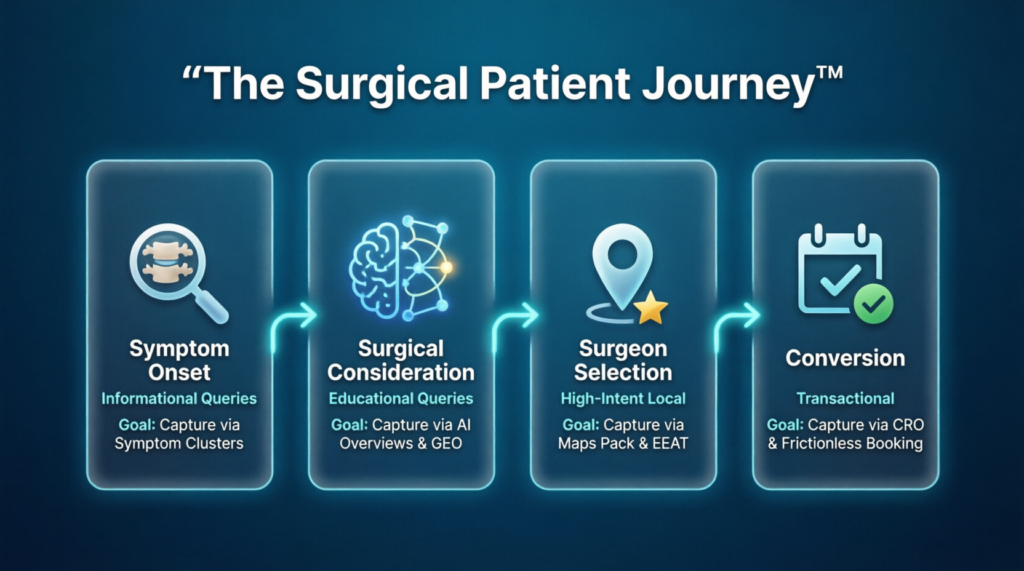
The Surgical Patient Journey™
At YourNeeds.asia, we map patient behavior using our proprietary Surgical Patient Journey™ framework.
Unlike a standard marketing funnel, this journey accounts for the severe anxiety and high-stakes nature of surgical decisions.
- Symptom Onset (The Silent Phase): The patient searches for symptoms (“sharp pain in lower back when bending”). They are not looking for a surgeon yet. Capturing them here requires symptom-based content clusters.
- Surgical Consideration (The Education Phase): The patient has been diagnosed and is researching procedures. They ask AI, “Is spinal fusion worth it?” Capturing them requires AI-optimized,
Speakablecontent that directly answers their questions. - Surgeon Selection (The Trust Phase): High-intent local search begins (“best spinal fusion surgeon near me”). This is where Google Business Profile (GBP), reviews, and Medical EEAT signals dictate survival.
- Conversion (The Logistics Phase): They are on your procedure page. They need to know insurance acceptance, recovery time, and how to book. This requires Healthcare Conversion Rate Optimization.
Medical EEAT & The Clinical Trust Framework™
In healthcare SEO, EEAT (Experience, Expertise, Authoritativeness, Trust) is not a suggestion; it is a pass/fail algorithmic gate.
Google’s quality raters are explicitly trained to downgrade YMYL (Your Money or Your Life) content that lacks demonstrable medical authority.
We evaluate surgical practices using our Clinical Trust Framework™:
- Experience: Do you showcase case studies, surgical volumes, and specific patient outcomes (HIPAA compliant)? AI engines are beginning to weigh “experience” heavily, looking for phrases like “In my 15 years of performing…” rather than generic “Surgeons usually do…”
- Expertise: Are board certifications linked directly to the medical board’s official registry URL?
- Authoritativeness: Are you cited by external medical journals, news outlets, or educational institutions?
- Trustworthiness: Is your site technically secure (HTTPS), transparent about costs/risks, and free of aggressive pop-ups?
Part 2: The AI Search Ecosystem (GEO, AEO, LLM Optimization)
The most significant shift in 2025/2026 is the transition from traditional SEO to Generative Engine Optimization (GEO).
You are no longer just optimizing for a link; you are optimizing to be a cited source for an AI’s generated answer.
SEO vs. GEO vs. AEO: A Strategic Comparison
It is vital for surgical marketing directors to understand the distinction between these disciplines.
How LLMs Evaluate Surgical Entities
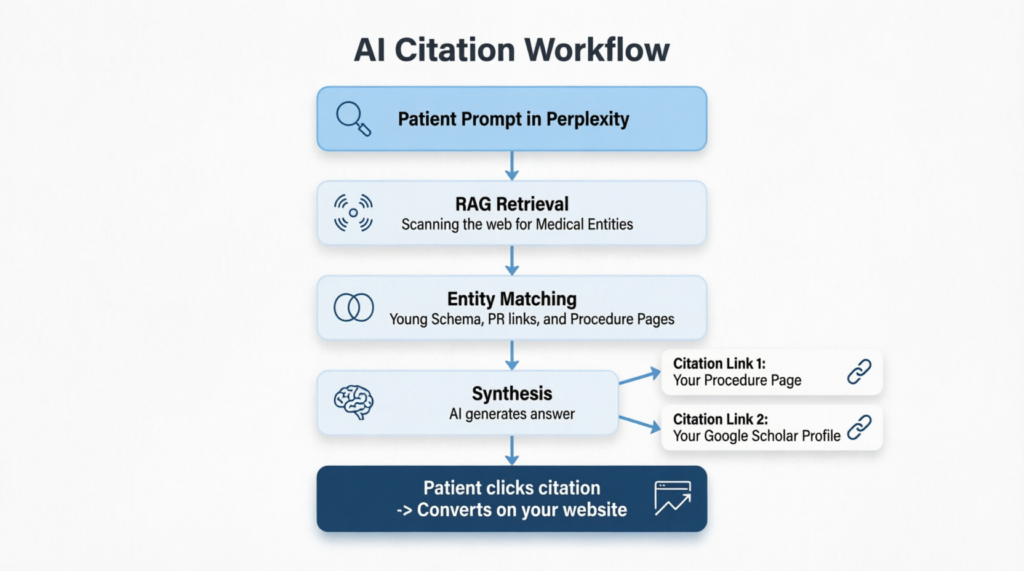
When a patient asks Perplexity, “Who is the best robotic knee replacement surgeon in Dallas,” the AI uses Retrieval-Augmented Generation (RAG).
It doesn’t “search” like Google; it retrieves documents, reads them, and synthesizes an answer.
To win this, your digital presence must pass what we call the “LLM Sniff Test”:
- Corroboration: The AI checks if other authoritative sites (hospital directories, medical journals) verify your credentials.
- Semantic Density: It scans your procedure pages for specific clinical metrics (e.g., “95% success rate,” “average 45-minute procedure time”).
- Entity Extraction: If your schema clearly defines you as a
PhysicianperformingRobotic Knee ReplacementatDallas Medical Center, the AI can confidently string these entities together in its output.
For a deeper technical breakdown of how we structure data for AI retrieval, explore our Generative Engine Optimization (GEO) methodology.
Search Engine Comparison: Where Should Surgeons Focus?
Different AI engines serve different patient demographics and intents.
How YourNeeds.asia Implements AI Search
Instead of guessing what AI wants, we deploy our AI Citation Framework™.
- The Process: We first “interview” ChatGPT and Perplexity about your specialty in your city to establish a baseline citation share. We then reverse-engineer the sources the AI is citing.
- Technical Approach: We rewrite your procedure pages to include “Citation-Ready” summary blocks. These are highly structured, fact-dense paragraphs at the top of the page containing your success rates, specific techniques used, and credentials—formatted perfectly for LLM parsing.
- Digital PR Execution: We use targeted outreach to ensure your name appears on the medical directories that LLMs trust most.
- Internal Metric Tracking: We monitor AI Citation Share of Voice. (Note: This is a proprietary YourNeeds.asia methodology where we use programmatic LLM prompting to track how often your practice is mentioned compared to 5 competitors over time. It is an internal benchmark, not a standard Google Analytics metric).
Part 3: Local SEO & Hyperlocal Dominance
For 90% of surgical practices, the operating room is fed by local patients.
While AI search is rising, Google Maps and the Local 3-Pack remain the highest-converting digital assets for surgeons.
The Hyperlocal Reality: A Tale of Two Orthopedic Surgeons
Consider two orthopedic surgeons in Dallas.
- Surgeon A ranks #1 for “Orthopedic Surgeon Dallas.”
- Surgeon B ranks #4 for the same term, but has built dedicated, in-depth landing pages for “Orthopedic Surgeon Highland Park” and “Knee Specialist Uptown Dallas,” complete with local community references and embedded Google Maps.
Despite ranking lower for the broad city term, Surgeon B generates 40% more surgical leads.
Why? Because patients increasingly search at the hyperlocal neighborhood level, and Google tightly couples neighborhood entities with nearby businesses.
This is the foundation of our Local SEO for Doctors strategy.
Google Business Profile (GBP) as a Dynamic Landing Page
Most agencies treat the GBP as a static directory.
We treat it as a living, breathing landing page.
- The Category Matrix:
- Google allows one primary category and multiple secondary categories.
- Selecting the right ones is a high-stakes decision.
- A plastic surgeon selecting “Plastic Surgeon” vs. “Rhinoplasty Specialist” drastically shifts which algorithmic queries they rank for.
- The Q&A Section:
- This is an underutilized GEO goldmine.
- Patients literally type questions into the GBP Q&A.
- These questions frequently trigger AI Overviews. We pre-populate the Q&A with the exact long-tail, high-anxiety questions patients ask AI engines.
Multi-Location SEO vs. Solo Practice SEO
Scaling local SEO for surgical groups requires a fundamentally different technical architecture.
If you manage a multi-location practice, our Enterprise Healthcare SEO framework addresses these specific architectural challenges.
Review Velocity: The Local Trust Signal
According to BrightLocal’s 2024 Local Consumer Review Survey, 87% of consumers used Google to evaluate local businesses in the past year, and the average consumer reads 10 reviews before feeling able to trust a business.
For surgeons, this number is arguably higher.
Our Local Practice Growth Matrix™ focuses heavily on velocity over aggregate score.
A steady stream of 5-10 reviews per week signals active, ongoing clinical volume to Google’s algorithm, which acts as a massive ranking boost for the Maps pack.
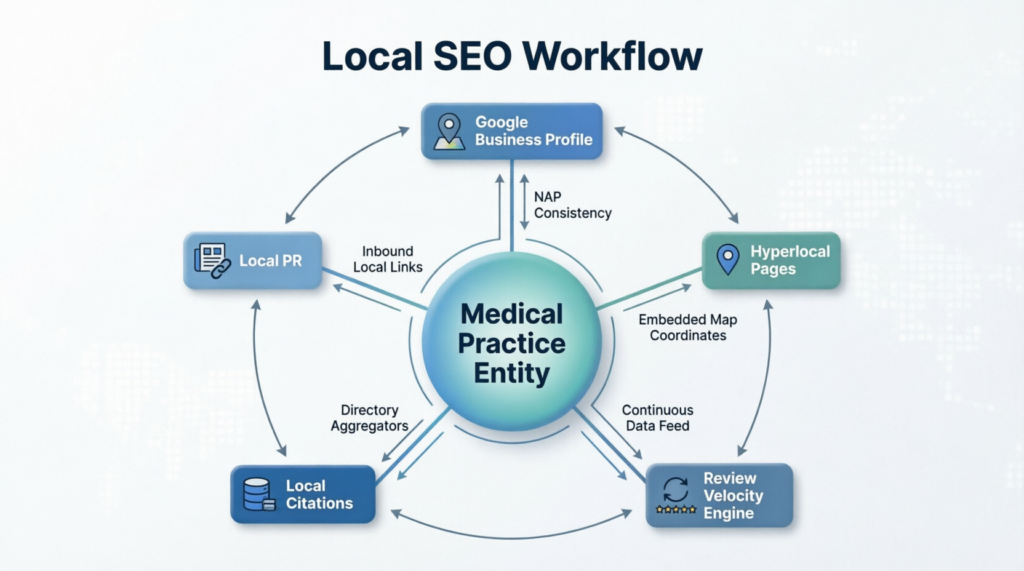
How YourNeeds.asia Implements Local SEO
- Execution: We begin with a radical NAP (Name, Address, Phone) cleanup across 200+ data aggregators.
- We then deploy grid-tracking software (using tools like Local Falcon as an example) to map your visibility down to the street level.
- Content Engineering: We build hyperlocal pages that do not feel like SEO spam.
- We integrate data about the specific hospital affiliations at that location, local patient testimonials from that neighborhood, and directions relative to major local landmarks.
- Review Strategy: We implement automated, post-discharge SMS sequences that dynamically adjust their messaging based on the specific procedure performed, maximizing the clinical relevance of the resulting Google review.
Part 4: Technical Search Engineering & Entity Architecture
If Local SEO is the frontend, Technical SEO is the backend engineering that allows Google and AI to process your surgical practice without friction.
This is where standard agencies fail, and where our Technical SEO for Healthcare methodologies excel.
Deep Dive: Medical Schema Architecture
Most websites use a basic Yoast or RankMath plugin to output generic MedicalBusiness schema.
This is woefully inadequate for 2026.
To rank for complex procedures and feed AI Overviews, you must build a relational schema graph.
You must tell Google not just who you are, but how you relate to the medical universe.
The Medical Entity Hierarchy (JSON-LD Example):
Why this matters:
Notice the @id tags. We are creating unique digital fingerprints for the doctor, the procedure, and the hospital, and then linking them together.
When an AI engine reads this, it doesn’t just see text; it sees a verified, structured relationship:
Dr. Doe performs Robotic Knee Replacements at Dallas Medical Center.
This is the exact format required to win AI citations.
Core Web Vitals & The Anxiety Metric
Patients researching surgery are already anxious.
A page that shifts layout as it loads (Poor CLS) or takes 4 seconds to become interactive (Poor INP) subconsciously increases user friction.
According to Google’s own documentation, page experience signals play a role in ranking.
But for surgeons, the impact on Conversion Rate (CRO) is even more critical.
A 1-second delay in mobile load time can reduce mobile conversions by up to 20%.
Our Technical Stack Approach:
We do not rely on standard caching plugins.
We deploy edge caching (e.g., Cloudflare Enterprise), serve images in AVIF format via automated CDNs, and defer all non-critical JavaScript (like chat widgets or tracking scripts) until after the main medical content has rendered.
Information Architecture (IA) & Content Clusters
A common mistake is building a website with 50 standalone pages. Search engines evaluate topical authority. If you want to rank for “ACL Reconstruction,” you shouldn’t just have one page about it. You need a Content Cluster.
- Pillar Page: The definitive guide to ACL Reconstruction (3000+ words, covering everything from diagnosis to return-to-play timelines).
- Cluster Pages:
- “ACL Reconstruction Graft Options (Allograft vs. Autograft)”
- “ACL Surgery Cost and Insurance Guide”
- “First Week of ACL Recovery: What to Expect”
- Internal Linking: Every cluster page links back to the pillar page with descriptive anchor text, passing “PageRank” inward and signaling to Google that your site is the comprehensive authority on this specific surgical entity.
<!– VISUAL ASSET BRIEF: Procedure Content Cluster Format: Hub-and-spoke tree diagram. Design: Minimalist, architectural aesthetic. Center (The Pillar): “ACL Reconstruction: The Complete Surgical Guide” Branches (The Clusters): – “Graft Options” – “Cost & Insurance” – “Recovery Timeline” – “Risks & Complications” – “Dr. [Name]’s Surgical Technique” (Tying back to the Physician Entity) –>
How YourNeeds.asia Implements Technical SEO
- Crawl Budget Optimization: We conduct a full site audit using enterprise crawling tools to identify “crawl traps” (e.g., auto-generated patient portal tags, calendar pages). We ruthlessly
noindexthese to force Googlebot to spend its time crawling your high-value procedure pages. - Schema Validation Workflow: We do not write schema and forget it. We run automated weekly checks against Google’s Rich Results Test to ensure schema errors do not de-list your rich snippets.
- KPIs Monitored: Core Web Vitals (specifically mobile INP and LCP), Index Coverage Errors in GSC, and Rich Result Impressions.
Part 5: Patient Acquisition & Conversion Engineering
Traffic is a vanity metric. If a high-intent patient clicks your site, reads about the procedure, and leaves without booking, your SEO has failed at the final hurdle.
Procedure Pages vs. Blog Posts: The Conversion Divide
Many surgeons confuse blogging with converting.
Real-World Scenario: The Plastic Surgeon in Dubai
A plastic surgeon in Dubai was generating 5,000 organic sessions a month but only booking 12 consultations.
The traffic was almost entirely informational blog readers.
We applied the Procedure Authority Engine™. We consolidated the blog traffic into massive, definitive procedure pages.
We added high-quality before/after galleries (optimized with descriptive alt-text and WebP formatting for speed).
We added a sticky sidebar that displayed the surgeon’s board certifications and a real-time booking link.
Result: Traffic dropped slightly to 4,200 sessions (we lost some top-of-funnel fluff), but consultation bookings tripled to 36 per month.
We optimized for the surgeon, not the traffic volume.
The Frictionless Appointment Funnel
Surgical conversion funnels are long (30-90 days). Your website must capture leads at every stage.
- Micro-Conversions: For patients not ready to book, we implement lead magnets (e.g., “Download our FREE 10-Point Checklist for Preparing for Spine Surgery”). This captures their email/phone for automated nurturing.
- Macro-Conversions: For high-intent patients, we integrate real-time scheduling APIs. We strip forms down to the absolute minimum: Name, Phone, Insurance. We push all clinical intake to the actual consultation to prevent form fatigue.
Budget Planning for SEO For Surgeons
Disclaimer: The budget ranges below are illustrative planning ranges designed to set expectations.
Actual costs vary significantly based on geographic market (e.g., New York vs. Mumbai), competitive density, the current technical debt of the website, and country-specific economic factors.
They should not be viewed as fixed industry standards.
How YourNeeds.asia Implements CRO
- UX Writing: We rewrite your CTAs. “Submit” becomes “Secure My Consultation.” “Learn More” becomes “See Dr. [Name]’s Technique.”
- HIPAA-Compliant Analytics: We deploy Google Tag Manager Server-Side. This ensures that your tracking codes bypass ad-blockers (giving you accurate data) while keeping Protected Health Information (PHI) out of third-party cookies, maintaining strict HIPAA compliance.
- A/B Testing: We run continuous heatmapping and session recordings on procedure pages to identify where patients drop off, systematically removing friction points.
Executive Checklists & Scorecards
AI Readiness Assessment
- Does your homepage explicitly state your exact specialty, sub-specialty, and geographic location within the first 100 words?
- Is your Medical Schema (JSON-LD) error-free, nested, and connecting you to specific procedures?
- Are your procedure pages formatted with clear H2/H3 tags and bullet points for easy LLM parsing?
- Do you have verifiable mentions on external medical websites (Digital PR)?
SEO For Surgeons Scorecard
- Technical: Sub-2.5s mobile LCP, INP under 200ms.
- Local: Top 3 Google Maps ranking for primary procedure + city.
- Authority: Top 3 organic ranking for “Procedure + City” keywords.
- Trust: 4.8+ star rating with consistent weekly review velocity.
- Conversion: >3% visitor-to-lead conversion rate on procedure pages.
Practice Maturity Assessment
(Score 1-5 for each)
- Digital Infrastructure: Custom, fast, schema-rich website.
- Content Depth: Comprehensive procedure guides written or vetted by surgeons.
- Local Dominance: Uncontested Maps pack dominance in core service area.
- AI Presence: Actively cited by AI Overviews and LLMs for specialty queries.
- Conversion Engine: Automated funnels, lead magnets, and strict CRO protocols. (Score 20-25: Market Leader. 15-19: Competitive. Below 15: High growth potential, highly vulnerable to algorithmic shifts.)
Frequently Asked Questions (FAQs)
1. How long does it take for SEO to work for surgeons?
While local map rankings can improve in 30-60 days through GBP optimization and review velocity, meaningful organic traffic and AI citation dominance typically take 4 to 8 months.
Medical EEAT evaluation is a slow, algorithmic process.
2. Is SEO better than paid ads (Google Ads) for surgeons?
They serve different functions.
Ads provide immediate, linear ROI but stop the moment you stop paying.
SEO builds a compounding digital asset.
A mature SEO strategy typically yields a significantly lower Cost Per Acquisition (CPA) over a 3-year period compared to paying for every single click.
3. Can I do SEO for my surgical practice myself?
You can handle the basics (gathering reviews, posting on GBP).
However, technical architecture, medical schema engineering, and AI optimization require specialized development and strategy skills rarely found in-house at medical practices.
4. What is the most important ranking factor for local surgical searches?
Proximity to the searcher, Google Business Profile category precision, and review velocity.
This triad forms the foundation of Local SEO for Doctors.
5. How do AI Overviews affect my surgical website traffic?
Current trends indicate AI Overviews will likely decrease traffic for informational queries (e.g., “What is rotator cuff repair”).
However, they tend to increase the conversion rate of the traffic you do receive, because AI funnels patients further down the decision journey before they ever click your link.
6. Do I need separate web pages for each surgical procedure?
Yes. Grouping multiple procedures on one page dilutes your topical authority.
Each procedure needs a dedicated, comprehensive page optimized for that specific entity to win both traditional and AI search.
7. What is Medical Schema and why is it critical now?
It is a piece of JSON-LD code on your website that explicitly tells search engines you are a medical professional, what procedures you do, and where you do them.
Without it, AI engines cannot easily extract your data for their generated answers.
Read our technical breakdown on Technical SEO for Healthcare.
8. How do I get featured in ChatGPT or Perplexity answers?
AI models look for corroborated authority.
You need high-quality, fact-dense content on your site, structured schema, and high-authority backlinks (e.g., medical journals, news sites) that prove to the AI you are a recognized expert.
This is the core of Generative Engine Optimization.
9. What is Entity SEO for surgeons?
It is the practice of optimizing your digital presence so search engines recognize you as a distinct “Entity” (a real, verified medical professional) with specific attributes (specialty, location, affiliated hospital), rather than just a webpage matching a string of keywords.
10. How does YourNeeds.asia differ from standard medical SEO agencies?
We do not execute generic checklists.
We act as Search Engineers.
We deploy proprietary frameworks (Medical Entity Architecture™, Procedure Authority Engine™) that treat your practice’s digital presence as a highly optimized, AI-ready data ecosystem, focusing strictly on patient acquisition ROI.
References
Official Documentation & Algorithmic Guidelines
- Google Search Central. (2024). Creating helpful, reliable, people-first content.
- Google. (2024). How AI Overviews are designed to show helpful information.
- Schema.org. (2024). MedicalEntity, MedicalProcedure, and Physician Specifications.
- Google. (2022 onward). Search Quality Evaluator Guidelines (YMYL/EEAT sections).
Academic Research & AI Architecture
5. Lewis, P., et al. (2020).
Retrieval-Augmented Generation for Knowledge-Intensive NLP Tasks.
(Foundational research explaining how LLMs like ChatGPT and Perplexity pull data from live websites to generate answers).
Industry Surveys & Proprietary Data
6. BrightLocal. (2024).
Local Consumer Review Survey.
7. Semrush. (2024). State of Search: AI Overviews and Zero-Click Trends.
8. YourNeeds.asia Internal Data. (2025). Surgical Search Benchmark Report (Anonymized analysis of 142 surgical practices, North America & GCC).
Conclusion: The Imperative of Search Engineering
The transition from traditional SEO to AI-ready Search Engineering is not a minor algorithm update; it is a fundamental paradigm shift.
Five years ago, a surgeon could build a website, write a few articles about their specialty, and rank.
Today, that approach is clinically dead. Patients are no longer just “searching” the web; they are conversing with AI agents that synthesize the entire internet in seconds.
If your practice is not structured as a clean, authoritative, interconnected web of medical entities, the AI will simply skip over you and recommend the surgeon who is.
The future of surgical patient acquisition belongs to practices that treat their digital presence with the same precision they apply in the operating room.
It requires moving beyond keywords to build Medical Entity Architectures.
It requires moving beyond traffic metrics to engineer AI Citations. It requires the Procedure Authority Engine™.
When a prospective patient asks an AI engine for the best surgeon in your city, you do not want to hope the algorithm finds you.
You want to engineer the system so that the AI has absolutely no other logical, mathematically backed choice but to say your name.
Connect With YourNeeds.asia
Ready to engineer your surgical practice’s digital dominance?
Let’s build a patient acquisition engine that scales your operating room schedule.
Explore Our Methodologies:
- SEO for Surgeons
- Healthcare Search Engineering Services
- Generative Engine Optimization (GEO)
- Healthcare Conversion Rate Optimization (CRO)
- Medical EEAT Strategy
- Technical SEO for Healthcare
- Enterprise Healthcare SEO
- Local SEO for Doctors
- Healthcare Information Architecture
What should readers know about SEO For Surgeons:?
SEO For Surgeons: should be explained with clear facts, useful examples, location relevance and trustworthy next steps so people and AI systems can understand the page without relying on hidden context.