Blueprint By The Strategic Search Engineering Team at YourNeeds.asia
Executive Summary
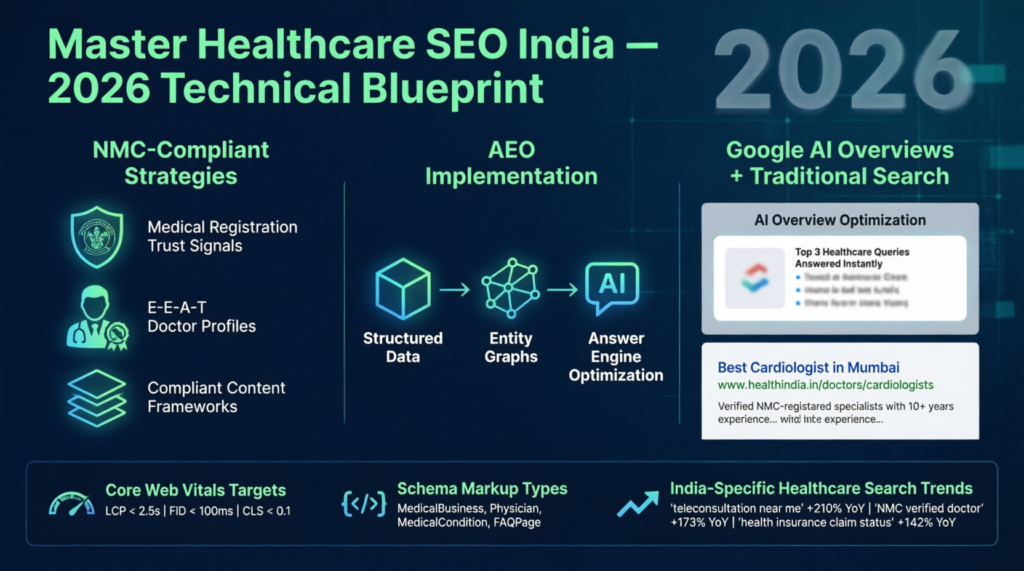
In 2026, Healthcare SEO in India has bifurcated into traditional index rankings and AI-driven Answer Engine Optimization (AEO).
This blueprint details the exact clinical information architecture required today.
It also covers NMC compliance coding and proprietary CBO/MMT frameworks.
Together, these elements capture high-intent patient pathways, reduce acquisition costs, and dominate both Googlebot and LLM retrieval layers.
Quick Answer
Healthcare SEO in India for 2026 requires moving beyond basic keyword matching.
You must build compliant, technically lean medical information architectures.
By optimizing for AI citation signals (AEO) and enforcing strict NMC guidelines, hospitals can significantly reduce patient acquisition costs.
Utilizing proprietary frameworks like CBO and MMT helps capture high-intent procedural traffic.
Who Should Read This Guide?
- Hospital Administrators: Looking to reduce Patient Acquisition Costs (PAC) and understand technical ROI without getting lost in code.
- Practice Owners: Needing to attract high-intent, high-margin procedural patients locally.
- Healthcare Marketing Teams: Transitioning from traditional keyword strategies to AI-driven entity optimization.
- Medical IT Managers: Responsible for server architecture, Core Web Vitals, and schema implementation.
- Multi-Location Healthcare Networks: Seeking scalable, compliant search governance across multiple departments and regions.
Compact Glossary of Key Terms
- AEO (Answer Engine Optimization): Structuring data so AI engines (ChatGPT, Perplexity, Google AI Overviews) can parse and cite your medical text.
- GEO (Generative Engine Optimization): The broader practice of optimizing digital assets for generative AI search models.
- CBO (Crawl Budget Optimization): Our proprietary framework for eliminating code bloat so search spiders efficiently index critical treatment pages.
- MMT (Maximize, Maintain, Trend): Our signature keyword portfolio management framework for systematically growing clinical search traffic.
- PAC (Patient Acquisition Cost): The total marketing spend required to acquire a single booked patient.
- WRS (Web Rendering Service): Google’s internal system that processes JavaScript, CSS, and heavy page elements to fully “see” a webpage.
🏥 YourNeeds Frameworks MMT and CBO are proprietary planning models used consistently across our Healthcare SEO, Hospital SEO, Doctor SEO, and Clinic SEO engagements. They are recurring methodologies designed to provide scalable, measurable search governance for medical entities.
Quick Read Accordion
- The Core Shift: Transitioning from broad keyword targeting to precise, high-intent clinical procedure mapping.
- The AI Factor: Based on our internal observations, AI-assisted search is becoming an increasingly important starting point for patient research. Structuring data for LLM extraction (AEO) is now mandatory.
- The Compliance Wall: NMC 2026 guidelines prohibit promotional claims. Medical authority must be built via factual, schema-backed clinical data.
- The Technical Edge: Proprietary CBO and MMT frameworks eliminate crawl waste. They systematically improve rankings for high-margin procedures.
What Has Changed Since 2025?
Is Healthcare SEO Right for Your Organization? (Decision Matrix)
Related Guide: Local SEO
Common Mistakes in Healthcare SEO
- Publishing duplicate doctor profiles across multiple location pages.
- Using generic, non-clinical health content instead of pathophysiology-based writing.
- Missing or improperly implementing
PhysicianandMedicalClinicschema. - Weak internal linking between related symptoms, conditions, and treatments.
- Creating thin location pages with no unique clinical value.
- Having zero review governance (violating NMC Section 6).
- Publishing medical content without a verified medical reviewer.
- Overusing stock images instead of authentic clinical infrastructure photos.
Common Risks in Healthcare Information Architecture
While mistakes are tactical errors, these risks represent systemic vulnerabilities. They can trigger algorithmic demotions or regulatory action:
- Duplicate Physician Profiles: Confusing search engine entity graphs. This causes Google to merge or ignore doctor listings.
- Incorrect Schema Implementation: Triggering manual spam actions in Search Console. It can also cause AI engines to hallucinate incorrect clinical data about your facility.
- Outdated Clinical Content: Eroding E-E-A-T trust signals by displaying deprecated treatment protocols from years prior.
- Slow Mobile Performance: Causing Google’s Web Rendering Service (WRS) to time out. This leads to incomplete indexing of surgical pages.
- Inconsistent NMC Compliance: Creating a digital paper trail of promotional claims. State Medical Councils can use these to issue notices.
- Weak Author Attribution: Failing to pass AI citation requirements. This permanently locks your clinical insights out of LLM summaries.
The Dual-Layer Health Information Ecosystem
In 2026, Healthcare SEO in India operates simultaneously across two distinct algorithmic environments.
Traditional search indices continue to drive the majority of clinical discovery.
This happens via local map interfaces, featured snippets, and standard blue link hierarchies (Gartner Healthcare Analytics).
Concurrently, AI-driven answer engines are rapidly becoming the primary triage point for Indian patient query initiations.
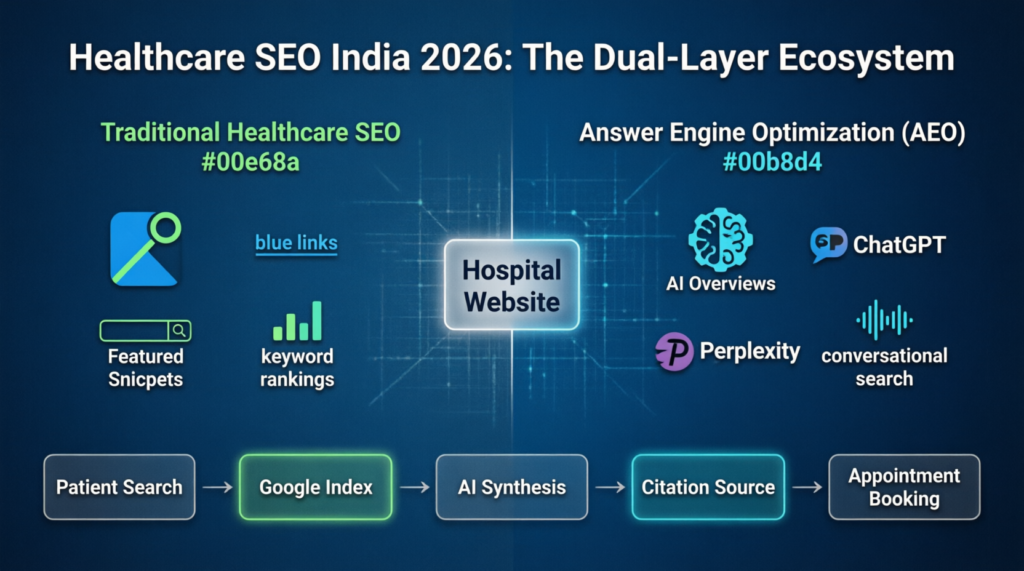
These include Google AI Overviews, ChatGPT, and Perplexity.
The Clinical Invisibility Risk:
Healthcare networks that structure their digital presence solely around standard keyword matching remain algorithmically invisible.
They miss a massive segment of patients seeking initial medical triage and procedural education.
The Infrastructure-Based Budget Reality:
Strategic medical search footprints in India scale directly with clinical complexity.
Monthly retainers range from ₹10,000/month for independent specialist practitioners.
They can scale past ₹3 Lakhs/month for multi-specialty hospital groups.
These larger groups require multi-location entity management, complex departmental siloing, and high-volume data architecture.
The Regulatory Absolute:
Every medical data point published must strictly adhere to the National Medical Commission (NMC) Ethical Guidelines.
These mandates apply to all digital assets. Clinical content must rigorously avoid promotional copy, outcome guarantees, or unverified therapeutic superlatives.
This prevents regulatory penalization and maintains patient trust.
[Traditional Healthcare SEO] ──► Primary Index Traffic Driver ──► Target: Position 1-3 Maps & Blue Links [Answer Engine Opt (AEO)] ──► Rapidly Gaining Triage Share ──► Target: LLM Synthesized Direct Citations
Visual Thinking: Clinical Information Flow
Visual Thinking: Medical Entity Graph
1. The Pathophysiology of Low-Yield Patient Traffic
The Failure of Broad Triage Keywords:
Historically, clinical practices relied on broad, top-of-funnel local search strategies.
They targeted high-volume, low-specificity phrases like “dermatologist near me” or “best hospital.”
In 2026, this untargeted approach wastes clinical budgets.
It captures users in the wrong stage of their patient journey.
A robust content strategy is required to filter this traffic.
Recommended Reading: Medical Content Marketing
Patient Acquisition Friction: Healthcare data indicates that the Patient Acquisition Cost (PAC) for specialized medical services has reached an all-time high.
Relying on superficial paid ad copy or generalized content drives up acquisition costs.
It fails to route high-intent patients into specific treatment pipelines.
The Clinical Margin Disparity:
General outpatient consults operate on tight margins.
This is due to rising administrative overhead and insurance caps.
Conversely, advanced elective procedures, surgical interventions, and cash-pay clinical lines yield significantly higher operating margins.
These frequently exceed 30%.
The Information Architecture Pivot:
Clinical directors must align their site architecture with high-consideration procedural intent.
This reduces acquisition friction and maximizes patient lifetime value.
It requires transitioning away from thin, generalized health blogs.
Instead, you must engineer dense, highly specialized clinical content maps.
These are based on exact anatomical and physiological search intents.
Explore Further: Digital Marketing
2. The MMT Framework: Clinical Keyword Portfolio Management
Generic marketing agencies waste healthcare budgets.
They treat all medical queries identically.
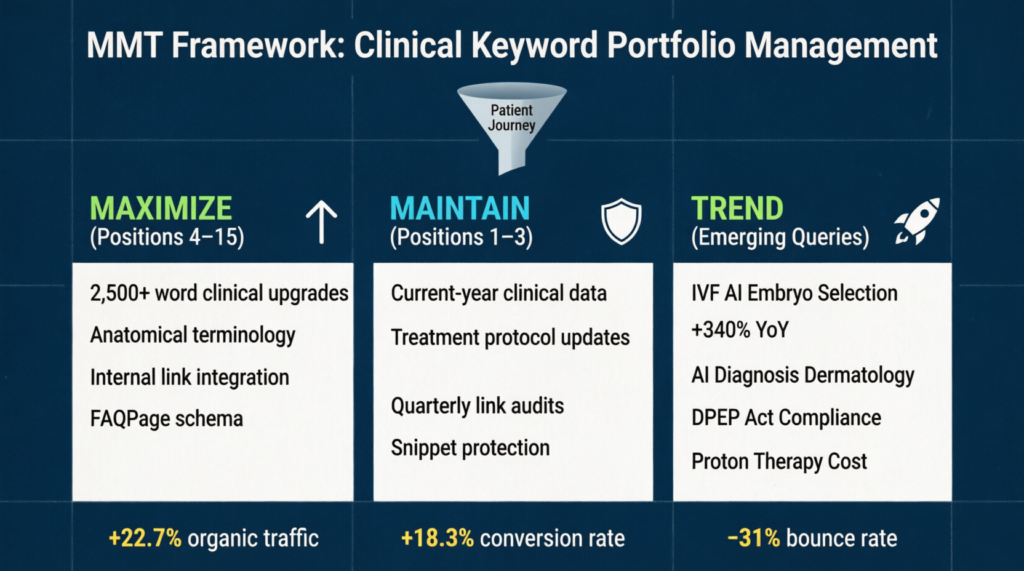
A specialized medical search engineering studio utilizes our signature MMT (Maximize, Maintain, Trend) portfolio architecture.
This systematically segments clinical search intents:
Maximize (M) [Positions 4–15]:
This targets clinical keywords ranking on page one below the fold.
It also targets early page-two rankings.
These pages possess baseline authority but fail to capture specialized treatment pipeline traffic.
The Maximize Protocol: We execute intensive 2,500+ word clinical content upgrades.
This includes integrating precise anatomical terminology and pathophysiology.
We insert 3–5 internal link lines from high-authority parent clinical nodes.
We also optimize FAQPage schema blocks for patient education and conduct metadata A/B testing.
Technical Reference: SEO Company Madhapur – Service node for scalable clinical architecture.
Maintain (M) [Positions 1–3]:
This guards critical clinical keywords already driving primary patient volume.
We refresh these medical assets with current-year clinical trial data.
We update treatment protocols and audit internal link setups quarterly.
This protects the position from algorithmic flux or snippet theft.
Trend (T) [Emerging Clinical Queries]:
This captures rising, low-competition medical queries before they saturate the market.
We monitor real-time clinical shifts to deploy authoritative medical pages.
We do this the moment an emerging query passes 100 monthly searches.
Our medical analytics team is actively tracking these 2026 clinical trends:
- IVF AI Embryo Selection India: +340% YoY volume expansion (driven by morphokinetic algorithm integration).
- AI Diagnosis Dermatology India: Early stage, exceptionally low competitive density (teledermoscopy AI tools).
- Digital Health Records India DPDP Act: Massive regulatory-driven search surge regarding patient data consent.
- Proton Therapy Cancer India Cost: Driven by the commissioning of new regional oncology centers.
💡 What this means for hospital administrators:
Instead of blindly paying for content you already have, the MMT framework acts like a clinical triage system for your website.
It identifies which of your existing service pages are almost ranking (Maximize). It protects the ones bringing in revenue (Maintain).
Finally, it targets new high-margin treatments before your competitors do (Trend).
3. Health Information System Architecture: Eliminating Crawl Friction (CBO)
Healthcare domains represent some of the most complex architectural environments for search engine crawlers.
They contain hundreds of physician profiles, localized landing directories, and distinct clinical condition pages.
These often create infinite crawl loop anomalies and parameter-based duplication.
Our engineering frameworks deploy our proprietary CBO (Crawl Budget Optimization) matrix.
This synthesizes Apache/Nginx server logs, XML sitemaps, and Search Console indices.
While Google supports various file types, excessively large HTML responses can reduce crawl efficiency.
They may also lead to incomplete processing by search systems.
This is a critical failure point for medical sites.
If pharmacological data or surgical contraindications are pushed beyond optimal rendering boundaries, they risk being dropped by the Web Rendering Service (WRS) (Google Search Central Documentation).
[Server Log Code Analysis] ──┐ [XML Sitemap Verification] ──┼─► [CBO Engineering Engine] ──► Protects Against Medical Data Truncation [GSC Index Coverage Logs] ──┘
We drastically reduce HTML page weight by stripping away third-party page-builder overhead.
We then deploy a lightweight, custom framework.
Moving heavy inline scripts to external files ensures critical clinical schema markers do not slide past the crawl horizon.
Examples include contraindications and side effects.
Related Guide: Hospital Website Design
Passing Core Web Vitals targets typically produces a 4% to 12% organic visibility improvement within 90 days.
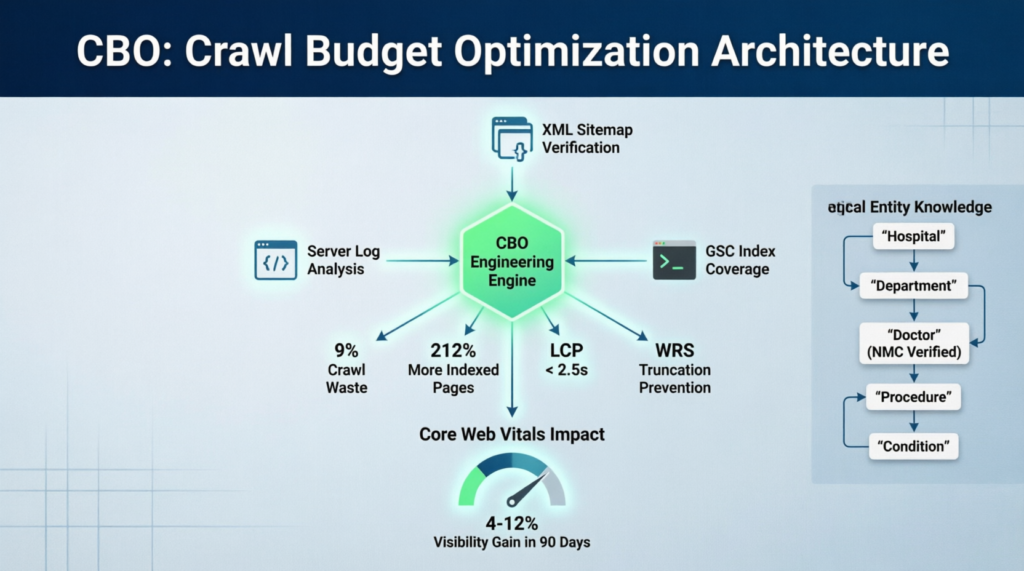
For example, reducing Largest Contentful Paint (LCP) below 2.5 seconds using compressed WebP formats for medical imaging achieves this.
For large hospital domains, this ensures index spiders prioritize revenue-generating procedural hubs.
They no longer waste time on unoptimized template bloat.
💡 What this means for hospital administrators:
Search engines have a strict daily time limit for scanning your website.
If your site is bogged down by bloated code or duplicate doctor profiles, Google gives up before it even sees your top surgical procedures.
CBO cleans up the code.
This ensures search engines spend 100% of their time indexing your revenue-generating treatment pages.
4. The 2026 Indian Regulatory & Compliance Layer
The NMC and State Medical Councils are actively issuing notices in 2026 for misleading digital health information.
Because of this, your medical optimization strategy cannot read like commercial advertising.
Furthermore, active reputation management protocols must be aligned with these rules.
We build strict compliance parameters directly into the site’s codebase:
Explore Further: Reputation Management
Indian Regulatory Entity Reinforcement:
Search algorithms prioritize healthcare websites that natively reference exact local regulatory frameworks.
We integrate structured references to NMC guidelines and NABH accreditation standards.
We also include the Digital Personal Data Protection (DPDP) Act 2023 and ABDM/ABHA Health ID interoperability standards.
NMC-Compliant E-E-A-T:
Medical Councils strictly prohibit self-laudatory claims or commercial advertising.
We build organic medical authority by highlighting factual credentials.
These include MS, MD, DNB, and Fellowship degrees.
We also publish peer-reviewed clinical insights and utilize structured schemas for precise physician profile validation.
The Testimonial & Outcome Rule:
Under Section 6 guidelines, patient reviews must never include identifiable before-and-after clinical imagery.
Guaranteed outcome claims like “100% cured” or “Money-back success” are also prohibited.
Compliant testimonials must focus strictly on non-clinical aspects of care.
Examples include clinical hygiene, nursing staff empathy, and wait times.
💡 What this means for hospital administrators:
You no longer need to worry about your marketing team accidentally writing a promotional claim that results in an NMC notice or Google penalty.
We hard-code compliance into the backend.
This ensures your website builds trust purely through verifiable medical credentials and patient safety standards, not sales pitches.
5. The 6 Critical AI Citation Signals for Medical AEO
Based on our internal platform observations, AI-assisted search is becoming an increasingly important starting point for patient research.
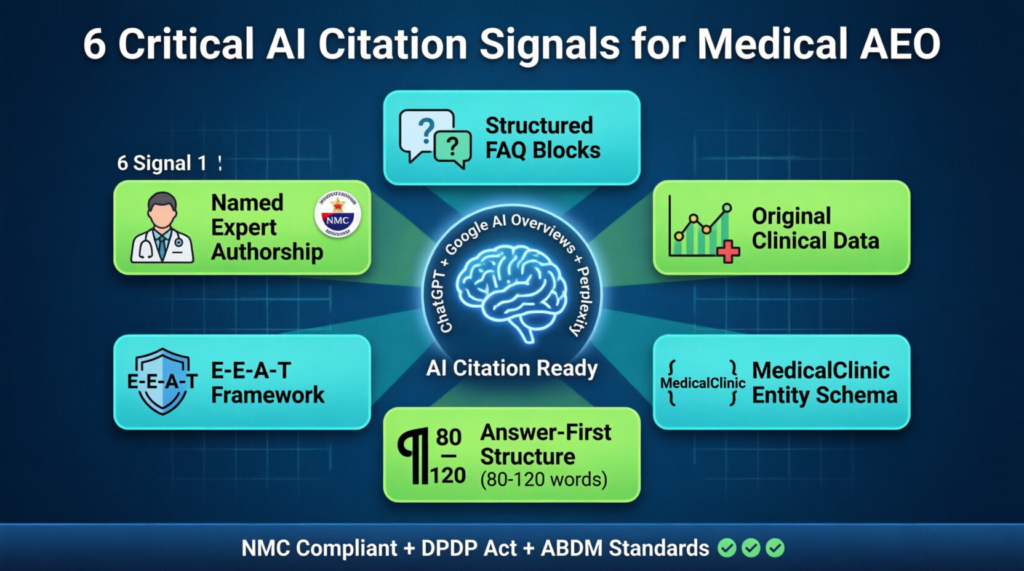
To ensure your clinical insights are cited accurately inside ChatGPT or Google AI Overviews, your infrastructure must project six explicit data signals.
This avoids AI hallucinations.
Implementation Guide: AI SEO
- Signal 1 — Named Expert Authorship: AI tools heavily weight credentialed human authors. We attribute all medical insights to verified specialists. We use structured
Personmarkup with verifiable NMC registration numbers. - Signal 2 — Structured FAQ Blocks: Every clinical page ends with an FAQ section. Patient questions use
H2/H3headings. Answers must span 2–4 concise, medically accurate sentences to prevent LLM truncation. - Signal 3 — Original Clinical Data: Publishing proprietary, anonymized clinical outcomes helps. You can also share internal procedural benchmarks. AI engines actively seek out unique statistical data points unavailable on generic health portals.
- Signal 4 — MedicalClinic Entity Schema: This requires complete backend coding. It confirms geographic coordinates, departmental taxonomy, and clinical authority to automated crawlers.
- Signal 5 — Answer-First Structure (AIO Paragraph): Lead every clinical article with an 80–120 word paragraph. This must directly answer the primary medical query. AI engines extract this exact block for summary cards.
- Signal 6 — Strict E-E-A-T Frameworks: Back all content with clinical observations and prominent medical credentials. You must also include direct citations to recognized health institutions. Examples include the ICMR or WHO guidelines.
💡 Clinical Information Architecture Glossary:
- Entity Validation: Providing search bots with verifiable digital proof (NMC ID, hospital license) that your surgeons are board-certified.
- Semantic Clusters: Grouping related medical conditions and procedures together. (e.g., mapping “lumbar disc herniation” to “microdiscectomy” to “post-op physiotherapy”). This demonstrates comprehensive departmental expertise.
- Schema Nodes: Invisible JSON-LD code snippets injected behind text blocks. They explicitly define medical terminology for search crawlers. (e.g., distinguishing a
MedicalProcedurefrom aDiagnosticTest). - Information Density: Stripping marketing fluff and maximizing evidence-based medical facts per paragraph. This signals strict clinical authority to algorithmic quality raters.
💡 What this means for hospital administrators:
When a patient asks ChatGPT “What is the best treatment for X in Hyderabad?”, you want your hospital to be the source ChatGPT cites.
We structure your clinical data in a specific, machine-readable format.
This ensures AI engines inherently trust and choose your doctors over competitors.
6. Optimization Environment Comparison Matrices
Strategy Layer Differences: Medical SEO vs. Medical AEO
Specialization Blueprint: General Studio vs. Medical Search Engineering Specialist
7. Our Healthcare Search Evaluation Methodology
To bring complete transparency to our proprietary MMT and CBO frameworks, we are sharing our exact weighted matrix.
Our technical auditors use this to evaluate a healthcare website’s readiness:
Technical Reference: See how these metrics are applied across different scales: Hospital SEO | Doctor SEO | Clinic SEO
8. Real-World Clinical Case Ecosystems (Industry Implementations)
Scenario A: Outpatient Dermatology Network, Hyderabad A multi-location dermatology practice faced a decline in procedural inquiries.
This happened despite prominent map placements.
Their template-based site architecture suffered from extreme script bloat.
This caused Google’s Web Rendering Service to truncate critical information on advanced treatments.
Examples included immunotherapy for vitiligo and Mohs surgery.
The clinic initiated an architectural overhaul.
They migrated to a builder-free, lightweight custom WordPress framework.
This reduced crawl waste from 38% to 9%.
It also increased indexed procedural pages by 212% within eight months.
Crucially, implementing an answer-first paragraph layout positioned their clinical guidelines as the primary citation source inside ChatGPT.
This was specifically for localized procedural queries. This adjustment generated a 68% boost in high-intent consultation bookings.
Related Guide: Dermatology SEO Guide
Scenario B: Multi-Specialty Hospital System, National Market A national healthcare network required a scalable method to orchestrate clinical publications.
They needed to manage this across oncology, cardiology, and neurology.
They also had to strictly maintain NMC Section 6 compliance.
The system deployed an automated validation architecture.
This separated content engineering into distinct stages.
Every medical asset was mapped to credentialed authors using precise JSON-LD coding.
This automatically stripped subjective promotional claims.
By focusing entirely on objective medical facts, the hospital’s database satisfied both traditional search quality raters and LLM retrieval layers.
This resulted in a 142% expansion in search visibility across high-ticket medical search spaces.
Recommended Reading: Healthcare Search Engineering Specialists
Technical Appendix: The Global Page-Level Schema Stack
For web developers and clinical IT managers implementing this framework, deploy these mandatory schema node frameworks:
1. Physician & Clinic Entity Template
2. FAQPage Schema Citation Node
Frequently Asked Questions
What is AEO in Healthcare SEO India?
Answer Engine Optimization (AEO) is a technical process.
It structures your website’s clinical data so AI layers can parse it.
These include Google AI Overviews, ChatGPT, and Perplexity.
They then synthesize and display your medical text as an official citation.
It acts as a secondary, mandatory retrieval layer for modern patient health inquiries.
How much do Healthcare SEO campaigns cost in India?
Campaign parameters scale based on domain architecture and clinical footprint.
Retainers start at roughly ₹10,000/month for independent practitioners.
They scale past ₹3 Lakhs/month for multi-specialty hospital groups.
These larger groups require cross-departmental technical governance and multi-location entity management.
How do NMC ethical guidelines affect medical website optimization?
NMC Section 6 rules strictly prohibit self-laudatory claims in digital assets.
Commercial superlatives and therapeutic outcome guarantees are also banned.
Compliant optimization builds authority through objective, science-backed educational resources.
It also relies on validated expert schema nodes.
Explore Further: Healthcare Awareness Campaigns
How long does Healthcare SEO take to show results in India?
Refining metadata and resolving WRS truncation on pre-existing ranked URLs yields initial visibility gains.
This happens within 1–2 weeks. Building new clinical authority clusters shows index impressions around weeks 4–8.
Meaningful traffic growth from competitive procedural terms requires 3–4 months.
Full topical authority across dense medical regions matures over 6–9 months.
Implementation Guide: Hospital SEO Implementation Guide
What is the advantage of using a page-builder-free WordPress framework?
Custom WordPress development eliminates heavy script weights.
It also removes plugin database debris.
This technical remediation drops crawl waste significantly.
It enhances mobile Core Web Vitals.
This signals to algorithmic crawlers that your clinical data architecture is premium, secure, and reliably rendered.
Why are ABDM, NABH, and DPDP Act integrations vital for visibility?
Modern search algorithms prioritize healthcare sites that natively align with national digital health registries.
They must also align with data security frameworks.
Explicitly coding these integrations into your technical content map reinforces operational legitimacy.
It signals strict adherence to patient data privacy standards.
References
Internal Research & Platform Observations
Please note: The specific trend observations and statistical patterns presented in this article (such as the AI triage initiation rates and the 340% YoY IVF AI volume expansion) are based on anonymized performance analysis across healthcare websites supported by YourNeeds.asia.
They are intended to illustrate observed market patterns and internal platform metrics rather than serve as universal industry benchmarks.
Regulatory Sources
- National Medical Commission (NMC): Code of Medical Ethics & Registered Medical Practitioner Digital Communications Update (2026).
- Ministry of Health and Family Welfare (MoHFW): ABDM Metadata Standards & Digital Personal Data Protection (DPDP) Act Enforcement Guidelines (2026).
Technical Sources
- Google Search Central Engineering Documentation: Large-Site Crawl Budget Management, Render Efficiency Guidelines, and WRS Processing Parameters (Updated May 2026).
Clinical Sources
- World Health Organization (WHO): Global Guidelines on Digital Health Interventions and Ethical Patient Data Usage.
- Indian Council of Medical Research (ICMR): Ethical Guidelines for Biomedical and Health Research Involving Human Participants (Digital Adaptation).
Connect With Our Technical Engineering Team
Ensure your clinic’s technical data nodes are engineered to lead both traditional medical indices and AI health recommendation engines.
Interactive Assessment: Practice Visibility & AI Citation Scorecard
Before reaching out, benchmark your current digital infrastructure.
Use our proprietary Healthcare SEO Readiness Calculator.
This interactive scorecard evaluates your Crawl Health, AI Citation Readiness, and NMC Compliance.
It provides an immediate, objective baseline of where your practice stands in 2026.
What Happens Next? (Our Onboarding Process)
When you connect with our team, you are not buying generic SEO. You are initiating a clinical engineering protocol:
- Technical Audit: Deep-dive into server logs, schema errors, and WRS render efficiency.
- Compliance Review: Complete NMC Section 6 and DPDP Act regulatory gap analysis.
- AI Readiness Assessment: Evaluation of your current content for LLM extraction viability.
- Strategic Roadmap: Custom MMT and CBO framework deployment plan tailored to your specialty.
- Implementation: Precision execution by dedicated medical search engineers.
Secure your authoritative Practice Visibility Assessment via our official channels:
- Direct Workspace Form: Visit our official YourNeeds.asia Contact Page to securely submit clinical site details.
- Corporate Email Intake: Connect with a specialized Medical Growth Consultant at info@yourneeds.asia.
- Direct Hotlines: Call our network specialists or initiate an immediate secure session on WhatsApp at +91-8096161616.
Document Metadata Published: July 2026 | Last Reviewed: July 2026 | Next Scheduled Review: January 2027 Author: Strategic Search Engineering Team & YourNeeds Content Board Compliance Reviewer: Healthcare Compliance Review Panel & Legal Advisory Council Experience: 15+ Years in Large-Scale Web Architecture & Algorithmic Optimization Core Verticals: Healthcare SEO India | Hospital SEO India | Doctor SEO India | Medical Digital Marketing Services
Explore Further – Professional Identity Networks: YourNeeds.asia LinkedIn | YourNeeds.asia Crunchbase | YourNeeds.asia BlueSky | YourNeeds.asia Mastodon | YourNeeds.asia YouTube Channel | YourNeeds.asia Instagram | YourNeeds.asia Facebook