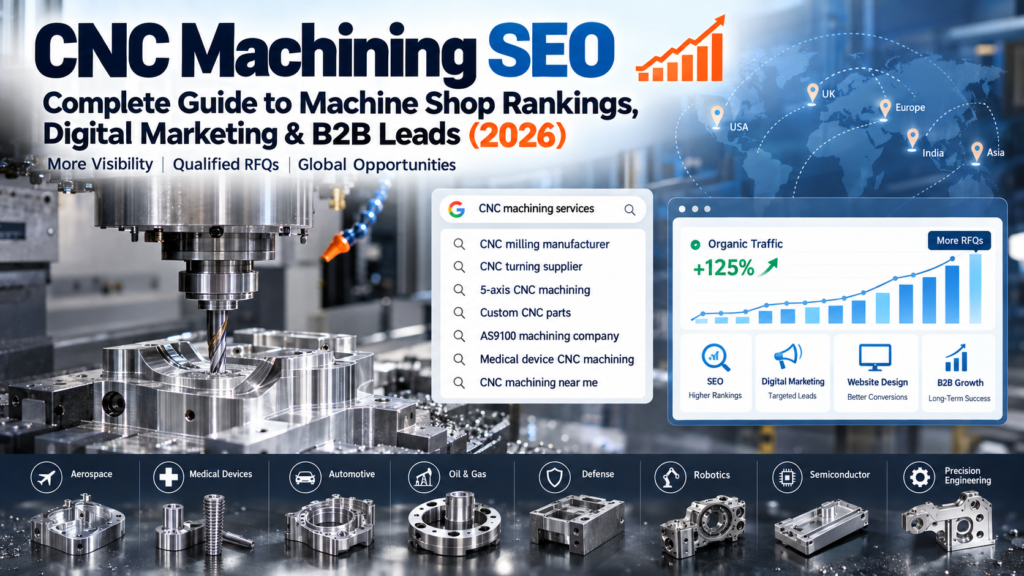
Quick answer
CNC Machining SEO helps CNC machine shops, precision manufacturers and machining businesses improve Google visibility, attract qualified industrial buyers and generate B2B requests for quotation (RFQs). Effective SEO for CNC machining businesses combines technical SEO, process-specific keywords, material and certification optimisation, local SEO, AI search optimisation and conversion-focused website development to reach engineers, procurement managers and OEM sourcing teams.
CNC Machining SEO: Complete Guide to Machine Shop Rankings, Digital Marketing & B2B Leads (2026)
SEO for CNC machining businesses, precision manufacturers, CNC milling and turning companies, job shops, OEM suppliers and industrial exporters.
Yourneeds.asia | Industrial SEO & B2B Digital Marketing | Updated October 2026
Introduction: Why CNC Machining SEO Matters in 2026
CNC machining companies operate in a highly specialised B2B market where dimensional accuracy, material expertise, production capacity, inspection capability and supplier reliability influence purchasing decisions.
However, even technically capable machine shops can struggle to attract qualified enquiries when their websites fail to appear for relevant industrial searches.
SEO for CNC machining businesses helps precision manufacturers connect with engineers, OEM sourcing teams, procurement managers and industrial buyers searching for CNC milling, CNC turning, five-axis machining, prototyping and custom-manufactured components.
Unlike conventional SEO, CNC Machining SEO requires a deeper understanding of manufacturing processes, dimensional tolerances, material specifications, production quantities, inspection requirements and supplier certifications.
A procurement manager searching for an AS9100-certified aerospace machining supplier has different requirements from an engineer sourcing low-volume aluminium prototypes.
A successful search strategy must address both the buyer’s intent and the manufacturer’s actual production capabilities.
At Yourneeds.asia, our approach to industrial SEO and digital marketing focuses on connecting manufacturing capabilities with relevant buyer searches, measurable enquiries and long-term business opportunities.
This guide explains how CNC machine shops can improve organic visibility, develop technically credible websites, strengthen local and international search presence, prepare for AI-assisted discovery and combine digital marketing channels to generate qualified B2B RFQs.
1. Why CNC Machining SEO Is Different From General B2B SEO
CNC machining is not a generic service category.
A manufacturer offering three-axis aluminium milling is not necessarily equipped to produce complex five-axis titanium components. A prototype specialist may not be commercially suited to a repeat order of 100,000 turned components.
These differences directly affect search intent.
Technical capability determines keyword relevance
Consider two search queries:
Precision CNC machining services
Five-axis titanium CNC machining with AS9100 quality management
The first is broad. The second contains process, material and supplier qualification requirements.
A relevant website should provide enough technical detail to help the buyer evaluate suitability.
That may include:
-
Three-axis, four-axis or simultaneous five-axis machining
-
CNC turning, mill-turn or Swiss-type turning
-
Machine travel and work envelope
-
Supported material grades
-
Typical prototype and production quantities
-
Inspection methods and measuring equipment
-
Dimensional and geometric tolerance capabilities
-
Available secondary operations
-
Applicable certifications and customer approvals
A shop should advertise only capabilities it can substantiate.
Precision matters more than generic marketing claims
A website statement such as “We deliver world-class precision machining” does little to help an engineer.
A more useful statement would explain the actual machining processes, materials, inspection methods and typical production requirements supported.
Even numerical tolerance claims need context.
A stated tolerance of ±0.005 mm should not imply that every feature on every material can be produced to that tolerance.
Machining capability depends on geometry, material, fixturing, tool condition, thermal effects, measurement methods and production conditions.
Long sales cycles require consistent visibility
Complex manufacturing programmes can involve extended supplier evaluation, sample production, quality approval and commercial negotiations.
For planning purposes, some industrial accounts may require six to eighteen months to progress from initial research to sustained production business. That is not a verified average for all CNC purchases; urgent prototype and overflow work can close much faster.
According to the 6sense 2024 Buyer Experience Report, buyers in its cross-industry B2B research completed an average of approximately 69% of the purchasing process before engaging sellers. This is a broader B2B finding, not a CNC-specific statistic.
The implication is that a machine shop’s website may be evaluated long before its sales team receives an enquiry.
For related principles, see [SEO Strategies for B2B Companies](LINK: seo-strategies-for-b2b-companies) — [a: previous post; URL to verify].
2. Who You’re Marketing To: Engineers, Procurement Managers and Shop Owners
CNC Machining SEO works best when content is written for the people who influence manufacturing purchases.
These audiences may participate in the same project but evaluate different information.
Manufacturing and design engineers
Engineers assess technical feasibility.
They may search for solutions involving thin-wall machining, difficult-to-machine alloys, tight-tolerance bores, complex contours, surface finish requirements or geometric dimensioning and tolerancing.
They need credible information about process capabilities, materials, equipment, workholding and inspection.
A strong engineering-focused page should demonstrate technical understanding rather than rely on sales language.
Procurement and sourcing managers
Procurement teams evaluate whether a supplier can meet contractual, quality, commercial and operational requirements.
They may need information about certifications, production capacity, minimum economic run size, lead times, traceability, documentation and delivery geography.
Their search behaviour often includes supplier qualification terms.
Examples include:
-
AS9100 CNC machining supplier
-
ISO 9001 precision machine shop
-
CNC machining manufacturer for OEM production
-
Contract machining supplier in India
-
CNC components manufacturer with inspection capability
A procurement-focused page should make the relevant information easy to find and verify.
Machine shop owners and operations managers
Another machine shop may be a potential customer.
A local job shop might outsource specialised five-axis work, overflow production, large-part machining or secondary operations.
This audience wants to know whether the supplier can handle the required work reliably and commercially.
Define the ideal customer profile
Before beginning an SEO campaign, define:
| Qualification factor | Questions to answer |
|---|---|
| Industry | Aerospace, automotive, medical, robotics, oil and gas or general engineering? |
| Process | Milling, turning, mill-turn, EDM or other processes? |
| Materials | Aluminium, stainless steel, titanium, PEEK or specialist alloys? |
| Quantity | One-off prototype, low-volume production or repeat manufacturing? |
| Tolerances | What dimensional and inspection requirements apply? |
| Certifications | Which quality or contractual requirements must be satisfied? |
| Geography | Local, national or international customers? |
| Commercial fit | Which jobs are profitable and operationally suitable? |
This profile should guide keyword research, content development and lead qualification.
3. CNC Machining Buyer Journey: Understanding the 6–18 Month Sales Cycle
A machining enquiry does not always represent an immediate purchase.
A buyer may be researching a manufacturing process, evaluating design feasibility, identifying suppliers or preparing for a future programme.
CNC Machining SEO should support each stage.
Stage 1: Technical research
The engineer investigates materials, processes, tolerances and manufacturing alternatives.
Relevant content includes machining guides, material comparisons, design-for-manufacturability articles and process explanations.
Stage 2: Supplier discovery
The buyer searches for machine shops offering the required manufacturing process.
Capability pages, industry pages and location-specific information become important.
Stage 3: Supplier qualification
The buyer checks equipment, quality systems, certifications, production quantities, inspection capability and experience.
A detailed manufacturing website can reduce uncertainty before contact.
Stage 4: Request for quotation
The buyer submits drawings, specifications, quantities, delivery expectations and other requirements.
The manufacturer assesses manufacturability, production fit, cost and capacity.
Stage 5: Technical approval and production
Depending on the programme, the supplier may need to provide samples, first-article inspection reports, process documentation or production validation.
Stage 6: Repeat orders and account development
Successful manufacturing relationships may generate recurring production orders.
A strong marketing and CRM system should support continued communication and account development.
The CNC manufacturing buyer journey
1
Research
Understand processes and specifications
2
Discover
Find technically suitable suppliers
3
Qualify
Check capabilities and credentials
4
RFQ
Submit drawings and production requirements
5
Approve
Validate quality, cost and delivery
6
Repeat
Develop a long-term supplier relationship
The objective is to create useful information for buyers before, during and after their initial contact with the manufacturer.
4. CNC Machining SEO: Keywords, Materials, Tolerances and Certifications
CNC Machining SEO improves a machine shop’s visibility for searches involving manufacturing processes, technical specifications, materials, production quantities, industry applications and supplier qualifications.
The objective is not to rank for every machining-related search. It is to attract buyers whose requirements match the manufacturer’s equipment, expertise and commercial capabilities.
A successful strategy begins with a verified capability matrix and a search-intent map.
4.1 CNC machine shop SEO and keyword research
CNC machine shop SEO should prioritise commercial searches that indicate a potential requirement for manufacturing services.
Examples include:
-
CNC machining services for industrial components
-
Precision CNC machine shop
-
Custom CNC parts manufacturer
-
CNC machining supplier for OEM production
-
CNC contract manufacturing company
-
CNC machining services in Hyderabad
-
CNC machining manufacturer in India
-
Aerospace precision machining supplier
-
Low-volume CNC machining services
-
High-volume CNC turning manufacturer
These keywords should be classified according to buyer intent.
A search for what is CNC milling is informational. A search for custom CNC milling manufacturer for aluminium components is more likely to involve supplier research.
Both may have value, but they should not be treated as equivalent conversion opportunities.
4.2 Build a manufacturing-focused website architecture
A strong CNC Machining SEO strategy requires separate pages for major capabilities.
For a manufacturer offering multiple machining processes, the recommended structure may include:
| Page | Main keyword focus | Buyer requirement |
|---|---|---|
| CNC machining services | CNC machining SEO | General supplier discovery |
| CNC milling | CNC milling SEO | Milled components |
| CNC turning | CNC turning SEO | Cylindrical and rotational parts |
| Five-axis machining | 5-axis CNC machining SEO | Complex geometry and multi-face machining |
| Prototyping | CNC prototyping SEO | Development and small-batch parts |
| Custom components | Custom CNC parts SEO | Drawing-based production |
| Precision engineering | Precision machining SEO | Demanding dimensional requirements |
| Quality and inspection | CNC machining inspection capabilities | Supplier qualification |
Each page should describe genuine capabilities, relevant equipment, supported materials, inspection methods and typical production requirements.
For example, a five-axis machining page should distinguish between 3+2 positional machining and simultaneous five-axis machining where relevant.
These processes have different applications and should not be presented as identical.
Recommended supporting article: [CNC Milling SEO for Precision Machine Shops](LINK: cnc-milling-seo) — [a: planned cluster article].
4.3 CNC milling SEO
CNC milling SEO should target buyers searching for machined components produced through material removal using rotating cutting tools.
Relevant content may address three-axis milling, four-axis machining, complex pocketing, precision bores, surface finish, workholding and multi-face machining.
Engineers may search by geometry, material or manufacturing challenge rather than the phrase CNC milling services alone.
For example:
Thin-wall aluminium CNC milling manufacturer
This search indicates a specific manufacturing challenge.
A credible landing page should explain the shop’s relevant experience with workpiece deflection, fixturing, machining sequence and dimensional inspection.
4.4 CNC turning SEO
CNC turning SEO targets buyers seeking components such as shafts, bushings, sleeves, threaded parts, connectors and other rotational components.
A turning capability page should describe machine type, turning diameter, length capacity, material expertise, production quantities and available secondary operations.
If the manufacturer provides live tooling, bar-fed turning or Swiss-type machining, those capabilities may justify dedicated sections or pages.
A useful supporting resource is [CNC Turning SEO for Contract Manufacturers](LINK: cnc-turning-seo) — [a: planned cluster article].
4.5 Five-axis CNC machining SEO
Five-axis machining can be valuable for complex geometries, difficult tool access, reduced setups and certain high-precision applications.
However, the website should explain the exact machine configuration and operating capability.
Some manufacturers offer positional five-axis machining, while others support simultaneous five-axis toolpaths.
This distinction matters to buyers.
Relevant content should cover machine envelope, component size, materials, fixturing, inspection and applications.
A shop should not promise tighter tolerances solely because it uses five-axis equipment. Actual accuracy depends on the complete manufacturing and measurement process.
4.6 CNC prototyping SEO
Prototype machining serves buyers who need parts for testing, design validation, fit checks or engineering development.
These buyers may prioritise communication, manufacturability feedback, short production runs and revision flexibility.
Prototype-focused pages should explain drawing submission, material availability, minimum quantities, inspection options and quotation procedures.
Where relevant, the website can distinguish between prototype machining and production machining.
This helps avoid enquiries that do not match the shop’s operating model.
4.7 Material-specific CNC machining SEO
Engineers frequently search for suppliers capable of machining particular materials.
Material pages can be valuable because machining conditions, tooling, inspection and cost vary substantially.
| Material | Relevant manufacturing considerations |
|---|---|
| Aluminium | Grade, burr control, dimensional stability, finishing |
| Stainless steel | Work hardening, tooling, coolant and grade-specific machinability |
| Titanium | Heat concentration, tool wear, cutting conditions |
| Inconel | High cutting forces, thermal management, tool life |
| Brass | Chip formation, dimensional control, surface finish |
| Engineering plastics | Fixturing, thermal behaviour, dimensional stability |
| PEEK | Temperature sensitivity, machining stresses, application requirements |
| Exotic alloys | Material-specific tooling, inspection and process control |
A material page should explain actual experience rather than make broad claims about machining every grade.
For example, a manufacturer that routinely machines 6061 aluminium should not automatically claim expertise in all aerospace aluminium alloys.
Supporting content: [CNC Machining Materials: Aluminium, Titanium, Inconel and PEEK](LINK: cnc-machining-materials-guide) — [a: planned cluster article].
4.8 Tolerance-based search optimisation
Precision machining SEO should address how engineers specify and verify dimensional requirements.
Useful subjects include:
-
General dimensional tolerances
-
Geometric dimensioning and tolerancing
-
Datum reference frames
-
Flatness and perpendicularity
-
Position and profile tolerances
-
Surface finish requirements
-
Coordinate measuring machine inspection
-
First-article inspection
-
Process repeatability
A manufacturer should avoid advertising one tolerance value as applicable to every part.
The correct tolerance depends on material, geometry, feature size, machining process, temperature, fixturing and inspection method.
Technical claims should be reviewed by manufacturing and quality personnel before publication.
4.9 Certification and supplier qualification SEO
Procurement managers often filter suppliers by quality systems and contractual requirements.
Relevant terms include ISO 9001, AS9100, ISO 13485, ITAR, NADCAP and DFARS.
These should be used accurately.
ISO 9001 addresses quality management systems.
AS9100 concerns aerospace quality management requirements.
ISO 13485 relates to quality management systems for medical devices within its applicable scope.
ITAR involves US defence-related export controls and applicable registration or compliance obligations. It is not a general machining quality certification.
NADCAP concerns accreditation of specific special processes.
DFARS refers to US defence acquisition regulations and contractual requirements rather than a single certification.
Only claim certifications, registrations, accreditations and compliance statuses that are genuine and current.
A dedicated quality page should describe the scope of each credential and provide appropriate verification information.
Recommended supporting post: [CNC Machining Certifications and Supplier Qualification](LINK: cnc-machining-certifications) — [a: planned cluster article].
4.10 Technical SEO and Core Web Vitals
Technical SEO ensures that search engines can access and understand the website.
Important activities include improving crawlability, correcting indexing issues, maintaining canonical URLs, building internal links and optimising page performance.
For manufacturing websites, large factory images, machinery videos and downloadable technical documents can create performance challenges.
Core Web Vitals provide useful experience measures.
Google’s published good thresholds are:
-
Largest Contentful Paint: 2.5 seconds or less
-
Interaction to Next Paint: 200 milliseconds or less
-
Cumulative Layout Shift: 0.1 or less
These are measured using appropriate user-experience data and are not guarantees of search rankings.
See Google Search Central’s Core Web Vitals documentation for technical guidance.
4.11 AI SEO, GEO and AI Overviews for CNC machining companies
AI-assisted search creates additional opportunities for manufacturers to make technical information discoverable.
Potential buyers may ask:
Which manufacturers provide five-axis titanium machining for aerospace components?
How do I evaluate a CNC machining supplier for medical device parts?
What information should I include in an RFQ for precision machined components?
AI SEO and Generative Engine Optimisation should focus on accurate technical explanations, clear company identity, structured content and verifiable manufacturing capabilities.
Relevant implementation areas include entity SEO, useful FAQs, service descriptions, consistent company information and appropriate schema markup.
Voice search may also involve natural-language supplier queries, particularly location-based searches.
Schema markup helps describe content to search engines but does not guarantee AI Overview inclusion or citation.
For technical implementation, manufacturers can consult Google’s structured data guidance — [c: official search-industry documentation].
4.12 CNC machining SEO vs Google Ads
SEO and paid advertising serve different purposes.
SEO develops organic visibility over time. Google Ads can provide paid exposure to relevant searches while campaigns remain active and funded.
For a new CNC website, paid campaigns may create earlier enquiry opportunities, but their performance depends on targeting, competition, landing-page quality and qualification.
The comparison should focus on qualified RFQs and won business rather than traffic alone.
4.13 How much does CNC machining SEO cost?
The cost of CNC machining SEO services depends on the manufacturer’s existing website, target markets, competition, number of capabilities and required content.
A small local machine shop may need a focused programme involving technical SEO, capability pages and local visibility.
A multi-location manufacturer serving aerospace, medical and international buyers may require substantially more content, technical development and coordination.
An SEO company for CNC machining should provide a proposal based on defined deliverables rather than guaranteed rankings.
4.14 How long does SEO take for a machine shop?
Some technical improvements can be completed within weeks, but meaningful organic growth commonly requires several months.
New websites may take longer to develop competitive visibility than established domains with relevant content and links.
Progress should be evaluated through indexing, relevant search visibility, qualified enquiries and commercial outcomes.
4.15 Why is my machine shop not getting leads?
A CNC shop may struggle to generate enquiries because its website targets overly broad searches, lacks technical detail, has weak calls to action or attracts buyers whose requirements do not match its capabilities.
Other causes include poor local visibility, slow quotation forms, inadequate follow-up and limited differentiation.
The solution begins with analysing actual search demand, manufacturing fit and the enquiry process.
5. CNC Machining Digital Marketing: Channels That Produce RFQs, Not Traffic
CNC machining digital marketing combines paid search, professional outreach, technical content, website conversion, CRM systems and account-based campaigns to generate and develop qualified manufacturing opportunities.
Digital marketing for CNC machining businesses should not be evaluated solely by impressions, clicks or website visitors.
Its commercial purpose is to help suitable buyers discover the manufacturer, understand its capabilities and submit relevant requests for quotation.
5.1 CNC machining Google Ads and PPC management
CNC machining Google Ads can target buyers actively searching for manufacturing suppliers.
Campaigns should distinguish between commercial searches and unrelated interest in machine tools.
For example, a search for custom CNC turned parts manufacturer may indicate supplier intent.
A search for CNC machine programming course does not.
CNC machining PPC management should include keyword selection, negative keywords, conversion tracking, landing-page optimisation and ongoing search-term reviews.
An effective paid campaign should direct buyers to the exact manufacturing capability being advertised.
Paid-campaign asset: [CNC Machining Google Ads and PPC Management](LINK: cnc-machining-google-ads) — [b: planned campaign landing page].
5.2 CNC machining LinkedIn marketing
LinkedIn can support visibility among manufacturing engineers, procurement managers, operations directors and industrial business owners.
Useful content includes technical machining insights, process demonstrations, quality improvements, equipment capabilities and genuine project examples.
A CNC machining LinkedIn marketing strategy should prioritise relevant audiences rather than general follower growth.
5.3 CNC machining LinkedIn Ads
LinkedIn Ads can support targeted campaigns toward selected industries, job functions and accounts.
However, a job title does not automatically indicate purchase intent.
Campaigns should combine relevant targeting with useful content and appropriate lead qualification.
For example, a campaign targeting aerospace sourcing teams could promote a verified capability statement or technical case study.
5.4 CNC machining email marketing
Email marketing can support existing customer relationships, distributor communication and qualified prospect development.
A manufacturer may share new capabilities, additional production capacity, material expertise or relevant technical resources.
Campaigns should be permission-based and comply with applicable marketing and privacy requirements.
Relevance matters more than sending large volumes of generic promotional messages.
5.5 CNC machining content marketing
Technical content should answer genuine engineering and procurement questions.
Examples include:
-
How to prepare CNC machining drawings for quotation
-
CNC milling versus CNC turning
-
Choosing materials for precision components
-
Design considerations for thin-wall machining
-
Reducing CNC machining setup costs
-
Understanding first-article inspection
-
Prototype-to-production manufacturing planning
These topics can attract buyers during early research and support supplier evaluation later.
Recommended supporting post: [CNC Machining Content Marketing for Engineers and Procurement Teams](LINK: cnc-machining-content-marketing) — [a: planned cluster article].
5.6 CNC machining retargeting campaigns
Retargeting can reconnect with eligible website visitors who previously explored relevant manufacturing capabilities.
For example, a buyer who visited a five-axis machining page may later see a related case study.
Campaigns should respect applicable consent requirements and avoid excessive advertising frequency.
5.7 CNC machining trade show marketing
Trade shows remain useful for manufacturing relationships and supplier discovery.
Digital marketing can improve their effectiveness through pre-event outreach, meeting scheduling, technical content and post-event follow-up.
A manufacturer should track which event contacts become qualified RFQs and commercial opportunities.
Trade shows should complement digital discovery rather than remain the company’s only acquisition channel.
5.8 CNC machining ThomasNet marketing
ThomasNet and related industrial supplier discovery platforms may be useful for manufacturers targeting North American buyers.
Supplier profiles should accurately describe manufacturing processes, materials, certifications and contact information.
Manufacturers should evaluate these platforms according to qualified enquiries and business outcomes rather than listing views.
5.9 CNC machining lead generation
CNC machining lead generation should prioritise buyers whose requirements match the manufacturer’s production capabilities.
A high-quality enquiry may include drawings, material specifications, quantities, tolerance requirements and delivery expectations.
A CNC machining lead gen agency should help define the difference between an enquiry, a technically qualified RFQ and a sales-qualified opportunity.
5.10 CNC machining sales funnels and landing pages
A CNC machining sales funnel should connect buyer discovery with technical qualification.
A practical sequence is:
Supplier discovery → Capability evaluation → RFQ submission → Technical qualification → Quotation → Purchase order → Repeat business
Landing pages should correspond to the advertised service.
For example, a CNC turning campaign should lead to a turning capability page rather than a generic homepage.
5.11 CNC machining quote request forms
An RFQ form should collect enough information for an initial feasibility review without creating unnecessary friction.
Useful fields include company name, contact information, part description, material, quantity, drawing revision, required delivery date and special manufacturing requirements.
Secure technical drawing uploads can be valuable.
Where confidential information is involved, manufacturers should provide appropriate security and NDA procedures.
5.12 CNC machining CRM integration
CRM integration helps connect marketing activity with actual sales outcomes.
A manufacturer should be able to record enquiry source, required process, material, production quantity, qualification status, quotation value and final order status.
This information helps determine which campaigns generate commercially suitable opportunities.
5.13 CNC machining marketing automation and AI lead qualification
Marketing automation can support quotation follow-up, sales reminders and customer communication.
AI chatbots may collect preliminary enquiry information and direct visitors to relevant capability pages.
However, automated systems should not promise manufacturing feasibility, tolerances, prices or delivery schedules without reliable approved data.
Engineering review remains essential.
5.14 Account-based marketing and intent data
Account-based marketing focuses on a defined group of target organisations.
For example, a precision machining supplier may prioritise robotics manufacturers, aerospace equipment suppliers or semiconductor machinery businesses.
Intent data marketing can help identify organisations showing relevant research activity, although such signals are not proof of an active purchasing requirement.
AI-powered ad targeting can assist campaign optimisation, but commercial qualification remains necessary.
5.15 CNC machining marketing budget and channel selection
Marketing budgets should reflect the manufacturer’s average order value, contribution margin, repeat-business potential, available production capacity and sales-cycle length.
A local prototype shop may prioritise local discovery and search advertising.
A specialised aerospace supplier may need a longer programme involving technical content, account-based outreach and supplier qualification resources.
Channel comparison: buyer stage and realistic timeline
The following are planning estimates, not guaranteed results.
| Marketing channel | Buyer stage | Initial evaluation timeline |
|---|---|---|
| Organic SEO | Research and supplier discovery | 3–6 months for early traction; longer for competitive terms |
| Google Ads | Active supplier search | Days to launch; 4–8 weeks for initial optimisation |
| LinkedIn organic | Awareness and credibility | 2–4 months of consistent activity |
| LinkedIn Ads | Target-account engagement | 4–12 weeks for initial learning |
| Technical content | Research and qualification | 3–9 months to build a useful library |
| Email marketing | Nurture and reactivation | Weeks, depending on audience quality |
| Retargeting | Reconsideration | Weeks after eligible audience activity develops |
| Trade shows | Discovery and relationship building | Event-dependent, with immediate follow-up |
| Industrial directories | Supplier discovery | Weeks to establish and assess initial presence |
The best marketing channels for machine shops are those that consistently produce qualified opportunities at an acceptable acquisition cost.
6. Industry-Specific CNC Machining SEO: Aerospace, Medical, Automotive, Oil & Gas and Defense
CNC Machining SEO must reflect the different requirements of industrial buyers.
A manufacturer producing automotive tooling does not necessarily have the quality systems or production controls required for aerospace or medical device programmes.
Industry-specific pages should explain genuine capabilities and avoid unsupported compliance claims.
Aerospace CNC machining
Aerospace buyers may require complex geometries, controlled processes, material traceability, documented inspection and relevant quality-system certification.
Searches may involve five-axis machining, titanium components, aerospace aluminium alloys, precision housings and structural components.
Manufacturers should describe their actual equipment, inspection processes, quality credentials and relevant experience.
Where applicable, AS9100 certification and first-article inspection capability should be accurately documented.
Medical device CNC machining
Medical manufacturing can involve specialised materials, dimensional requirements, traceability and controlled production processes.
Relevant applications may include surgical instrument components, medical equipment parts and implant-related manufacturing where the supplier is appropriately qualified.
ISO 13485 may be relevant depending on the manufacturer’s role and scope.
Marketing content should distinguish component machining capabilities from regulatory approval of finished medical devices.
Automotive CNC machining
Automotive manufacturers may prioritise production repeatability, process stability, cost competitiveness and dependable delivery.
Some programmes require production part approval, statistical process control and customer-specific documentation.
A shop specialising in prototypes should not present itself as a high-volume automotive production supplier unless its operations support that claim.
Oil and gas CNC machining
Oil and gas machining may involve stainless steels, nickel alloys, threaded components, valve parts and other specialised industrial components.
Marketing should describe relevant material experience, dimensional inspection and manufacturing capabilities.
Claims involving pressure ratings, corrosion resistance, sour-service suitability or industry compliance require appropriate technical evidence.
Defense CNC machining
Defense-related manufacturing can involve additional security, export-control, traceability and contractual requirements.
Manufacturers should describe applicable ITAR, DFARS or other obligations accurately and avoid implying certifications that do not exist.
Controlled technical information and confidential customer details must not be published without authorisation.
Robotics, semiconductor and precision engineering
Robotics manufacturers may require lightweight structural components, precision housings and repeatable assemblies.
Semiconductor equipment manufacturers may require demanding surface specifications, cleanliness controls and dimensional consistency.
Fabrication shops, tool-and-die makers and precision engineering companies may need specialised subcontract machining or overflow capacity.
Each vertical should have its own content strategy based on genuine buyer requirements.
Recommended supporting post: [CNC Machining Marketing for Aerospace, Medical and Automotive Manufacturers](LINK: cnc-machining-industry-marketing) — [a: planned cluster article].
7. Local SEO for CNC Machine Shops in the USA, UK, India and Hyderabad
Local SEO helps CNC manufacturers reach buyers searching within specific industrial regions.
A buyer may prefer a nearby supplier for urgent prototypes, engineering collaboration, inspection visits or shorter logistics routes.
However, geographic proximity is only one qualification factor.
The supplier must still meet technical and commercial requirements.
Local CNC machining searches
Examples include:
-
CNC machine shop near me
-
CNC machining services in Hyderabad
-
CNC milling company in Telangana
-
Precision machining suppliers in India
-
CNC machining manufacturers in the USA
-
CNC turning companies in the UK
-
CNC machining services in [city]
-
Precision machine shop in [state]
A manufacturer should target only locations it genuinely operates in or serves.
CNC machining SEO in Hyderabad
Hyderabad has industrial markets where machining and manufacturing suppliers may seek local business visibility.
Relevant geographic areas include Jeedimetla, Balanagar, Patancheru, Medchal and Cherlapally.
A CNC manufacturer operating in or serving these areas can develop location-specific content explaining its actual manufacturing capabilities, customer coverage and logistics arrangements.
Manufacturers should not create pages claiming physical facilities where none exist.
Google Business Profile optimisation
A legitimate machine shop should maintain accurate business information, suitable categories, contact details and genuine factory photographs.
Reviews should reflect real customer experiences.
The website and business profile should provide consistent company information.
International supplier visibility
Manufacturers exporting CNC components may target buyers in the United States, United Kingdom and other markets.
International pages should explain supported markets, export capabilities, manufacturing processes and quotation procedures.
A manufacturer based in India should not imply that it operates a US or UK factory unless that is true.
For broader location-based search strategies, visit Yourneeds.asia SEO and Digital Marketing Services — [d: official company website].
8. Measuring CNC Machining SEO Performance and Qualified Leads
Website traffic is useful, but it is not the final measure of manufacturing marketing success.
A CNC machine shop may receive hundreds of visitors without generating a commercially relevant enquiry.
The objective should be to attract buyers whose projects match the shop’s equipment, materials, capacity and quality requirements.
What makes a qualified CNC machining RFQ?
A qualified RFQ should be assessed against several factors:
-
Manufacturing process fit
-
Material compatibility
-
Required tolerances
-
Production quantity
-
Inspection requirements
-
Applicable certifications
-
Delivery location and schedule
-
Commercial potential
An enquiry does not need to contain every detail immediately, but it should provide enough information to begin meaningful qualification.
Important CNC machining SEO KPIs
Organic visibility: Performance for relevant process, material and supplier searches.
Qualified organic RFQs: Enquiries from buyers whose projects match manufacturing capabilities.
RFQ conversion rate: The proportion of relevant website visitors who submit an enquiry.
Quotation-to-order conversion: The proportion of issued quotations that result in orders.
Cost per qualified RFQ: Marketing expenditure divided by technically qualified enquiries.
Marketing-attributed revenue: Revenue associated with marketing-generated opportunities.
Repeat customer value: Commercial contribution from ongoing manufacturing relationships.
Example: Measuring qualified RFQ acquisition
Suppose a hypothetical CNC marketing campaign costs ₹120,000 per month and generates 12 technically qualified RFQs.
The campaign’s profitability still depends on how many enquiries convert into orders and the margin those orders generate.
A low-cost enquiry is not necessarily valuable if it requires work the shop cannot manufacture profitably.
Connect SEO reporting with sales
CRM integration should record enquiry sources, qualification outcomes, quotations and won orders.
Marketing and sales teams should review this information together.
This allows future campaigns to focus on the processes, materials, industries and locations that produce suitable opportunities.
9. 90-Day CNC Machining SEO Implementation Roadmap
A practical implementation plan should begin with manufacturing capability verification and technical website improvements.
The first 90 days should establish a measurable foundation rather than promise guaranteed rankings.
Days 1–30: Research, audit and strategy
Review the existing website, search visibility, technical performance and enquiry history.
Interview the shop owner, engineering team, quality personnel and sales representatives.
Document actual processes, machine capabilities, materials, typical run sizes, inspection methods and certifications.
Identify commercially relevant keywords and target buyers.
Key deliverables: Technical SEO audit, capability matrix, keyword map, ideal customer profile and conversion baseline.
Days 31–60: Website optimisation and content development
Improve the most important manufacturing service pages.
Create or revise process-specific content for CNC milling, turning, five-axis machining and other verified capabilities.
Add useful material information, quality documentation and clearer RFQ pathways.
Correct major indexing, navigation and performance issues.
Configure appropriate analytics and conversion tracking.
Key deliverables: Optimised priority pages, technical fixes, improved internal linking, RFQ forms and initial content assets.
Days 61–90: Campaign launch and performance review
Launch approved acquisition campaigns where appropriate.
Monitor relevant search queries, organic visibility and enquiry quality.
Review whether submitted RFQs match the manufacturer’s equipment, materials, production quantities and commercial requirements.
Use engineering and sales feedback to refine targeting.
Key deliverables: Initial performance report, qualified lead review, campaign improvements and next-quarter content priorities.
Beyond the first 90 days
Expand successful content topics, develop authentic case studies and strengthen relevant supporting pages.
Continue improving technical SEO and conversion performance.
Use qualified enquiries and won business to guide investment decisions.
Recommended supporting post: [90-Day CNC Machining SEO and Digital Marketing Plan](LINK: cnc-machining-seo-90-day-plan) — [a: planned cluster article].
10. Common CNC Machine Shop SEO Mistakes
Targeting irrelevant manufacturing keywords
Broad keywords can attract students, hobbyists, machine-tool buyers and other visitors who are not looking for contract machining services.
Keyword research should prioritise relevant industrial purchasing intent.
Publishing unsupported tolerance claims
A universal tolerance claim without context may mislead buyers.
Manufacturing claims should be reviewed by qualified technical personnel.
Treating certifications as promotional badges
Certifications and compliance requirements must be accurate, current and relevant.
Misrepresenting quality credentials can damage trust and create commercial or regulatory risks.
Using generic AI-generated manufacturing content
Content that repeatedly mentions precision, quality and innovation without explaining manufacturing capabilities provides limited value to engineers.
AI-assisted writing should be technically reviewed before publication.
Creating one page for every minor keyword variation
Thin or repetitive pages can confuse visitors and weaken the site’s content structure.
Related terms should be grouped according to genuine search intent.
Sending paid traffic to generic pages
An advertisement for CNC turning should direct buyers to relevant turning information.
A generic homepage may not answer the buyer’s immediate questions.
Ignoring RFQ form usability
Complex forms, broken uploads and unclear contact information can prevent qualified enquiries.
The quotation process should be tested regularly.
Measuring traffic instead of business outcomes
Rankings and visits do not establish commercial success.
Qualified RFQs, quotations, orders and profitable customer relationships are more meaningful.
Depending entirely on trade shows and referrals
Traditional channels remain valuable, but manufacturers can benefit from developing additional digital acquisition channels.
Hiring an agency without manufacturing knowledge
A CNC machining SEO agency should understand the difference between processes, materials, production quantities, tolerances and supplier qualifications.
Without that understanding, marketing campaigns can attract technically unsuitable enquiries.
11. CNC Machining SEO FAQs
1. What is CNC Machining SEO?
CNC Machining SEO is the process of improving a CNC manufacturer’s organic search visibility for queries involving machining services, materials, technical specifications, supplier qualifications and industrial purchasing requirements.
2. Why is SEO important for CNC machining businesses?
SEO helps potential buyers discover a manufacturer’s capabilities, evaluate technical suitability and contact the company for relevant machining requirements.
3. How much does CNC machining SEO cost?
Costs depend on website condition, competition, target markets, number of capabilities and content requirements. A professional proposal should define deliverables, responsibilities and reporting.
4. How long does CNC machining SEO take?
Some technical improvements can be completed within weeks, while sustained organic growth often requires several months. Results vary according to competition, existing visibility and implementation.
5. What are the best keywords for CNC machine shop SEO?
Relevant keywords may include CNC machining services, precision CNC machining, CNC milling, CNC turning, five-axis machining, custom CNC parts and material-specific supplier searches. The best keywords depend on the manufacturer’s actual capabilities.
6. Is SEO or Google Ads better for CNC machining businesses?
SEO supports long-term organic visibility, while Google Ads can provide paid exposure to active supplier searches. The appropriate mix depends on budget, competition, sales objectives and qualified lead performance.
7. How can CNC machine shops generate more RFQs?
Machine shops can improve RFQ generation through relevant capability pages, technical SEO, paid search, clear quotation forms, useful manufacturing content and reliable sales follow-up.
8. Can AI SEO help precision machining companies?
AI SEO can improve the organisation, clarity and discoverability of technical manufacturing information. However, rankings, AI citations and recommendations cannot be guaranteed.
9. What should a CNC machining website include?
A CNC machining website should include manufacturing capabilities, supported materials, equipment information, industry applications, quality credentials, technical content, contact details and an RFQ form.
10. How do I choose the best CNC machining SEO company?
Choose an agency that understands industrial search intent, manufacturing processes, technical website optimisation, B2B lead qualification and commercial performance measurement.
12. Conclusion: Choosing the Right CNC Machining SEO Services
CNC Machining SEO is most effective when it reflects the technical and commercial realities of precision manufacturing.
Engineers need evidence of manufacturing capability.
Procurement managers need confidence in quality, capacity, documentation and supplier reliability.
Machine shop owners need enquiries that fit their equipment, production model and commercial objectives.
A successful strategy should therefore combine accurate technical content, relevant keyword targeting, professional website development, local and international visibility, AI-search readiness and measurable B2B lead generation.
For CNC machining businesses, the objective is not simply to appear in Google results.
It is to become discoverable by suitable buyers, communicate capabilities clearly and support profitable manufacturing relationships.
Grow Your CNC Machining Business with Yourneeds.asia
Yourneeds.asia provides SEO, website development and digital marketing services that can be tailored to industrial and B2B businesses.
Manufacturers seeking better organic visibility, stronger digital positioning and qualified enquiries can explore a strategy aligned with their production capabilities and target markets.
Key Takeaways
-
CNC Machining SEO should target real manufacturing capabilities and relevant buyer intent.
-
Technical information about materials, tolerances, processes and certifications builds credibility.
-
Dedicated capability pages help engineers and procurement teams evaluate suppliers.
-
AI SEO, local search and international optimisation support broader discovery.
-
Digital marketing channels should be measured through qualified RFQs and commercial outcomes.
-
Long-term success depends on cooperation between marketing, engineering, quality and sales teams.