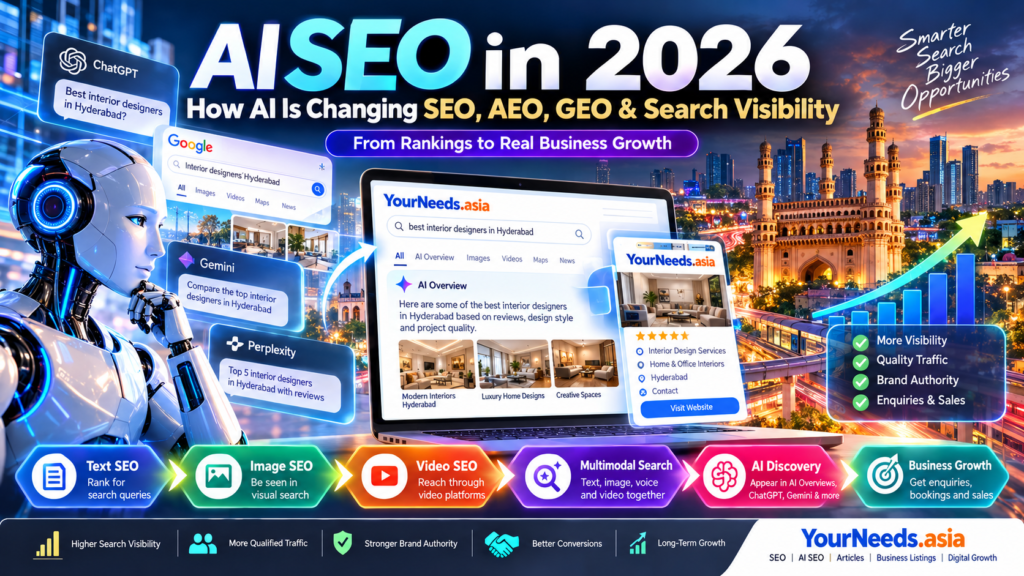
AI SEO : How AI Is Changing SEO, AEO, GEO & Search
Published on: | Last Updated:
AListen to this articleFree AI-style voice reader using your browser
Ready to read this page aloud.
This update explains AI SEO : How AI Is Changing SEO, AEO, GEO & Search in a short, reader-friendly format.
AI SEO in 2026: How Artificial Intelligence Is Rewriting Search, AEO, GEO and Website Visibility A YourNeeds.asia Industry Guide to Winning Search Visibility in the AI Era Quick Answer: What Is AI SEO?
AI SEO is the evolution of search engine optimization for a world where artificial intelligence influences both how people search and how search systems retrieve, synthesize and present information.
First, businesses can use AI to perform SEO better—for research, search-intent analysis, content planning, technical audits, internal-link discovery, data analysis and optimization.
Second, businesses increasingly need to prepare their websites and digital entities for AI-powered discovery, including Google AI Overviews, AI Mode, conversational search, multimodal search and other generative experiences.
Google's 2026 guidance explicitly says SEO best practices remain relevant to generative AI Search because its generative experiences are rooted in Google's core ranking and quality systems.
QAsk AI About This ArticleAnswers are limited to this article content
A YourNeeds.asia Industry Guide to Winning Search Visibility in the AI Era
Quick Answer: What Is AI SEO?
AI SEO is the evolution of search engine optimization for a world where artificial intelligence influences both how people search and how search systems retrieve, synthesize and present information.
It has two sides.
First, businesses can use AI to perform SEO better—for research, search-intent analysis, content planning, technical audits, internal-link discovery, data analysis and optimization.
Second, businesses increasingly need to prepare their websites and digital entities for AI-powered discovery, including Google AI Overviews, AI Mode, conversational search, multimodal search and other generative experiences.
But this does not mean conventional SEO is dead.
Google’s 2026 guidance explicitly says SEO best practices remain relevant to generative AI Search because its generative experiences are rooted in Google’s core ranking and quality systems.
Google also describes retrieval-augmented generation and query fan-out as techniques involved in AI-powered Search. Google for Developers
The opportunity is therefore not:
SEO → AI SEO
It is:
SEO + AI + Entities + Answers + Authority + Generative Discovery + Conversion
That distinction forms the foundation of the YourNeeds.asia approach to AI SEO.
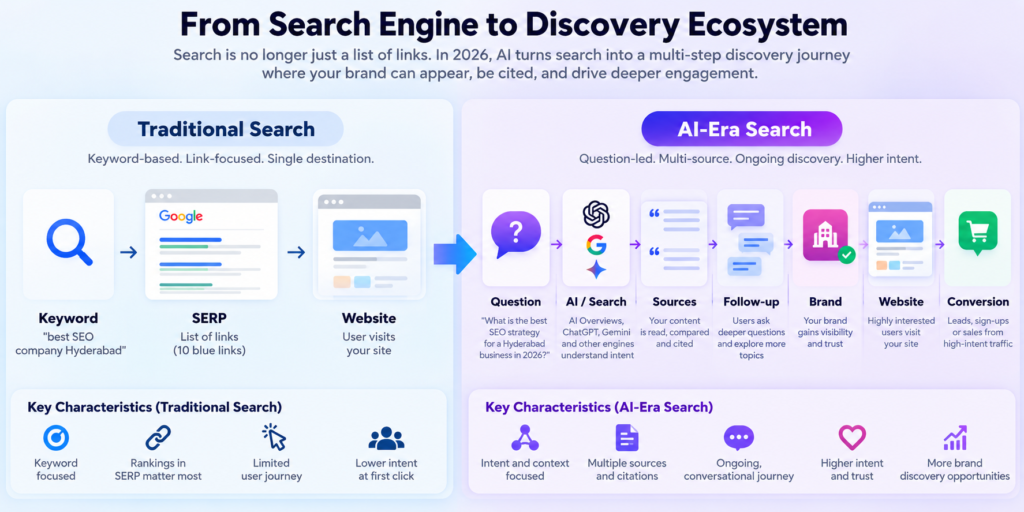
The Search Engine Has Become a Research Engine
For more than two decades, SEO revolved around a familiar journey:
Ask a complex question → receive an AI-generated response → investigate cited sources → ask a follow-up → compare brands → visit a website → convert
Or:
Upload an image → ask a visual question → discover a product/business → research the company → convert
Or:
Ask an AI assistant → discover several options → Google the brands → check reviews → make a decision
This matters because visibility is becoming distributed.
In May 2026, Google described a “new era for AI Search,” including more advanced model capabilities and agentic features.
Google reported that AI Mode had surpassed one billion monthly users and that its queries were more than doubling each quarter at that point. blog.google
SEO therefore needs a broader objective.
It isn’t simply:
Can this URL rank?
The bigger question is:
Can this business, entity, product, service or piece of knowledge be discovered and understood throughout an AI-assisted research journey?
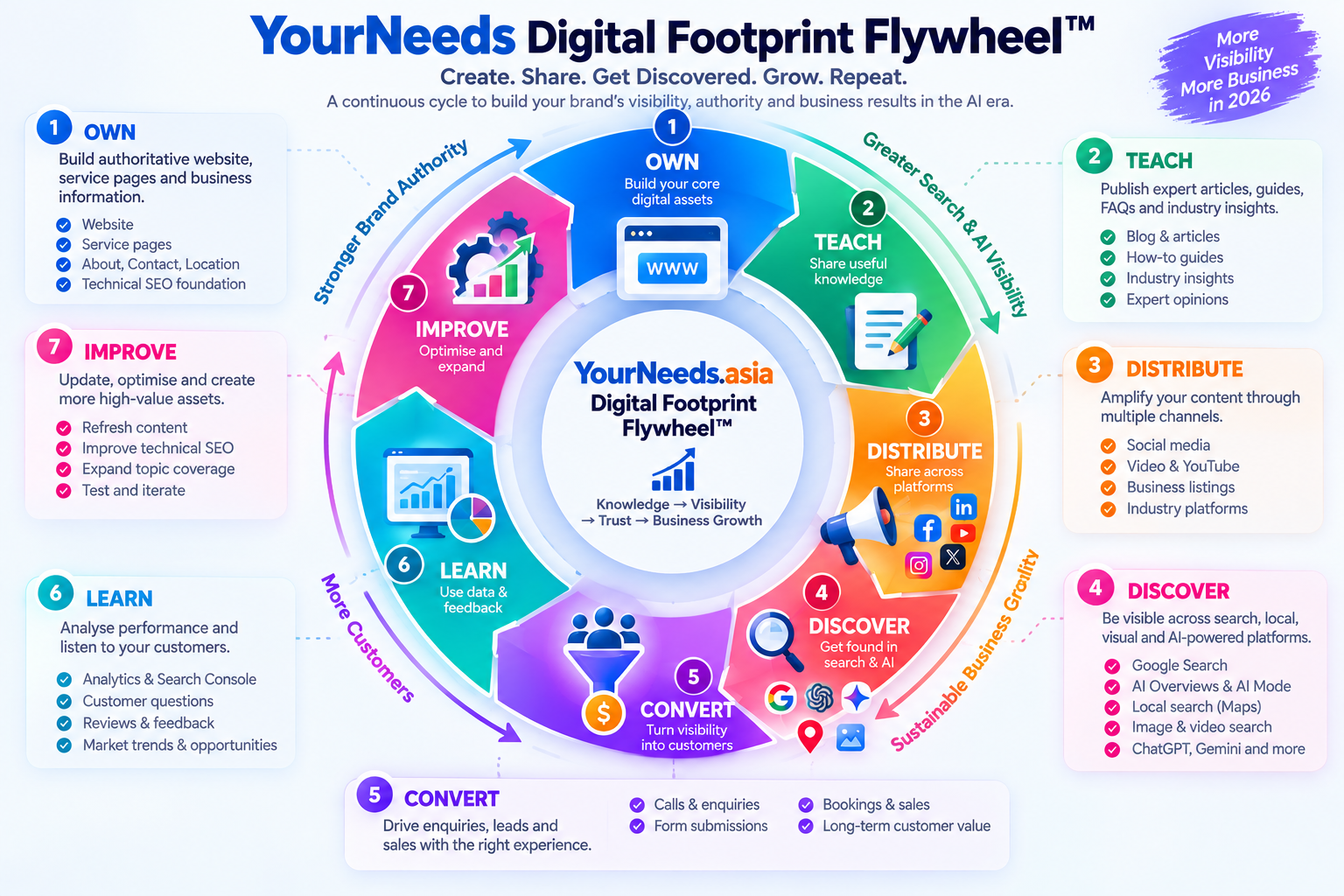
From Search to AI Discovery image on YourNeeds.asia
What Is AI SEO?
The term AI SEO currently describes several overlapping practices.
This involves preparing websites and information for discovery through generative search experiences.
3. Building machine-understandable entities
This means making it clear:
Who are you? What do you do? Where do you operate? What are you authoritative about? What entities are connected with you?
4. Building answer-ready information
This involves answering real questions clearly enough for both people and machines to understand.
5. Measuring AI visibility
This is increasingly becoming measurable rather than speculative.
Google introduced dedicated Generative AI performance reports in Search Console in June 2026, including visibility information for AI Overviews and AI Mode, and said the insights had rolled out worldwide by August 31, 2026. Google for Developers
That represents an important transition:
AI SEO is moving from theory toward measurable search visibility.
What AI SEO Is NOT
This section may be more important than defining AI SEO itself.
AI SEO is not:
Stuffing “AI” into existing SEO copy.
It is not:
Creating thousands of AI-generated articles.
It is not:
Adding dozens of FAQ questions because someone says AI loves FAQs.
It is not:
Buying fake brand mentions.
It is not:
Creating llms.txt because somebody promises it will increase Google AI rankings.
It is not:
Breaking every paragraph into tiny chunks because someone claims LLMs require it.
And it is certainly not:
“Pay us and we’ll guarantee ChatGPT recommends your company.”
Google’s 2026 generative-search documentation directly addresses several of these myths.
Google says there is no requirement for special AI markup or llms.txt for Google Search, no requirement to artificially “chunk” content, no need to rewrite specifically for AI systems, and no benefit from pursuing inauthentic mentions. Google for Developers
That is why YourNeeds.asia approaches AI SEO as search evolution, not as an SEO loophole.
How Has AI Changed SEO?
AI has changed both sides of search.
Search engines have changed
Search engines can increasingly:
Interpret complex questions
Generate answers
Retrieve information from multiple sources
Understand conversational follow-ups
Process images and multimodal queries
Connect entities and concepts
Searchers have changed
People can increasingly ask:
“Which digital marketing strategy would work for a Hyderabad fertility clinic with a ₹1 lakh monthly budget?”
instead of:
“digital marketing company Hyderabad”
They can ask:
“Compare these three products based on reliability, price and maintenance.”
instead of searching each model separately.
This moves search from keyword retrieval toward research assistance.
And that changes SEO.
Keywords Are Not Dead—But Keywords Alone Are Not Enough
The rise of AI does not mean keyword research should be abandoned.
It means keywords should be interpreted as evidence of intent.
Consider:
AI SEO
Someone searching this could mean:
What is AI SEO?
How does AI SEO work?
How do I optimize for AI search?
Which AI SEO tools should I use?
What is AEO?
What is GEO?
Can AI improve Google rankings?
How do I appear in AI Overviews?
How do I find an AI SEO company?
Your original search research surfaces many of these exact themes, including “What is SEO for AI called,” “What is AI SEO,” “SEO for AI search,” “How to use AI in SEO,” “AI SEO vs traditional SEO,” “AI SEO expert,” “Free AI SEO tools,” “AI SEO companies,” and “Future of SEO with AI.” Pasted markdown Pasted markdown
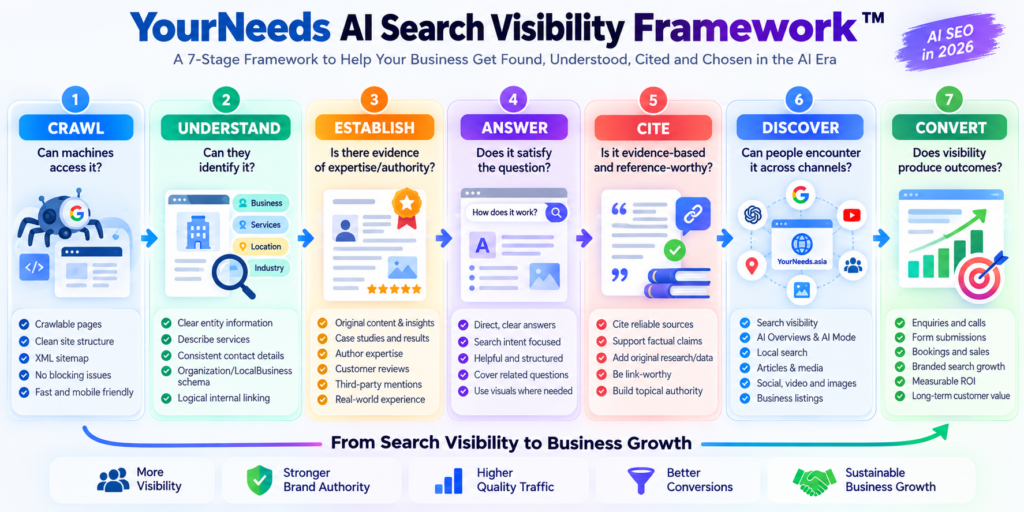
This is the YourNeeds AI Search Visibility Framework™.
Each stage solves a different visibility problem.
Stage 1: CRAWL
Can search systems reliably access your information?
Before thinking about ChatGPT citations, AI Overviews or GEO, ask a more basic question:
Can search engines properly crawl and index the website?
Review:
robots.txt
noindex directives
canonical tags
XML sitemap
JavaScript rendering
internal linking
duplicate URLs
site architecture
HTTP status codes
mobile rendering
page performance
crawl traps
Google’s official generative-search guidance specifically says crawlability remains important because generative AI features rely on publicly accessible, crawlable content. Google for Developers
YourNeeds principle:
If information cannot be reliably discovered, everything after it becomes harder.
Stage 2: UNDERSTAND
Can machines clearly understand the business and page?
Imagine a search engine finding:
“We provide world-class solutions to customers everywhere.”
What exactly does that mean?
Compare it with:
“YourNeeds.asia provides SEO, AI SEO, website development and digital marketing services for businesses in Hyderabad, India and international markets.”
The second statement establishes:
Entity: YourNeeds.asia Services: SEO, AI SEO, web development, digital marketing Primary market: Hyderabad/India Business relationship: provider → service → market
This is entity clarity.
Useful supporting signals can include:
descriptive page titles
clear About information
service descriptions
location information
author information
Organization/LocalBusiness structured data where appropriate
consistent contact information
logical internal linking
Google says Organization structured data can help it understand administrative details and disambiguate organizations. Google for Developers
Stage 3: ESTABLISH
Why should anyone trust or remember this entity?
Understanding does not automatically create authority.
A business can describe itself perfectly and still have no evidence that anyone should trust its claims.
This stage asks:
What have you actually done?
What do you know that generic publishers don’t?
Who created the content?
Can important claims be substantiated?
Do customers or independent sources recognize the business?
Does the site demonstrate experience?
This is where businesses need:
original research
case studies
first-hand examples
proprietary frameworks
expert authorship
original images
useful tools
industry contributions
credible third-party mentions
Google’s 2026 guidance emphasizes unique, valuable, non-commodity content rather than content that merely restates common knowledge. Google for Developers
This article itself follows that principle by introducing the YourNeeds AI Search Visibility Framework™ and the scoring system later in this guide rather than simply rewriting “What is AI SEO?” for the thousandth time.
Stage 4: ANSWER
Does your content solve actual questions?
A page shouldn’t make readers dig through 1,000 words to discover a simple definition.
If someone asks:
What is AI SEO?
Answer it immediately.
Then provide depth.
A good structure is:
Direct answer → explanation → evidence → example → next question
This helps humans.
It also creates information that machines can interpret more easily without turning the article into robotic “AI writing.”
Google specifically says publishers do not need to rewrite content in a special style for generative AI systems. Google for Developers
So answer clearly because it improves communication—not because someone told you AI requires 40-word paragraphs.
Stage 5: CITE
Is the content worth citing—and does it cite responsibly?
This stage has two meanings.
First:
Support important factual claims with reliable sources.
For example, rather than claiming “Google doesn’t need llms.txt,” cite Google’s actual documentation.
Second:
Create information other publishers may want to cite.
That’s harder.
Commodity statement:
“AI is changing SEO.”
Citation-worthy statement:
“Our analysis of 500 local-service pages found X pattern.”
Or:
“We developed a seven-stage framework for assessing AI-search readiness.”
The latter creates information gain.
Your goal shouldn’t merely be collecting backlinks.
Create something worth referencing.
Stage 6: DISCOVER
Visibility should not depend on one URL.
A company can be discovered through:
its website
Google Search
Google Business Profile
industry articles
business listings
news coverage
video
social content
images
forums
reviews
AI-assisted discovery
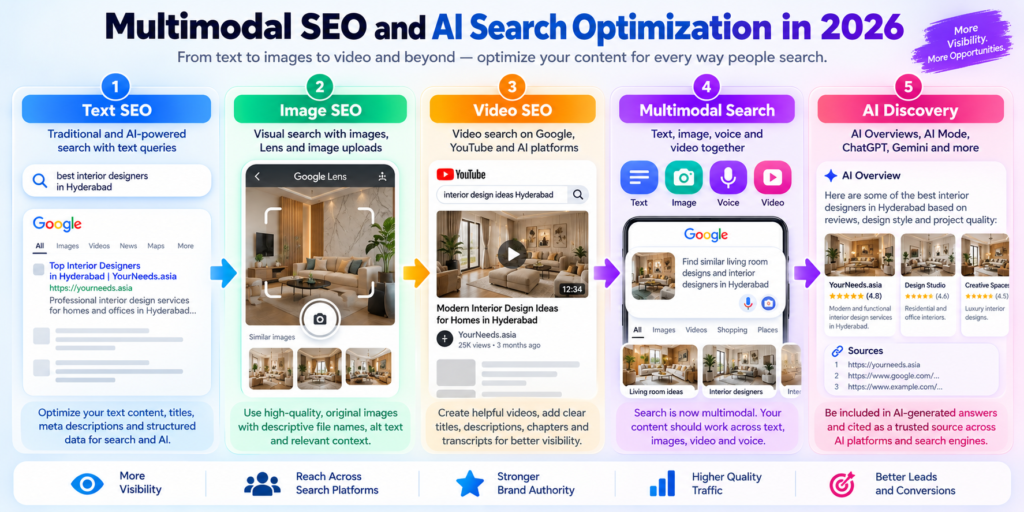
This is especially relevant because search itself is becoming multimodal.
In September 2026, Google introduced Search Console reporting for web multimodal search, covering searches involving Lens, Circle to Search, image uploads and related visual-search interactions. Google for Developers
So “SEO content” can no longer mean text alone.
Stage 7: CONVERT
AI visibility without business impact is vanity.
The final stage asks:
Did someone enquire?
Did they call?
Did they subscribe?
Did they book?
Did they buy?
Did they return?
Did branded search increase?
This is where many AI SEO discussions become disconnected from reality.
The purpose of AI SEO for most businesses isn’t:
“We appeared in an AI response.”
The purpose is:
“We became discoverable to the right audience and that visibility contributed to business outcomes.”
YourNeeds AI Search Visibility Framework image on YourNeeds.asia
How Google AI Overviews and AI Mode Change SEO
One important technical concept is query fan-out.
Google describes query fan-out as generating multiple related searches to gather information needed to answer the original query. Google for Developers
Consider:
“What is the best CRM for a 20-person real-estate company?”
The system may need information about:
CRM features
real-estate workflows
pricing
team size
integrations
reviews
alternatives
This creates a major SEO lesson.
You shouldn’t necessarily create a separate page targeting every imaginable fan-out query.
Instead, build deep topical coverage where it genuinely helps users.
Google explicitly warns against producing separate pages for every query variation primarily to manipulate rankings or generative responses. Google for Developers
The YourNeeds AI Search Readiness Score™ — 100 Points
Here is a practical asset businesses can use immediately.
Score your website out of 100.
Category
Maximum Score
Crawlability & Indexation
15
Technical/Page Experience
10
Entity Clarity
15
Originality & Information Gain
15
Search Intent & Answer Quality
10
Authority & Evidence
10
Structured Data & Machine Clarity
5
Local/Industry Signals
5
Visual & Multimodal Content
5
Measurement & Conversion
10
TOTAL
100
0–39: AI Search Foundation Weak
Major SEO fundamentals need attention.
40–59: Search Ready, AI Visibility Underdeveloped
The site may perform conventionally but lacks deeper entity/content architecture.
60–74: AI Search Competitive
Strong foundation with identifiable opportunities.
75–89: Advanced AI Search Readiness
The business has strong technical, content and authority signals.
90–100: AI Search Authority Candidate
The website demonstrates exceptional technical accessibility, original information, entity clarity, authority, multimodal depth and measurable performance.
Important: This is a YourNeeds.asia diagnostic framework, not a Google ranking score. Google does not assign or endorse this score.
That distinction should always remain clear.
AI SEO Checklist
Use this as a practical audit.
Technical
☐ Important pages are indexable
☐ robots.txt isn’t blocking essential content
☐ Canonicals are correct
☐ Sitemap is current
☐ Internal links expose important pages
☐ JavaScript content is accessible
☐ Mobile experience works properly
☐ Duplicate/near-duplicate pages are controlled
Entity
☐ Organization name is consistent
☐ Services are explicitly described
☐ Locations are accurate
☐ Contact information is consistent
☐ About page establishes the organization
☐ Author/editor information is available where appropriate
☐ Organization/LocalBusiness schema accurately matches visible content
Content
☐ Primary intent is satisfied quickly
☐ Content provides information beyond generic summaries
☐ Important factual claims have evidence
☐ Original examples/data/experience are included
☐ Related questions are answered naturally
☐ Existing content is regularly updated where necessary
Authority
☐ Real case studies exist
☐ Claims can be substantiated
☐ Authors have relevant expertise/experience
☐ External mentions are legitimate
☐ Reviews/testimonials are genuine
☐ No fake awards or manufactured authority signals
AI/Generative Search
☐ AI Overviews/AI Mode visibility is monitored where available
☐ Content handles conversational intent
☐ Pages explain entities and relationships clearly
☐ AEO/GEO tactics do not undermine SEO fundamentals
☐ No reliance on unsupported AI hacks
Visual/Multimodal
☐ Original relevant images are used
☐ Important visuals have descriptive context
☐ Videos are added where they genuinely help
☐ Product/service imagery is high quality
☐ Visual-search performance is monitored where relevant
Conversion
☐ Calls/enquiries are tracked
☐ Forms work on mobile
☐ CTAs match intent
☐ Landing pages explain next steps
☐ Organic/AI visibility is connected to business outcomes
Real-World Example: A Hyderabad Service Business
Consider a hypothetical Hyderabad interior-design business.
This is an illustrative example, not a claimed YourNeeds.asia client case study.
Before optimization
Website:
Home About Services Gallery Contact
Homepage:
“We are the best interior designers providing world-class solutions at affordable prices.”
The problem is using it without editorial judgment.
Google says generative AI can be useful for research and adding structure to original content, while using AI to create many pages without adding value may violate its scaled-content-abuse policy. Google for Developers
Google’s Organization documentation says structured data can help Google understand organizational details and disambiguate an organization. Google for Developers
Depending on the page/site, useful structured data may include appropriate:
Organization
LocalBusiness
Article
Product
Breadcrumb
and other supported types.
But Google explicitly states there is no special structured data required for generative AI search. Google for Developers
So:
Use schema to describe reality—not manufacture authority.
Do You Need llms.txt for AI SEO?
For Google Search:
No.
Google clarified in June 2026 that llms.txt isn’t required and doesn’t positively or negatively affect visibility or rankings in Google Search. Google for Developers
Other systems may develop their own conventions, so a company can choose to maintain such files where another service actually uses them.
But:
Do not sell llms.txt as a Google AI ranking hack.
Are FAQs Still Important?
Yes—for users.
But an important 2026 change is frequently missed.
Google deprecated the FAQ rich-result feature in May 2026 and subsequently removed its documentation. Google for Developers
That doesn’t mean:
“Stop writing FAQs.”
It means:
Don’t write FAQs merely because you expect an FAQ rich result.
Use them when customers genuinely ask those questions.
AI SEO Is Becoming Measurable
This may be one of the most significant developments of 2026.
For years, businesses struggled with questions such as:
Did our site appear in AI Overviews?
Which URLs were surfaced?
Which countries saw them?
Google’s Generative AI performance reporting in Search Console now provides dedicated visibility data including impressions, pages, countries, devices and dates for eligible generative AI appearances. Google for Developers
That means businesses should increasingly build dashboards around:
Traditional SEO KPIs
Organic clicks
Impressions
Rankings
Conversions
AI Search KPIs
Generative-search impressions
Pages surfaced
Country/device patterns
AI visibility trend
“Our agency checked ChatGPT manually and saw you once.”
It should become increasingly evidence-driven.
Multimodal SEO: The Opportunity Most Businesses Are Ignoring
Search isn’t becoming merely conversational.
It’s becoming visual.
Google’s September 2026 Search Console update added reporting for multimodal search, including Lens, Circle to Search, image uploads and Chrome image-search interactions. Google for Developers
This means original visuals can become strategic search assets.
Businesses should think about:
product images
before/after photographs
infographics
diagrams
maps
demonstrations
videos
charts
screenshots
visual explainers
For YourNeeds.asia articles, this creates a strong editorial rule:
Don’t decorate the article. Visualize the knowledge.
Multimodal SEO_ The 2026 Search Journey image on YourNeeds.asia
AI SEO for Local Businesses
Local businesses have an unusual advantage in AI search:
They possess information generic publishers don’t.
A Hyderabad dental clinic knows:
common local patient questions
actual appointment patterns
treatments offered
doctor experience
local service areas
parking/accessibility information
real clinic photographs
local pricing context where appropriate
A generic AI article cannot authentically reproduce that experience.
Local businesses should therefore build around:
real location information
Google Business Profile
local reviews
local service pages
expert answers
original photographs
local FAQs
community/industry mentions
consistent NAP/contact details
local structured data where applicable
AI SEO for Ecommerce
Ecommerce AI SEO can benefit from:
better product attributes
comparison content
buying guides
original product photography
reviews
FAQs based on customer service data
structured product information
inventory accuracy
category architecture
internal linking
AI can help normalize thousands of attributes.
But AI shouldn’t invent:
product specifications
reviews
availability
certifications
warranties
or performance claims.
At scale, one hallucination multiplied across 20,000 products becomes a serious data-quality problem.
AI SEO for Healthcare, Finance and Legal Content
High-stakes industries require a stricter model.
Use:
qualified expert review
credible citations
clear authorship
dates/updates
careful claims
regulatory awareness
transparent limitations
AI can accelerate research.
It should not replace accountability.
This is where EEAT isn’t something to “add” to an article.
Experience and expertise must actually exist behind the content.
AI SEO Tools: What Should You Actually Use?
Instead of publishing another list of “50 best AI SEO tools,” categorize tools by the problem they solve.
Need
Tool Category
Understand demand
Keyword/search research
Understand performance
Search Console/analytics
Crawl website
Technical crawler
Analyze competitors
Competitive intelligence
Build briefs
AI research/content assistant
Validate schema
Structured-data validator
Monitor rankings
Rank tracking
Understand conversions
Analytics/CRM
Analyze AI visibility
AI-search monitoring
Improve workflow
Automation/AI assistants
Your research already shows strong search interest around AI SEO tools and free AI SEO tools. Pasted markdown
But the right question isn’t:
“Which AI SEO tool should I buy?”
It is:
“Which decision am I trying to improve?”
The YourNeeds.asia 80/20 Rule for AI Content
For important commercial content:
80% should deliver value.
Education.
Research.
Examples.
Frameworks.
Answers.
Tools.
Evidence.
20% or less should explain how your business can help.
This keeps the content useful even to someone who never becomes a customer.
And ironically, that often makes the commercial message stronger.
How YourNeeds.asia Fits Into the AI Search Ecosystem
YourNeeds.asia is developing an ecosystem rather than treating SEO as an isolated agency service.
Branded searches
Direct traffic
Legitimate mentions
Review growth
Business
Calls
Forms
Bookings
Qualified leads
Sales
Revenue
Then ask:
Which visibility actually contributed to business growth?
AI SEO Decision Tree
Use this before launching an AI SEO campaign.
Is the website technically crawlable?
NO → Fix technical SEO first.
YES ↓
Is the business/entity clearly described?
NO → Fix entity architecture.
YES ↓
Does the site contain genuinely useful original information?
NO → Build expertise/content assets.
YES ↓
Does it answer customer questions?
NO → Build intent-driven content.
YES ↓
Are important claims substantiated?
NO → Add evidence/citations.
YES ↓
Does the brand have legitimate external validation?
NO → Build reputation/PR/community presence.
YES ↓
Are AI and conventional search visibility measured?
NO → Configure measurement.
YES ↓
Does visibility convert?
NO → Fix UX/offer/CTA/CRO.
YES → SCALE WHAT WORKS.
Common AI SEO Mistakes in 2026
Mistake 1: Publishing AI content at maximum volume
Volume doesn’t create expertise.
Mistake 2: Ignoring technical SEO
AI doesn’t fix an uncrawlable website.
Mistake 3: Chasing every new acronym
Strategy matters more than terminology.
Mistake 4: Fake third-party mentions
Google specifically warns against inauthentic mentions as an AI-search tactic. Google for Developers
Mistake 5: Treating schema as magic
Structured data helps describe information. It doesn’t manufacture authority.
Mistake 6: Creating every possible long-tail page
Google warns against creating many query variations primarily to manipulate rankings or AI responses. Google for Developers
Mistake 7: Forgetting conversion
Visibility without outcomes isn’t a business strategy.
Frequently Asked Questions About AI SEO
What is AI SEO?
AI SEO is the use of artificial intelligence within SEO workflows and the adaptation of websites, content and entities for an increasingly AI-powered search ecosystem.
Is AI SEO replacing traditional SEO?
No. Google’s official 2026 guidance says established SEO best practices remain foundational for its generative AI Search features. Google for Developers
What is SEO for AI called?
Common terms include AI SEO, AI Search Optimization, Answer Engine Optimization (AEO), Generative Engine Optimization (GEO) and LLM optimization. Terminology is still evolving.
What is AEO?
AEO means Answer Engine Optimization. It generally refers to making content useful for answer-oriented search experiences and direct questions.
What is GEO?
GEO means Generative Engine Optimization. It generally describes optimization aimed at improving visibility and representation in generative search environments.
Does Google treat AEO and GEO separately from SEO?
Google says that, from its Search perspective, optimizing for generative AI search is still SEO and advises publishers to prioritize established SEO practices over AEO/GEO hacks. Google for Developers
How do I optimize for Google AI Overviews?
Start with crawlability, useful original content, search intent, technical SEO, strong page experience and accurate information.
There is no guaranteed technique for inclusion.
Do I need special AI schema?
Google says no special structured data is required for generative AI Search.
Continue using supported structured data where it accurately describes visible content. Google for Developers
Does llms.txt improve Google AI rankings?
No. Google clarified that llms.txt is not required and neither helps nor hurts Google Search visibility or rankings. Google for Developers
Can AI-generated content rank?
AI assistance itself isn’t the issue. Google says generative AI can help with research and structure, but generating many pages without adding user value may violate scaled-content-abuse policies. Google for Developers
Are FAQs useful in 2026?
Yes, when users genuinely need the answers.
However, Google discontinued FAQ rich results in Search in May 2026, so FAQs shouldn’t be created merely to chase that former SERP feature. Google for Developers
Are keywords still important?
Yes. But modern SEO interprets keywords within broader intent, topic and entity context rather than relying on exact-match repetition.
Is entity SEO important?
Entity clarity can help systems understand who or what a page discusses and the relationships between organizations, people, services and locations.
Google’s Organization structured-data guidance explicitly discusses disambiguating organizations. Google for Developers
How can local businesses use AI SEO?
Strengthen technical SEO, accurate location/entity information, expert local content, reviews, business profiles, original images and genuine answers to local customer questions.
How do I measure AI SEO?
For Google, Search Console now includes dedicated generative-AI performance reporting for eligible visibility in features including AI Overviews and AI Mode.
Combine that with conventional organic, brand and conversion metrics. Google for Developers
Does AI SEO guarantee ChatGPT recommendations?
No responsible provider should guarantee that an independent AI system will recommend a particular company.
What is the best AI SEO strategy?
Start with strong conventional SEO, then improve entity clarity, original information, answer quality, external authority, multimodal assets, AI visibility measurement and conversion.
That’s why YourNeeds.asia does not view SEO, AI SEO, AEO and GEO as four isolated products fighting for the same acronym.
They are different parts of a larger visibility problem.
A business needs to be:
technically accessible
semantically understandable
genuinely authoritative
useful to customers
supported by evidence
discoverable across formats
and ultimately:
capable of converting attention into business.
Google’s own 2026 direction supports the fundamental premise: established SEO remains important, unique non-commodity content matters, artificial AEO/GEO tricks aren’t necessary, AI visibility is becoming measurable, and Search is becoming increasingly generative and multimodal. Google for Developers
The competitive advantage, therefore, isn’t going to come from generating the most content.
It will come from creating the most useful digital evidence of what your organization knows, does and contributes.
Santhosh Sirigineni is the Managing Director of YourNeeds.asia and a digital marketing and web technology expert with over 20 years of experience in helping businesses build, optimize, and scale their online presence. Throughout his career, he has worked with startups, SMEs, and enterprise organizations, delivering innovative digital solutions that combine technology, search intelligence, and business strategy.
Read full biographyShow less
His expertise spans Search Engine Optimization (SEO), AI SEO, Answer Engine Optimization (AEO), Generative Engine Optimization (GEO), Technical SEO, WordPress Development, website architecture, content strategy, and AI-powered search optimization. As search continues to evolve with AI-driven experiences, Santhosh focuses on helping brands improve their visibility across traditional search engines as well as emerging AI platforms such as ChatGPT, Google AI Overviews, Gemini, Perplexity, and other generative search experiences.
As a seasoned WordPress developer, he has successfully designed and developed high-performance, secure, and SEO-friendly websites for businesses across various industries. His technical expertise includes website performance optimization, Core Web Vitals, structured data implementation, schema markup, technical audits, and user experience optimization that supports sustainable organic growth.
Santhosh regularly writes about the latest trends in SEO, AEO, GEO, AI SEO, digital marketing, WordPress development, technical SEO, content optimization, and emerging search technologies. His articles are designed to provide practical, actionable insights that help businesses, marketers, and website owners adapt to the rapidly changing digital landscape and maximize their online visibility.
Send your title, content, images and preferred location. Choose VIP Lounge, Spotlight, Gallery, Top, Premium or Featured after payment approval.
VIP LoungeRs.5000
for 30 days
Highest priority visibility with premium placement above regular ads.
SpotlightRs.4000
for 30 days
Highlighted homepage and category visibility directly below VIP Lounge.
GalleryRs.3000
for 30 days
Gallery-style placement for stronger visual discovery.
TopRs.2500
for 30 days
Top priority listing treatment with stronger paid-ad styling.
PremiumRs.2000
for 30 days
Premium listing treatment to stand out in search results.
FeaturedRs.1500
for 30 days
Compact featured treatment inside the normal paid-listing flow.
Sponsored Image / GIF AdRs.1000
for 30 days
Rotating right-side homepage sponsor placement for a normal image or animated GIF.
QR
Upload QR in VIP Directory
Pay by scanning QR or bank transfer
After payment, send the payment screenshot, selected package name and ad title to info@yourneeds.asia. We will activate VIP Lounge, Spotlight, Gallery, Top, Premium or Featured after verification.